Affiliate Disclosure: This article contains affiliate links. NonToxicFinder (Solved Labs LLC) may earn commissions on qualifying purchases at no extra cost to you. We are not affiliated with, endorsed by, or partnered with the Environmental Working Group or any certification program.
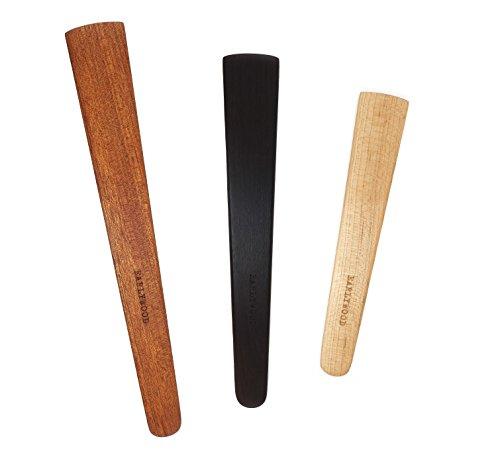
A good wooden spatula is a thin, flat piece of hard, close-grained wood with a straight edge, finished with plain mineral oil. Earlywood's flat saute set fits that description. You get three spatulas (13, 11.3 and 9.5 inches long, each about 0.2 inch thick), handmade in Montana from jatoba, Mexican ebony and hard maple in the JEM mix. They are not stained, and Earlywood oils every piece with mineral oil before it ships. Buy it if you cook in nonstick or ceramic pans and will hand wash and re-oil your tools. If everything you own goes in the dishwasher, a one-piece silicone spatula suits you better.
Wood, Silicone or Nylon for Nonstick Pans
All three are gentle on a nonstick coating, and that is the rule that matters most. FDA's Food Code, the model rules FDA gives state and local regulators for restaurants, says pans with a perfluorocarbon resin (PTFE) coating “shall be used with nonscoring or nonscratching utensils,” because the finish “may be scratched by sharp or rough-edged kitchen tools.” Caraway gives the same advice for its ceramic nonstick pans: skip metal and use “wooden, silicone, plastic, or nylon products.” Past that, the three materials differ in heat, cleanup and what touches your food.
| Earlywood flat saute (wood) | GIR silicone spatula | Typical nylon turner | |
|---|---|---|---|
| What touches food | Solid hardwood, mineral oil finish | Platinum-cured silicone over an inner core GIR does not name | Polyamide (nylon) plastic |
| Heat | Does not melt; Earlywood's warranty excludes burns | Rated to 425°F, per GIR | Set by each maker |
| Edge | Thin, rigid and straight; flips and scrapes | Flexible; best for scraping bowls and folding | Thin and flexible; made for flipping |
| Dishwasher | No; voids Earlywood's warranty | Yes, any rack, per GIR | Usually yes |
| Staining | Maple can pick up beet or cumin color, which Earlywood says washes out in two or three uses | “Stain and odor resistant,” per GIR | Varies by maker |
| Upkeep and lifespan | Oil when dry; lifetime guarantee against defects | None | Replace when the edge melts or frays |
Wood's practical edge is that it is rigid and thin at the same time. In Earlywood's product video, the maker uses the straight end as a bench scraper and to scrape the whole side of a deep pot, and it is thin enough to slide under pancakes and burgers. Silicone flexes, which is better for scraping batter from a bowl and worse for pushing food around a hot pan. Nylon is the cheap, light option. One note on nylon: the European Commission requires every shipment of polyamide kitchenware from China and Hong Kong to arrive with test results, under Regulation 284/2011, after such kitchenware “has been reported to release high level” of primary aromatic amines into food, a family of compounds the regulation says includes some that are carcinogenic. That rule covers imports into the EU and names no brand.
What the Spatulas Are Made Of and Finished With
The wood. The JEM option is listed on Earlywood's product page as “jatoba-ebony-maple.” Earlywood describes its Mexican ebony as about “as hard as wood gets,” at 3,660 on the Janka hardness scale; jatoba as “extremely strong, shock resistant, and rot resistant” with fairly large pores; and hard maple, its softest wood, as the wood used for gym floors and butcher blocks. Its FAQ says even the maple is “much harder than the woods typically used for making wooden spoons (like beech and cherry).” That matters because FDA's Food Code allows wood on food-contact utensils only if it is “hard maple or an equivalently hard, close-grained wood.” Earlywood does not say which size comes in which wood, and grain and color vary from piece to piece.
No stain. Asked what it stains the wood with, Earlywood answers “Absolutely NOTHING! All the vibrant color you see is 100% natural,” and the color runs all the way through, so scrubbing exposes fresh wood rather than wearing off a coating.
The finish. Earlywood's returns page says it will “oil and check and ship every single product,” and its FAQ describes a new utensil as having “oil on it from here at Earlywood.” The oil it sells and demonstrates in its care guide is Earlywood Oil, which it describes as “a blend of low-viscosity mineral oil and organic lemon peel oil.” Earlywood explains why it chose mineral oil: unlike olive, sesame or walnut oil it does not go rancid, it never dries into a sticky film, and it “does not form a hard coating that will chip off into your food.” Its optional Wood Wax is mineral oil and beeswax. Earlywood lists no other material in the spatulas: no lacquer, no varnish and no handle hardware. They are hand worked in its shop in Red Lodge, Montana.
Sizes, and Whether the Set Is Worth It
Earlywood sells each flat saute on its own, with dimensions in inches:
- Large, 13 x 1.9 x 0.2: reaches into deep pots and stockpots. Earlywood calls it “probably the most useful.”
- Medium, 11.3 x 1.7 x 0.2: the everyday size for a 10 or 12 inch skillet, about the length of GIR's 11-inch silicone spatula.
- Small, 9.5 x 1.6 x 0.2: for small pans, jars and one-person meals.
The three together weigh 218 grams, so these are light tools. The set costs less than buying the three pieces one at a time on Earlywood's site. Whether it is worth paying hardwood prices over a pack of nylon turners comes down to how long you keep tools: Earlywood replaces a piece that “cracks, splits or breaks because of something we did,” for life, and unused utensils can be returned within 30 days. If you mostly flip eggs in one pan, the large or medium on its own may be all you need. Two large or two medium flats also work as salad servers, which Earlywood suggests.
See the Earlywood 3-Piece Flat Wooden Spatula Set, JEM, on Amazon →
How to Clean and Oil a Wooden Spatula
Earlywood's care guide boils it down to five rules:
- Wash by hand in hot soapy water.
- Always use the scratchy side of your sponge. It takes off a very thin layer of wood and keeps the color fresh.
- Never put them in the dishwasher.
- Never let them soak in water.
- Oil liberally when they start to look dry.
To oil: start with spatulas that are completely dry, rub them with the Scotch-Brite pad from the woodcare packet in the box (or the green side of a kitchen sponge) along the grain, then lather on as much oil as the wood will absorb. Leave it overnight and wipe off what is left in the morning. Earlywood uses its own mineral oil blend and recommends it over cooking oils, which can turn sticky or rancid on wood; for a stronger moisture barrier, follow with a coat of wax, let it sit 15 minutes and wipe it off. Earlywood suggests the wax about once a month, or whenever the wood looks dull.
Signs it needs attention:
- Looks pale or dry: time to oil.
- Feels fuzzy: that is raised grain, common after the first few washes. Rub it smooth with the Scotch-Brite pad once and oil it; Earlywood says it should not come back.
- Gray and rough after neglect: Earlywood says “a little sandpaper and some elbow grease” can often bring it back, followed by an overnight oiling.
- A crack or a burn you cannot scrub clean: replace it. FDA's Food Code notes that a wood surface that deteriorates “may become difficult to clean.”
That routine is the real cost of wood. A silicone spatula goes in the dishwasher; these never do.
Do Wooden Spatulas Harbor Bacteria or Crack?
Bacteria. Clean wood is not the problem it is often made out to be. A 2016 review of 20 years of studies in Comprehensive Reviews in Food Science and Food Safety (Aviat and colleagues, “Microbial Safety of Wood in Contact with Food: A Review”) concluded that the porous nature of wood “is not responsible for the limited hygiene of the material,” that its surface “often generates unfavorable conditions for microorganisms,” and that some woods produce compounds that inhibit pathogens. The review centered on wooden food packaging, so read it as evidence about wood in general. The rule that applies to every utensil comes from CDC: “Wash utensils, cutting boards, and countertops with hot, soapy water after preparing each food item.” A spatula that has touched raw meat gets washed before it stirs anything else, whatever it is made of.
Cracking. Water is what cracks wood. Earlywood explains that wood soaks up water, then shrinks as it dries, and the repeated swelling and shrinking splits it; oil repels the water. That is why soaking and the dishwasher are out. In its own test, Earlywood ran pieces through the dishwasher 20 times without a crack or warp, but the colors washed out until it “could barely tell them apart,” and its warranty page says the dishwasher “increases the chance for your utensils to crack and warp” and voids the guarantee. Washed by hand and oiled when dry, Earlywood says its utensils keep working for decades, and it replaces any piece that cracks from a defect.
Who Should Buy It
- Buy it if you cook in nonstick, ceramic or enameled pans, want a rigid flat edge for sauteing and scraping, and will hand wash.
- Buy one large or medium instead if you want to try the shape before committing to three.
- Skip it if your tools go in the dishwasher, or you mostly scrape batter from bowls, where a flexible silicone spatula does the job better.
The pans matter as much as the spatula. Our PFAS-free cookware guide compares cast iron, stainless and ceramic; if you are looking at ceramic nonstick, our Caraway cookware review covers how long the coating lasts, and if you cook in cast iron, see how Lodge, Victoria and FINEX skillets compare. A wood cutting board takes the same wash-and-oil routine: the John Boos maple board and the Teakhaus teak board are the two we have covered. The set also makes an easy present, and it appears in our PFAS-free kitchen gift ideas.
Frequently Asked Questions
Is a wooden spatula better than silicone or plastic for nonstick pans?
All three protect a nonstick coating; FDA's Food Code only asks for nonscratching utensils. Wood is rigid and thin, so it is better for sauteing and scraping a pan, and it is solid wood rather than plastic. Silicone and nylon are flexible and go in the dishwasher. Choose wood if you will hand wash it.
What is the Earlywood flat spatula set made of?
Solid hardwood, with no stain. The JEM set is jatoba, Mexican ebony and hard maple, per Earlywood, and each piece is oiled with mineral oil before it ships.
Can you put a wooden spatula in the dishwasher?
No. Earlywood says the dishwasher washes out the color, makes the wood fuzzy, raises the chance of cracking and warping, and voids its lifetime guarantee. Wash it by hand in hot soapy water.
How do you oil a wooden spatula?
Let it dry completely, smooth any fuzz with a Scotch-Brite pad, then coat it in as much mineral oil (Earlywood sells its own blend) as it will absorb. Leave it overnight and wipe off the extra. Do it whenever the wood looks dry.
How long are the spatulas in the set?
13 inches (large), 11.3 inches (medium) and 9.5 inches (small), each about 0.2 inch thick, per Earlywood.
Do wooden spatulas hold bacteria?
A 2016 peer-reviewed review found wood's porous surface is not what limits its hygiene and often works against microbes. Wash any spatula in hot soapy water after each food, as CDC advises, and replace one with a crack you cannot clean.
This article contains affiliate links. NonToxicFinder (Solved Labs LLC) may earn commissions on qualifying purchases at no extra cost to you. We are not affiliated with, endorsed by, or partnered with the Environmental Working Group or any certification program.