Affiliate Disclosure: This article contains affiliate links. NonToxicFinder (Solved Labs LLC) may earn commissions on qualifying purchases at no extra cost to you. We are not affiliated with, endorsed by, or partnered with the Environmental Working Group or any of the makers named here.
A bare cast iron skillet is one piece of iron with a layer of oil baked onto it. There is no nonstick coating, and all three makers here say so: Lodge says its skillets are made without PFAS, FINEX says its cookware is free of PFAS, PTFE and Teflon, and Victoria says its pan has no synthetic coatings, PTFE or PFOA. For most kitchens the Lodge 12 inch is the one to buy: made in the USA, priced at the budget end, and backed by a lifetime warranty. Pick the Victoria if you want flaxseed seasoning instead of soybean oil, a longer handle and two pour spouts. Pick the FINEX only if you want a machined, glass-smooth cooking surface and a cool-touch spring handle and will pay a lot more for them.
The Three Skillets Side by Side
| Lodge 12 Inch with Handle Holder | Victoria 12-Inch | FINEX 12-Inch | |
|---|---|---|---|
| Made in | South Pittsburg, Tennessee, USA | Colombia | Portland, Oregon, USA |
| Weight | 7.69 lb (listed for the set) | 6.7 lb | 8.5 lb |
| Seasoning oil | Kosher-certified soy-based vegetable oil | Non-GMO, kosher-certified flaxseed oil, 3 layers | Organic flaxseed oil |
| Cooking surface | Sand-cast texture that Lodge says smooths with use | “Smooth, textured surface” | Machined and polished; 9.25 inch cooking area |
| Handle | Cast-in handle; red silicone holder included for carrying | Long curved cast handle | Stainless steel “Speed Cool” spring handle with brass caps |
| Coating statement | “Made without PFAS” | “No synthetic coatings, PTFE, or PFOA” | “Entirely free of PFAS, PTE, PTFE, PFOS, Teflon” |
| Warranty | Limited lifetime | Limited lifetime | “Guaranteed Good Forever”: repair or replace |
| Price tier | Budget | Budget | Premium |
All facts in the table come from each maker’s own product, care, warranty and disclosure pages, linked in the sections below. Current prices are in the product cards.
What Is Actually in a Cast Iron Skillet
California’s cookware disclosure law (AB 1200) makes cookware makers list certain chemicals in their food-contact surfaces and handles, and all three companies publish the full list of materials, which is the clearest answer to what you are cooking on.
- Lodge lists, for its seasoned cast iron, iron, phosphorus, manganese, strontium, carbon, silicon, sulfur, steel and “Seasoning (Soybean Oil).” Lodge sums it up as “made with just iron and oil” on its California disclosure page.
- Victoria lists iron, carbon, silica, magnesium, manganese, phosphorus, chromium, sulfur, nickel (“less than .05%”) and flaxseed-oil seasoning on its material composition page.
- FINEX lists the same elements as Lodge for its iron castings (phosphorus, manganese, strontium, carbon, silicon, sulfur), plus organic flaxseed oil seasoning, on its AB 1200 disclosure. The handle is a separate part: a stainless steel spring, and brass caps that FINEX says “may contain trace amounts of lead and are not intended as food contact surfaces.”
None of the three lists a fluoropolymer or any other coating on the cooking surface. That is why cast iron keeps turning up in our guide to PFAS-free cookware and in advice on replacing nonstick pans. If you want the background on the chemicals themselves, our explainer on what PFAS are and where they hide covers it.
Two federal points for buyers. FDA’s Food Code, the model rules for restaurants and stores, says “cast iron may be used as a surface for cooking” and for serving straight from the stove, but not for other food-contact equipment, because its slightly porous surface is hard to clean and it is the cooking heat that deals with any germs. At home, that translates to cook and serve in it, then move leftovers to another container. And FDA’s page on lead in food and foodwares warns that certain imported cookware made from aluminum, brass and the aluminum alloys sold as Hindalium or Indalium can leach lead into food. That warning does not name cast iron; the only lead any of these three makers lists is in FINEX’s brass handle caps.
What the Seasoning Is Made Of
Lodge explains seasoning on its How to Season page: it is “just oil baked onto the pan through a process called polymerization,” where heated oil turns from a liquid into a hard, slick layer bonded to the iron. Every pan here arrives seasoned, and the coat thickens each time you cook with fat.
- Lodge uses “a Kosher-certified, soy-based vegetable oil.” For readers who avoid soy, Lodge says the oil is refined at very high temperatures until the proteins behind food allergies “are no longer detectable.”
- Victoria uses three layers of “100% non-GMO, kosher-certified flaxseed oil.” Victoria says it tested over a dozen oils and chose flaxseed because it polymerizes into a hard layer more readily.
- FINEX uses organic flaxseed oil, which gives a new pan a golden bronze color that darkens to black with use.
The trade-off with flaxseed is that the hard layer can flake if it is built too thick, so Victoria advises no more than 3 to 4 extra flaxseed coats if you season at home.
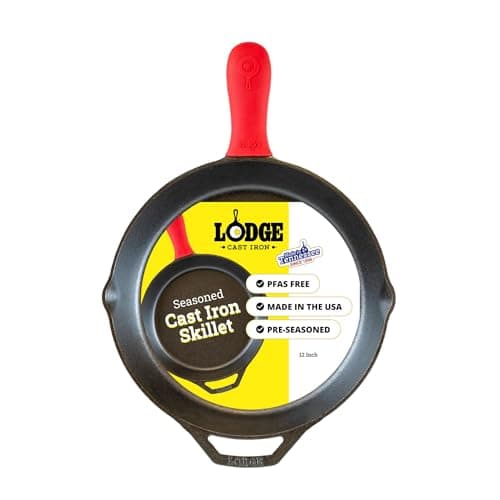
Lodge 12 Inch Cast Iron Skillet with Handle Holder
Basis: materials, as stated by Lodge on its product page: “Made in the USA,” “Seasoned with 100% natural vegetable oil,” and “made without PFAS.”
This is Lodge’s classic 12-inch skillet, cast at the company’s South Pittsburg, Tennessee foundry, sold with a red silicone handle holder. Lodge says the sand-casting process leaves a slightly rough surface that the seasoning grips, and that it gets smoother the more you cook. It works on any stovetop including induction, in the oven, on a grill or over a campfire, and it carries Lodge’s limited lifetime warranty.
The holder is the one part not made of iron. Lodge says it is made in China, protects hands from heat up to 500°F, and is “Not intended for use during cooking, grilling, or baking.” It is for carrying a hot pan to the table, so it never sits on the stove or in the oven.
Buy it if you want one dependable pan at a budget price, made in the USA. Skip it if you avoid soybean oil and do not want to strip and reseason a new pan.
Lodge 12 Inch Cast Iron Skillet with Handle Holder on Amazon →
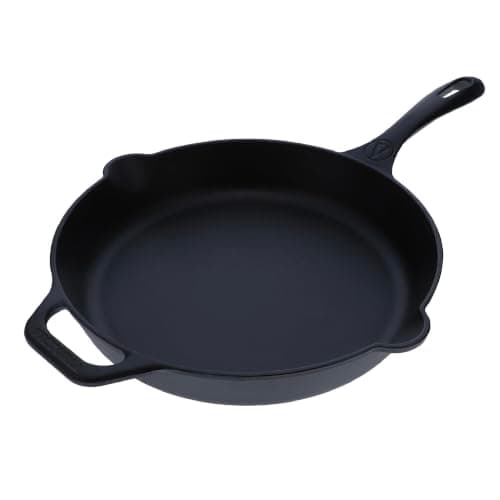
Victoria 12-Inch Cast Iron Skillet
Basis: materials, as stated by Victoria on its product page: grey cast iron “preseasoned with 100% non-GMO, kosher-certified flaxseed oil,” “with no synthetic coatings, PTFE, or PFOA.”
Victoria is a family-owned company in Medellin, Colombia, casting since 1939, and it says this skillet is “Made 100% in Colombia.” At 6.7 lb it is the lightest of the three. The design differences are practical: a long curved handle Victoria says gives a balanced grip, pour spouts on both sides, an extra-thick edge Victoria says reduces warping, and a deeper vessel for sauces and eggs. Victoria’s product page names PTFE and PFOA rather than PFAS as a group, but its full materials list above shows no coating of any kind. It carries a limited lifetime warranty covering a pan that breaks, cracks or warps under normal use.
Buy it if you want flaxseed seasoning, a lighter pan, or a handle and spouts that suit pouring. Skip it if you specifically want a pan made in the USA.
Victoria 12-Inch Cast Iron Skillet on Amazon →
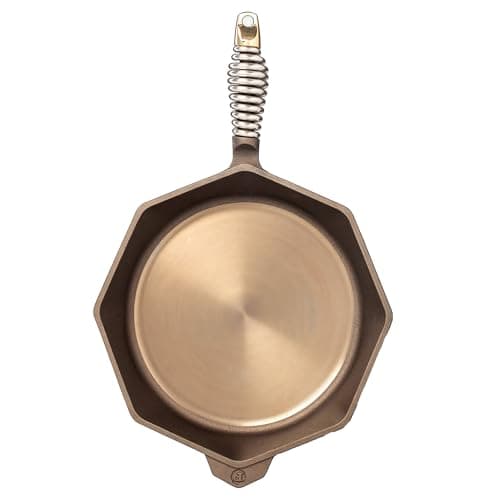
FINEX 12-Inch Cast Iron Skillet
Basis: materials, as stated by FINEX on its product page: a “machined and polished” cooking surface “pre-seasoned with organic flaxseed oil,” and “Like all FINEX cookware, our skillets are entirely free of PFAS, PTE, PTFE, PFOS, Teflon.”
Why it costs so much more. FINEX lists what you are paying for on its product and about pages:
- A cooking surface machined smooth and stone-tumble polished, the finish FINEX says it copied from vintage cast iron. Lodge and Victoria leave the cast texture in place.
- A handcrafted stainless steel spring handle, modeled on old wood-stove door handles, that FINEX says “stays cool longer.”
- A patented octagonal shape, where every corner works as a pour spout and the straight sides help release cornbread.
- “100% made-in-USA craftsmanship” in Portland, Oregon, and a “Guaranteed Good Forever” promise to repair or replace a pan that fails (abuse, theft and loss excluded).
Is it worth it? The cooking material is the same: FINEX’s disclosure lists the same elements in its iron castings as Lodge’s, and the seasoning is oil in both cases. What the premium buys is a surface that is smooth from the first egg instead of after months of cooking, a handle FINEX says stays cool enough to fry an egg without a mitt, and a guarantee that covers repair. It is also the heaviest of the three at 8.5 lb, with a 9.25 inch flat cooking area inside the octagon. It makes sense as a once-in-a-lifetime gift or for a cook who has used cast iron for years and knows those details matter to them. For a first pan, the Lodge does the same jobs for far less.
Buy it if a smooth surface and a cooler handle are worth a premium price to you. Skip it if weight bothers you or you are buying your first cast iron pan.
FINEX 12-Inch Cast Iron Skillet on Amazon →
Does Cast Iron Put Iron Into Your Food?
Yes, in small and variable amounts. In a study in the Journal of the American Dietetic Association (Brittin and Nossaman, 1986, “Iron content of food cooked in iron utensils”), researchers cooked 20 foods in iron and non-iron pans. Ninety percent of the foods held significantly more iron after cooking in iron. Acidity, moisture and cooking time all raised the amount, and two different iron skillets gave different results, which the authors put down to how much each had been used before.
For most people that is a modest plus. MedlinePlus, the National Library of Medicine’s consumer health site, lists cooking in a cast-iron skillet among the ways to increase the iron your food provides. It is not a measured dose, though, so it is no substitute for treatment if you have been told you are low in iron. The exception runs the other way: MedlinePlus says the treatment for hemochromatosis, a condition where the body absorbs too much iron, includes a low-iron diet. If you have it, or have been told to limit iron, ask your doctor about cast iron, and cook long-simmered acidic dishes in enameled cast iron or stainless steel.
How to Care for It and Re-Season It
All three makers give nearly the same routine. These steps follow Lodge’s cleaning and care and troubleshooting pages, Victoria’s everyday cleaning guide and FINEX’s use and care page.
After every use:
- Clean it while it is still warm. Wash by hand in warm water with a little mild dish soap. Victoria says mild dish soap “will not damage your seasoning,” and Lodge’s own routine is warm, soapy water.
- Lift stuck food with a pan scraper, a chain mail scrubber or coarse salt. For a really stuck mess, Victoria suggests simmering a little water for 2 minutes, then scraping.
- Dry it completely, straight away, with a towel. Never let it air dry, soak in the sink or go in the dishwasher. Lodge names all three as causes of rust, and FINEX and Victoria give the same warnings.
- Rub in a very thin coat of cooking oil with a paper towel. FINEX suggests then warming the pan on the stove or in the oven to drive off any moisture.
For the first few weeks: cook with a little more fat than usual (FINEX’s pick is bacon) and hold off on acidic foods like tomato sauce, wine and citrus. Lodge says that once the seasoning is built up, acidic dishes are fine with cook times under 45 minutes. For chili or a long tomato braise, an enameled cast iron Dutch oven is made for the job.
To re-season after rust or a stripped patch, Lodge’s method:
- Scrub off any rust with a metal scouring pad and warm, soapy water, then dry completely.
- Wipe a very thin layer of cooking oil over the whole pan, inside and out. It should not drip or run when you tilt it.
- Put foil on the bottom rack, set the pan upside down on the rack above, and bake at 450–500°F for one hour.
- Turn the oven off and let the pan cool inside it.
For a small dull spot, FINEX’s quicker fix is to buff in a light coat of oil and heat the pan on medium until the oil starts to smoke. A sticky, gummy surface means too much oil; Lodge says another hour upside down in the oven cures it. Black flakes are bits of carbonized oil that did not fully bond, and Lodge says they are not harmful to you or the pan: scrub, rinse, dry and oil, and they stop as the seasoning builds.
Cast Iron, Carbon Steel or Enameled?
If you are weighing cast iron against other coating-free pans, two are worth knowing. Carbon steel is spun and stamped from steel rather than cast, so Lodge says it is lighter and thinner and heats up and cools down faster; it is seasoned and cared for exactly like cast iron. Enameled cast iron has a glass coating instead of seasoning, so it needs no oiling and handles acidic food, but the enamel can chip and Lodge says prolonged high heat can damage it. A ceramic-coated pan is the other route if you want something light and slick; our Caraway cookware review covers one. To compare cast iron with stainless steel, carbon steel and ceramic in one place, see our guide to non toxic pans by material.
Frequently Asked Questions
Is cast iron free of PFAS and nonstick coatings?
Bare cast iron has no nonstick coating. Lodge says its skillets are made without PFAS, FINEX says its cookware is free of PFAS, PTFE and Teflon, and Victoria says its pan has no synthetic coatings, PTFE or PFOA. The black finish on all three is seasoning, which is baked-on oil.
What are these skillets seasoned with?
Lodge uses a kosher-certified soy-based vegetable oil. Victoria uses three layers of non-GMO, kosher-certified flaxseed oil, and FINEX uses organic flaxseed oil.
Can I use soap on cast iron?
Yes. Victoria says mild dish soap will not damage the seasoning, and Lodge tells owners to wash in warm, soapy water. What does damage it is soaking, the dishwasher and leaving the pan wet.
Can I cook tomato sauce in a cast iron skillet?
Not in a new one. All three makers say to wait until the seasoning is built up. After that, Lodge says acidic dishes are fine with cook times under 45 minutes. Acidic, wet, long-cooked food also pulls the most iron from the pan.
Does EWG rate cast iron skillets?
No. EWG VERIFIED® does not cover cookware, so these pans are compared on what each maker says they are made of.
Affiliate Disclosure: This article contains affiliate links. NonToxicFinder (Solved Labs LLC) may earn commissions on qualifying purchases at no extra cost to you. We are not affiliated with, endorsed by, or partnered with the Environmental Working Group or any of the makers named here.