Affiliate Disclosure: This article contains affiliate links. NonToxicFinder (Solved Labs LLC) may earn commissions on qualifying purchases at no extra cost to you. We are not affiliated with, endorsed by, or partnered with the Environmental Working Group.
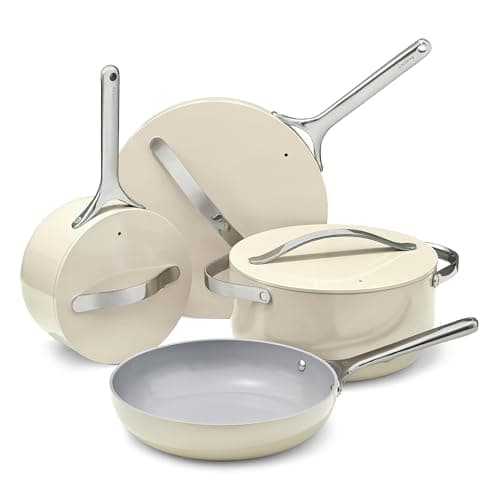
Our Caraway cookware review verdict, up front: the 12-piece ceramic nonstick set is worth it if you want a cohesive, matched cookware set with a design-forward look and you're prepared to pay a premium for that combination. It's harder to justify if you'd be equally happy buying two or three individual PFAS-free pieces at a lower total cost. Caraway's PFAS-free coating claim has real backing (more on that below), but the set is expensive, ceramic nonstick has known durability tradeoffs versus PTFE, and there's no independent, reproducible test of Caraway's exact formula. Here's the detail behind that verdict.
What Caraway's Ceramic Nonstick Coating Is (and Isn't)
Caraway describes its coating, in its own current wording, as "a mineral-based coating made without PTFE, PFOA, or PFAS" (carawayhome.com/our-materials). That is a manufacturer material description, not an independent certification. There is no named accredited certifying body attached to this specific claim on Caraway's site: no disclosed third-party mark comparable to, say, a GREENGUARD or UL certification number. Caraway's claim is that its own coating formulation and manufacturing process do not use these specific compounds, backed by lab testing described below, not that a certifying organization has independently audited and certified the finished product.
Verified Test Scope (and Its Limitations)
Caraway states its ceramic coating is third-party lab tested and shows no detection of PTFE, PFOA, PFAS, lead, or cadmium within the labs' reporting limits. This is manufacturer-cited lab testing, not an independent certification program. In plain terms: Caraway pays a lab to test its cookware, and the lab reports back that it didn't detect these compounds above a certain threshold. That is meaningfully different from a certifying body independently verifying the claim on its own initiative, and it is not an EWG rating of any kind (see below).
Caraway's site currently states its cookware is tested for over 600 types of forever chemicals as of the date we checked (September 2026). That figure has changed over time: earlier materials and some third-party review sites cite a "200+" count for the same product line. We can't reconcile which count is current or complete, so treat any specific number you see, including the one above, as a snapshot rather than a fixed fact, and expect it to keep moving.
LeafScore, an independent eco-product review site, has noted that it cannot independently confirm the composition of Caraway's proprietary ceramic formula, because Caraway hasn't disclosed the underlying recipe. LeafScore's own assessment relies on Caraway's lab reports rather than testing it can reproduce itself, which means outside reviewers, including us, can repeat what Caraway's lab reports say, but nobody outside Caraway has independently verified the coating's exact composition firsthand.
One point of independent corroboration worth noting: in an August 2025 decision, the National Advertising Division (NAD, part of BBB National Programs) reviewed Caraway's advertising and found the company had a reasonable basis for its core "PFAS-free" and "non-toxic" claims for its ceramic cookware. NAD did flag separate comparative claims Caraway had made about competing nonstick brands (language about "toxins in your home" and rising "Teflon flu" cases) as unsupported, and Caraway said it would stop using that framing. We don't repeat any of that comparative language here; this review is about Caraway's own product, not a comparison of what other brands may or may not release.
Food-Contact Materials
Caraway's own claim is that its ceramic non-stick coating is "made from inorganic natural ingredients that are FDA approved" (carawayhome.com/our-materials). That's Caraway's characterization of its own materials, not an independent finding we've verified ourselves.
Performance and Lifespan: What to Expect
As a category, ceramic nonstick coatings generally don't hold up as long as PTFE-based nonstick under high heat or with metal utensils: this is a known tradeoff of the ceramic category broadly, not a Caraway-specific defect. If you look across other Caraway reviews, one theme comes up repeatedly: whether the nonstick performance holds up two to three years in, not just on day one. We haven't run our own multi-year durability test of this specific set, so we can't make a longevity claim of our own. What we can say is the honest category-level expectation: ceramic nonstick coatings typically degrade gradually with heat abuse and utensil scratching, and how well any specific pan holds up depends heavily on how closely you follow the care guidance below.
Heat, Oven, and Induction Compatibility (12-Piece Ceramic Nonstick Set)
The following figures are scoped specifically to the 12-Piece Ceramic Nonstick Set, Caraway's flagship line and the set reviewed in this article. They do not necessarily apply to Caraway's stainless steel or enameled cast iron lines, which use different materials and different claims we have not researched for this review.
- Oven safe: up to 550°F
- Stovetop compatibility: gas, electric, and induction cooktops
These figures come from Caraway's own current product page and are consistent with the numbers independent outside sources cite for this set.
Care Instructions
Per Caraway and independent published sources, the recommended care routine for this set is: hand-wash in warm soapy water with a soft sponge, avoid metal utensils and abrasive scrubbing pads, and cook on low-to-medium-low heat, since the design retains heat well and doesn't need high settings. We're citing this secondhand, via outside sources describing Caraway's guidance, rather than quoting Caraway's own care-instructions page directly: treat it as high-confidence, standard-for-the-category guidance rather than a verbatim manufacturer quote.
Pricing and Value: Is Caraway Cookware Worth It?
As of late September 2026, expect to pay roughly $395–$445 for the Caraway 12-Piece Non-Stick Ceramic Cookware Set (ASIN B08XM1B6ZX) on Amazon. We're giving a range rather than a single number because Caraway/Amazon pricing on this set moves with promotions (the same listing has priced anywhere in that band recently), so check the current price at the time you're actually deciding to buy, rather than trusting either end of this range as fixed. We're describing it here plainly as the 12-piece cookware set; we did not independently verify whether this particular Amazon listing includes the same storage-organizer accessories featured on Caraway's own direct-to-consumer bundle page, so we're not claiming those extras are included.
The real question most people weighing this purchase are asking is whether a $400+ set beats buying pieces individually, or buying a different brand entirely. A few honest comparison points:
- Versus buying pieces individually: if you only need one or two pans, buying Caraway's fry pan and sauce pan separately (or a smaller ceramic nonstick skillet from another brand) will cost meaningfully less than the full 12-piece set. The set makes more sense if you're outfitting a kitchen from scratch and want everything to match.
- Versus Lodge: a pre-seasoned Lodge cast iron skillet costs a fraction of what any single Caraway piece costs and is PFAS-free by composition rather than by coating, with no nonstick coating to eventually wear out: a genuinely different tradeoff (weight and technique versus out-of-the-box nonstick convenience).
- Versus GreenPan: GreenPan's Thermolon ceramic coating is a lower-cost way to get PFAS-free ceramic nonstick performance, without Caraway's matched-set aesthetic or price point.
If you want the fuller side-by-side comparison across brands and price points, see our full guide to PFAS-free cookware brands, which covers Lodge, GreenPan, and Caraway options from about $22 up.
Caraway 12-Piece Non-Stick Ceramic Cookware Set , Check current price on Amazon ↗
Who Should Buy It (and Who Shouldn't)
Buy it if you're outfitting a kitchen from scratch, want one cohesive matched set rather than a mismatched collection of pans, value the aesthetic and gift-ability (see our guide to PFAS-free kitchen gifts for more gift-focused picks), and are comfortable paying a premium for that combination alongside Caraway's PFAS-free coating claim and testing.
Skip it (or at least hold off) if you'd be equally well served by buying two or three individual PFAS-free pieces (Caraway or otherwise) at a fraction of the cost, if you cook frequently with metal utensils or at high heat and don't want to change that habit, or if you're specifically looking for an independently certified (not manufacturer-tested) PFAS-free guarantee, since that doesn't currently exist for any ceramic cookware brand, Caraway included.
No EWG Rating Applies to This Product
EWG VERIFIED® does not cover cookware, so no EWG rating applies to Caraway or any cookware brand. Our connection to EWG here is limited to EWG's published PFAS research and guidance, not a product-level rating. NonToxicFinder is not affiliated with, endorsed by, or partnered with the Environmental Working Group. Nothing in this review should be read as an EWG endorsement of Caraway or as an assertion that this product carries a government or independent safety certification: we make no health or safety guarantee of our own, and Caraway's testing described above is manufacturer-cited lab testing, not a formal safety certification.
Frequently Asked Questions
Q: Is Caraway cookware worth it?
It depends on what you're comparing it to. Versus buying individual PFAS-free pieces, the 12-piece set is a premium, "buy once, match everything" option rather than the lowest-cost way to get PFAS-free cookware. If a matched set and design are part of what you're paying for, that's a reasonable premium purchase in our assessment. If you just need one or two pans, it's harder to justify over buying pieces separately.
Q: Is Caraway actually PFAS-free, or is that just marketing?
Caraway's core "PFAS-free" and "non-toxic" claims for its ceramic cookware were reviewed by the National Advertising Division in 2025, which found the company had a reasonable basis for those specific claims. That's independent regulatory scrutiny of the core claim, which is more than most cookware brands have. What hasn't been independently verified is Caraway's exact coating formula or a fixed compound-count figure: the testing behind the claim is commissioned by Caraway, not run by an outside party with public access to the raw data.
Q: Does EWG VERIFIED® apply to Caraway cookware?
No. EWG VERIFIED® is a certification program for personal care and cleaning products; EWG does not operate a rating or verification program for cookware of any kind. We reference EWG's published PFAS research and guidance for context, not as an endorsement of Caraway or any cookware brand. NonToxicFinder is not affiliated with, endorsed by, or partnered with EWG.
Q: Is the Caraway 12-Piece Set oven safe and induction compatible?
Yes, per Caraway's current product page for this specific set: oven safe up to 550°F, and compatible with gas, electric, and induction cooktops. These figures are specific to the 12-Piece Ceramic Nonstick Set and don't necessarily carry over to Caraway's stainless steel or enameled cast iron lines.
Affiliate Disclosure: This article contains affiliate links. NonToxicFinder (Solved Labs LLC) may earn commissions on qualifying purchases at no extra cost to you. We are not affiliated with, endorsed by, or partnered with the Environmental Working Group.