This article contains affiliate links. NonToxicFinder (operated by Solved Labs LLC) earns commissions on qualifying purchases at no extra cost to you. We are not affiliated with or endorsed by the Environmental Working Group.
EWG cookware means pots and pans that align with the Environmental Working Group's published research on PFAS — the synthetic "forever chemicals" EWG has identified in traditional nonstick coatings. EWG VERIFIED® does not apply to cookware (that certification covers personal care and cleaning products only), but EWG's guidance points to three PFAS-free alternatives: cast iron, stainless steel, and ceramic nonstick with verified PFAS-free coatings. Our picks below cover each category by budget, from a $22 Lodge skillet to a $395 Caraway set.
EWG (the Environmental Working Group) has published research and guidance documenting PFAS in traditional nonstick cookware coatings as a household chemical exposure route. This is not a certification program — EWG VERIFIED® applies to personal care and cleaning products, not cookware. But EWG's published concerns about PFAS in the kitchen are well-documented, and they point toward specific cookware materials: cast iron, stainless steel, and ceramic nonstick with verified PFAS-free coatings. This guide explains the options and recommends the best products by price range.
What EWG Says About PFAS in Nonstick Pans
EWG has documented concerns about PTFE-based nonstick coatings (commonly known by the brand name Teflon) as a PFAS exposure route in the home. PTFE is itself a PFAS compound, and its manufacturing has historically involved PFOA — a separate PFAS chemical that has been largely phased out in the U.S. but remains a concern in cookware produced before 2013.
At very high temperatures (above 500°F for many pans, lower for older or damaged coatings), PTFE can break down and release volatile compounds. EWG's guidance recommends transitioning to PFAS-free cookware materials — cast iron, stainless steel, or certified PFAS-free ceramic nonstick — particularly in households with young children. We make no independent health claims about specific exposure levels; reference EWG's published research at ewg.org for their documentation.
Which Cookware Materials Are PFAS-Free?
Stainless Steel: Naturally PFAS-Free
Food-grade stainless steel (18/8 or 304 grade) contains no synthetic coatings. It is not naturally nonstick, but with the right cooking technique — adequate preheating, appropriate fat, and proper heat management — it performs well for most cooking tasks. Stainless is durable, dishwasher-safe, and lasts decades with basic care. It is PFAS-free by composition.
Cast Iron: Naturally PFAS-Free and Naturally Nonstick
Seasoned cast iron is the original nonstick surface: layers of polymerized vegetable or animal fat build up over time to create a genuinely slick cooking surface with no synthetic coatings. Cast iron is PFAS-free by composition — it is iron seasoned with oil, nothing else. It is oven-safe to any temperature, works on all heat sources including induction and campfire, and when maintained properly, improves with age. The main downsides are weight and the requirement to hand-wash and re-season periodically.
Ceramic Nonstick: PFAS-Free When Certified
Ceramic nonstick coatings are an alternative to PTFE. Not all ceramic nonstick is PFAS-free — the term "ceramic-coated" without certification can describe a range of coatings with varying formulations. Look specifically for products that are explicitly certified PTFE-free, PFOA-free, and PFAS-free. The Thermolon ceramic coating used by GreenPan is one example of a third-party verified PFAS-free ceramic coating. The Caraway cookware line is independently tested for 200+ PFAS types.
Traditional Nonstick (PTFE): What EWG's Guidance Suggests
EWG has flagged PTFE-based coatings as a PFAS exposure route and recommends avoiding them, particularly at high heat or with scratched or degraded coatings. This category covers most conventional nonstick pans — Teflon and equivalent brands. The risk from a well-maintained pan at normal cooking temperatures is debated in the scientific literature; we cite EWG's documented position without overstating it. For families that follow EWG's guidance, the alternatives below offer equivalent or superior cooking performance.
Best PFAS-Free Cookware Picks
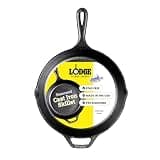
Lodge Pre-Seasoned Cast Iron Skillet, 10.25" (ASIN: B00006JSUA, ~$22) — Budget Pick
Lodge is the most accessible entry point to PFAS-free cooking. This 10.25" skillet is American-made in South Pittsburg, Tennessee, and arrives pre-seasoned with vegetable oil. The composition is iron and vegetable oil — zero synthetic coatings. It is PFAS-free by composition, not just by certification claim. Works on gas, electric, induction, glass-top, and open flame; oven-safe to any temperature. At ~$22, it's the lowest-cost item in this guide and one that will outlast any coated pan.
Material: Cast iron, vegetable oil seasoning — zero synthetic coatings
PFAS status: PFAS-free by composition
Size: 10.25 inches
Heat sources: All, including induction and open flame
Oven-safe: Any temperature
Made in: USA
Lodge Pre-Seasoned Cast Iron Skillet, 10.25" — Buy on Amazon ↗
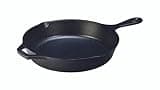
Lodge Pre-Seasoned Cast Iron Skillet, 12" (ASIN: B00006JSUB, ~$28) — Best for Families
The 12" Lodge offers the same PFAS-free cast iron composition in a larger cooking surface better suited to family-size meals. This is Lodge's best-selling skillet size for a reason: it handles a whole chicken, four pork chops, or a pan of cornbread with room to spare. Same vegetable oil pre-seasoning, same American manufacturing, same lifetime durability. If you are buying one cast iron pan, 12" is the more versatile size.
Material: Cast iron, vegetable oil seasoning
PFAS status: PFAS-free by composition
Size: 12 inches
Best for: Family meals, batch cooking
Lodge Pre-Seasoned Cast Iron Skillet, 12" — Buy on Amazon ↗
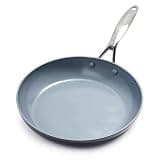
GreenPan Valencia Pro 12" Ceramic Nonstick Skillet (ASIN: B07YT3X21D, ~$45) — Best Mid-Range Nonstick
For cooks who want nonstick cooking performance without PTFE, the GreenPan Valencia Pro is the best mid-range option. It uses Thermolon ceramic coating — independently certified PFAS-free, PTFE-free, PFOA-free, and free from lead and cadmium. America's Test Kitchen named it their Best Ceramic Nonstick. The hard-anodized aluminum body distributes heat evenly; the pan is oven-safe to 600°F and induction compatible. Dishwasher-safe, though hand-washing extends coating life.
Coating: Thermolon ceramic — PFAS-free, PTFE-free, PFOA-free, lead/cadmium-free
Size: 12 inches
Body: Hard anodized aluminum
Oven-safe: 600°F
Compatible: All stovetops including induction
Award: America's Test Kitchen Best Ceramic Nonstick
GreenPan Valencia Pro 12" Ceramic Nonstick Skillet — Buy on Amazon ↗
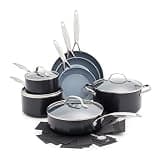
GreenPan Valencia Pro 11-Piece Cookware Set (ASIN: B071HVQL76, ~$175) — Full Set Option
The same Thermolon ceramic certification extends throughout this 11-piece set: skillets, saucepans, a stockpot, and lids. For families replacing their entire cookware collection at once, this set offers Thermolon's PFAS-free coverage across every piece. At roughly $175 for 11 pieces, the per-piece cost is significantly lower than buying individual GreenPan skillets. All pieces are induction-compatible, oven-safe to 600°F, and backed by the same Thermolon certification.
Coating: Thermolon ceramic throughout — PFAS-free, PTFE-free, PFOA-free
Pieces: 11 (various pots, pans, lids)
Oven-safe: 600°F
Compatible: All stovetops including induction
GreenPan Valencia Pro 11-Piece Cookware Set — Buy on Amazon ↗
Caraway 12-Piece Ceramic Nonstick Set (ASIN: B08XM1B6ZX, ~$395) — Premium Pick
Caraway is the most extensively tested option in this guide. The cookware is independently tested by third parties for 200+ types of PFAS and 20+ heavy metals — and certified free from all. No PTFE, PFOA, PFAS, lead, or cadmium. The set received the Good Housekeeping Sustainable Innovation Award. At roughly $395 for a 12-piece set, Caraway is the "invest once" premium option: complete kitchen coverage with the most rigorous PFAS documentation of any product reviewed here.
Coating: Ceramic nonstick; third-party tested for 200+ PFAS types and 20+ heavy metals
Certification: PFAS-free, PTFE-free, PFOA-free, lead/cadmium-free
Pieces: 12
Award: Good Housekeeping Sustainable Innovation Award
Best for: Families replacing their complete cookware collection; maximum PFAS assurance
Caraway 12-Piece Ceramic Nonstick Cookware Set — Buy on Amazon ↗
How to Transition Your Kitchen Away From PFAS Cookware
You do not need to throw away your existing pans today. A practical approach: replace pans as they wear out, starting with your most-used item. For most families, that is the everyday skillet — which makes the Lodge 12" cast iron or GreenPan Valencia Pro 12" a natural first purchase. Pans with visibly scratched, flaking, or degraded nonstick coatings are a reasonable first priority for replacement, as damaged coatings are more likely to release compounds at cooking temperatures.
Cast iron as a first purchase makes sense for budget-conscious families: the Lodge 12" is the lowest-cost item in this guide, performs well for most cooking, and requires no future replacement. Ceramic nonstick (GreenPan, Caraway) is the better choice for cooks who prioritize the nonstick cooking experience and are replacing a conventional nonstick pan directly.
Beyond the Pan: A Safer Kitchen Starts With More Than Cookware
PFAS can also appear in food packaging, nonstick bakeware, and waterproof kitchen textiles — areas beyond the scope of this guide. For drinking water, see our guide to the best water filters for PFAS removal, which covers NSF-certified options from pitchers to reverse osmosis systems. For dish cleaning, see our roundup of non-toxic dish soaps top-rated by EWG. For food storage containers, our guide to swapping plastic food storage for glass and stainless maps EWG's documented PFAS concerns in some food-contact plastics to four verified glass and stainless picks.
Frequently Asked Questions
Q: Is ceramic nonstick always PFAS-free?
No. "Ceramic-coated" is a broad term that does not guarantee PFAS-free formulation. Look for explicit third-party certification: PTFE-free, PFOA-free, and PFAS-free on the product listing or brand materials. Thermolon (GreenPan) and Caraway's third-party testing are examples of certifications that go beyond marketing language. Avoid products that use "ceramic" as a description without specific PFAS-related certification claims.
Q: Does EWG VERIFIED® apply to cookware?
No. EWG VERIFIED® is a certification program for personal care products and cleaning products. EWG does not operate a cookware rating or verification program. The EWG connection for this category is EWG's published research and guidance on PFAS in nonstick cookware — not a product-level certification. Do not interpret "aligned with EWG's PFAS guidance" as an EWG endorsement of any specific pan.
Q: Is it safe to use cast iron every day?
Cast iron does leach small amounts of iron into food, particularly with acidic ingredients like tomatoes cooked for extended periods. The scientific consensus is that this iron leaching is generally not a concern for the majority of people and may even contribute marginally to iron intake. We do not make independent health claims; consult your physician if you have a condition affected by dietary iron. Cast iron's PFAS-free-by-composition status and durability make it a widely recommended option for daily cooking.