This article contains affiliate links. NonToxicFinder (Solved Labs LLC) earns commissions on qualifying purchases at no extra cost to you. We are not affiliated with or endorsed by the Environmental Working Group.
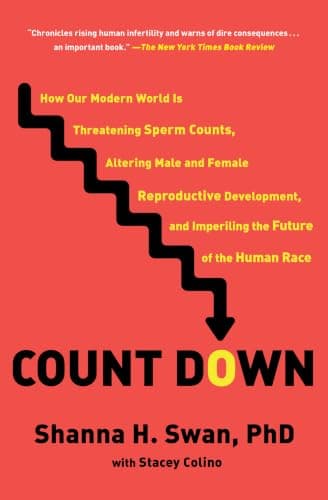
Every month, NonToxicFinder selects one book for families who want to go deeper than a product swap list. Our Count Down book review covers the November 2026 pick: Count Down: How Our Modern World Is Threatening Sperm Counts, Altering Male and Female Reproductive Development, and Imperiling the Future of the Human Race by Shanna H. Swan, PhD and Stacey Colino (Scribner, 2021). It is one of the most rigorously credentialed books on endocrine-disrupting chemicals (EDCs) written for a general audience, and the most accessible source available for understanding why certain personal care and baby product ingredients have attracted sustained scientific attention.
Dr. Swan’s Credentials and the Peer-Reviewed Foundation
Shanna H. Swan is a reproductive epidemiologist and Professor in the Department of Environmental Medicine and Public Health at the Icahn School of Medicine at Mount Sinai. Her research is peer-reviewed and published in leading scientific journals.
The scientific anchor for much of Count Down is a 2017 meta-analysis she co-authored with Levine and colleagues, published in Human Reproduction Update. That study pooled data from 185 studies conducted between 1973 and 2011 and found a 52.4% decline in sperm concentration among men in Western countries over that period. The trend data are peer-reviewed and have been cited extensively in the scientific literature. That is the credible, specific claim at the book’s foundation: a documented population-level decline in sperm concentration, corroborated across a large number of independent studies conducted by different research teams. This is worth distinguishing carefully from the broader interpretive claims the book makes around those data, which we address in a later section.
Stacey Colino is a health journalist whose work has appeared in The Washington Post, Newsweek, and other major outlets. The pairing of Swan’s scientific expertise with Colino’s communication skills produces a book that is technically grounded and accessible to non-scientists.
Count Down was an NYT Book Review Editors’ Choice and was longlisted for the 2022 PEN/E.O. Wilson Literary Science Writing Award. These are genuine credibility signals for a book in this genre.
What Count Down Covers: EDCs in Everyday Products
The book focuses significantly on phthalates, a class of chemicals used as plasticizers in some plastics and as solvents in synthetic fragrance formulations. Research (including Swan’s own peer-reviewed work) has found associations between phthalate exposure during pregnancy and measurable changes in anogenital distance in male infants, a biomarker researchers use to assess prenatal androgen activity. This research identifies statistical associations in population-level studies; it does not establish that phthalates cause harm to any specific individual at any specific exposure level.
Other EDC categories Count Down covers:
- Bisphenol A (BPA) and its substitutes: Research links BPA to disruptions in estrogen signaling pathways. BPA has been removed from many food-contact plastics in the U.S., though replacement chemicals (BPS, BPF) are under active research scrutiny.
- Parabens: Preservatives used in personal care products. Research has found associations between paraben exposure and estrogen receptor activity; the clinical significance of that association at typical consumer exposure levels remains under debate in the scientific community.
- PFAS (per- and polyfluoroalkyl substances): Research suggests associations between certain PFAS compounds and hormonal disruption. PFAS are found in some non-stick coatings, food packaging, and other consumer product categories.
- Pesticide residues: Research suggests associations between certain pesticide classes and reproductive hormone levels, with dose, timing, and duration of exposure all playing important roles in how researchers interpret the findings.
In every case, the accurate framing is that research identifies associations, not certainties. The science of EDC exposure is active and evolving. The peer-reviewed evidence is meaningful and worth taking seriously as a basis for practical consumer decisions; it does not support absolute claims about outcomes at the individual level.
An Honest Read on the Book’s Framing
This is where an honest review requires some balance.
The peer-reviewed data Swan brings to the book are solid. The documented sperm concentration decline is real, replicated across multiple independent research teams, and worth understanding. Swan is a credentialed expert, and the science in the core research chapters is handled carefully.
Some reviewers (including Tom Chivers writing in UnHerd and commentary published in Science 2.0 ) have raised concerns about the book’s more sweeping interpretive claims, particularly around population-level projections for long-term reproductive health. Their criticism is not that the sperm concentration trend data are wrong. The concern is that inferential steps from documented trends to broader civilizational projections involve more uncertainty than the book’s narrative register sometimes acknowledges.
We share that measured caution. The most credible and practically useful parts of Count Down are the sections explaining EDC mechanisms, the research on specific chemical classes like phthalates, and the actionable guidance on reducing exposure. Those sections are well-grounded in the peer-reviewed literature. The broader interpretive narrative is where we recommend reading with proportionate skepticism: not dismissal, but calibrated engagement with what the evidence supports and what it does not yet establish.
For parents who want to understand the science behind ingredient concerns in personal care and baby products, this distinction is useful rather than discouraging. The research on phthalates and prenatal exposure is meaningful on its own terms. It does not require the civilizational frame to justify taking it seriously.
What Parents Can Do: Reducing EDC Exposure by Category
This is the most directly applicable section for families. Count Down identifies product categories where EDC exposure is most likely to occur. Here is how those map to practical steps, with links to current product roundups:
Personal Care Products
Synthetic fragrance is one of the most common sources of phthalate exposure in personal care products. Phthalates are often used to extend the persistence of synthetic scent and are typically listed on ingredient labels as “fragrance” or “parfum” rather than by chemical name. Research suggests associations between phthalate exposure and changes in reproductive hormone levels in population-level studies.
Practical steps: choose personal care products that disclose fragrance sources specifically (essential oils, botanical extracts) or that are fragrance-free. The EWG Skin Deep® database rates thousands of personal care products by ingredient hazard level and is a useful starting point for looking up specific products. NonToxicFinder is not affiliated with, endorsed by, or partnered with EWG; we reference EWG Skin Deep® as a useful independent research tool whose ratings reflect EWG’s own methodology.
See our roundups: Top-Rated Non-Toxic Face Wash (EWG Skin Deep®) | Non-Toxic Deodorant: EWG’s Top-Rated Picks
Baby and Pregnancy Care
Swan’s research specifically identifies the prenatal period as a window of heightened sensitivity to EDC exposure. Her peer-reviewed work on phthalates involves prenatal exposure measurements, which makes product choices during pregnancy and for newborn care directly relevant to the research she describes. Families expecting a child or with infants and toddlers are the audience most likely to find the actionable sections of Count Down immediately useful.
Practical steps: choose baby care products with shorter, fragrance-free ingredient lists. The EWG VERIFIED® mark covers personal care products (including baby lotions, washes, and wipes) that meet EWG’s published ingredient standards for their VERIFIED program. EWG VERIFIED® reflects EWG’s own standards, not a health or safety guarantee from NonToxicFinder.
See our roundups: Best Non-Toxic Baby Wipes, EWG-Rated | Top-Rated Non-Toxic Baby Body Wash | Best EWG VERIFIED® Baby Lotion
Household Cleaning Products
Conventional cleaning products often contain synthetic fragrances (a frequent source of phthalate exposure) and other ingredients that appear as concerns in EWG’s Guide to Healthy Cleaning. Fragrance-free or simply scented alternatives that perform well in EWG’s rating system are widely available and typically comparable in price to conventional options.
See our roundups: EWG-Rated Laundry Detergent | Non-Toxic Dish Soap, EWG-Rated
Food Storage and Packaging
The book covers food-contact plastics as a source of BPA and related compound exposure. Research-based practical steps include using glass or stainless steel containers for heated foods rather than plastic, avoiding microwaving food in plastic containers, and choosing canned food brands that use BPA-free can lining. These are low-cost, low-disruption changes that the available research supports as a reasonable precaution.
Get the Book
Count Down is available in paperback, hardcover, Kindle, and audiobook editions. As of September 2026, the paperback is priced at $17.36 on Amazon (price verified via Amazon Creators API on 2026-09-16; prices fluctuate and may differ at the time you visit). The paperback is the most accessible entry point for price and format.
Get Count Down (Paperback) on Amazon →
For context on where Count Down fits among credentialed non-toxic living books, see our full non-toxic living reading list, which covers five MD- and PhD-authored titles including this one.
Pair With Our Product Guides
Count Down identifies the chemical categories worth reducing. Our product roundups give you current, specific options in each category:
- Top-Rated Non-Toxic Face Wash (EWG Skin Deep®)
- Non-Toxic Deodorant: EWG’s Top-Rated Picks
- Best Non-Toxic Baby Wipes, EWG-Rated
- Top-Rated Non-Toxic Baby Body Wash
- Best EWG VERIFIED® Baby Lotion
- EWG-Rated Laundry Detergent
- Non-Toxic Dish Soap, EWG-Rated
- Full Non-Toxic Living Reading List (5 MD & PhD-Authored Picks)
Frequently Asked Questions
Is Count Down endorsed by or connected to EWG?
No. Count Down by Shanna H. Swan and Stacey Colino has no EWG endorsement or EWG connection. NonToxicFinder (Solved Labs LLC) is not affiliated with, endorsed by, or partnered with the Environmental Working Group. We selected this book for its peer-reviewed scientific foundation and its practical guidance on EDC reduction in everyday products. We reference EWG Skin Deep® and EWG VERIFIED® throughout this article as independent third-party resources, not as partners or affiliates.
Is Count Down available as an audiobook or Kindle edition?
Yes. Count Down is available in Kindle and audiobook editions in addition to paperback and hardcover. The audiobook is published by Simon & Schuster Audio. See the Amazon product page for current format availability and pricing.
How does Count Down compare to other non-toxic living books?
Count Down is the strongest available book for understanding the peer-reviewed science of phthalates, BPA, and reproductive health research specifically. It is narrower in scope than Non-Toxic: Guide to Living Healthy in a Chemical World by Dr. Aly Cohen, MD and Frederick vom Saal, PhD (which covers the full range of product categories and chemical classes for a general family audience) but it goes deeper on the reproductive epidemiology. See our full reading list and comparison for a side-by-side look at five credentialed titles in this genre.