Affiliate Disclosure: This article contains affiliate links. NonToxicFinder (Solved Labs LLC) may earn commissions on qualifying purchases at no extra cost to you. We are not affiliated with, endorsed by, or partnered with the Environmental Working Group or any certification program.
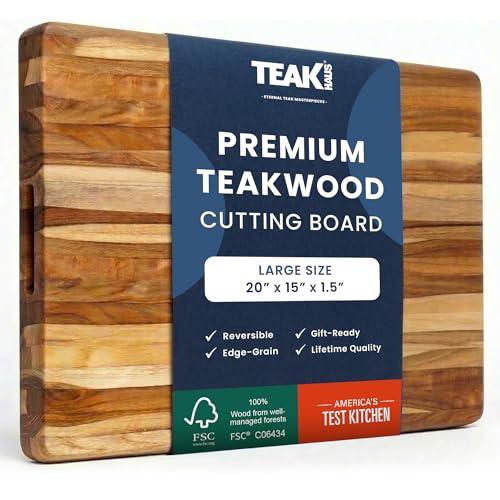
The Teakhaus cutting board most people mean is the Traditional edge-grain teak board, and it comes in two flat sizes. The 24 x 18 inch model 107 is America’s Test Kitchen’s top-rated wood cutting board. The 20 x 15 inch model 106, the board on this page, is the same teak board made smaller, and ATK rates it Highly Recommended as its “Great Smaller Option.” Buy the 106 if you want a big, stable board that still fits in a normal sink. Step up to the 107 only if your counter and sink can take a 15 lb, 24 x 18 slab.
Is This the Board America’s Test Kitchen Recommends?
Yes, in its smaller size. In its review of the best wood and bamboo cutting boards, ATK names the Teakhaus Edge Grain Cutting Board (XL), model 107, as the winner and calls it “our longtime favorite wood cutting board.” Testers liked its “smooth, medium-hard, reversible teak surface” and found it “required the least maintenance” of the nine boards, though a few noted it wobbled occasionally and it picked up some knife scars.
The 20 x 15 inch model 106 is listed right below it as the “Great Smaller Option,” also Highly Recommended. ATK’s verdict: “We love this smaller version of our winning cutting board just as much as our favorite.” Being smaller, ATK found it easier to lift and clean, though it budged a little during heavy work such as pounding cutlets. The Amazon listing this page links to is the same model 106 ATK tested.
Teakhaus prints “America’s Test Kitchen Best Wood Cutting Board Winner” on the 106’s page too. Strictly, the winner is the 107; the 106 is the recommended smaller version.
Which Teakhaus Size and Model to Buy
The Traditional Collection boards are all 1-1/2 inch thick edge-grain teak with hand grips, and all are reversible. The difference is size and whether one side has a juice canal (a groove around the edge that catches meat juices).
| Model | Size and weight | Juice canal | Best for |
|---|---|---|---|
| 106 Traditional Cutting Board (L) | 20 x 15 x 1.5 in, 12 lb | No, flat both sides | Most kitchens. ATK’s smaller pick. |
| 107 Traditional Cutting Board (XL) | 24 x 18 x 1.5 in, 15 lb | No, flat both sides | Big counters and big prep. ATK’s winner. |
| 109 Traditional Carving Board (L) | 20 x 15 x 1.5 in, 12 lb | Yes, one side | Same size as the 106, for cooks who carve roasts often. |
| 108 Traditional Carving Board (XL) | 24 x 18 x 1.5 in, 15 lb | Yes, one side | Holiday birds and briskets, if you have the room. |
Sizes and weights are from the Teakhaus product pages. ATK and Teakhaus number the 107 and 106 the same way.
How to choose. ATK’s rule is to get “the biggest cutting board that will fit on your counter and in your sink” and that you can lift comfortably. It thinks at least 15 by 20 inches is right for most home cooks, which the 106 meets. ATK found 15 lb the weight sweet spot, heavy enough to stay put and light enough to lift, which favors the 107 if you have the space. In practice:
- Pick the 106 if your sink is standard size, you lift the board to wash it every day, or you share the counter.
- Pick the 107 if the board will live on a large counter, you often break down big cuts or roll dough, and a 24 inch board fits under your tap.
- Pick a juice-canal model (109 or 108) only if you carve roasts often. For chopping vegetables, a flat board is easier to sweep clean, and the canal models still have a flat reverse side.
Measure your sink before you order. You will hand wash this board every time, so it has to fit.
See the Teakhaus edge-grain teak cutting board, 20 x 15 inch (model 106), on Amazon →
What It Is Made Of and Finished With
Every surface that touches food is described on Teakhaus’s own pages:
- Wood: teak, built edge grain, which means long strips laid side by side with the grain running along the cutting surface. Teakhaus’s FAQ says the teak comes mainly from Latin America and the boards are made at its facility in Vietnam.
- Finish: the boards are “pre-finished with a mix of Mineral oil and beeswax.” The product page says the same: “We use a mixture of mineral oil and natural beeswax to coat.”
- Glue: the strips are joined with KOYOBOND, which Teakhaus describes as a “water-based polymer-isocyanate” adhesive that “does not contain formaldehyde or volatile organic compounds (VOC).”
Teakhaus says it uses no “synthetic glazes” on its boards, so once the oil and wax wear in, the surface is bare teak. That is why it needs regular oiling.
How to Oil and Care for It
All of this comes from Teakhaus’s care guide and product page.
Before the first use: wash it with warm, not hot, water and mild dish soap, rinse, and dry it completely with a towel. A new board can look pale or a bit orange from drying out in shipping; Teakhaus says that is normal and the color deepens with washing and oil.
Oiling, two to three times a month if you use it daily:
- Start with a clean, completely dry board.
- Apply a generous amount of Teakhaus oil or food-grade mineral oil to every surface: top, bottom, sides and edges.
- Work it in with a lint-free cloth in circles.
- Let it soak in for at least 4 to 6 hours, or overnight.
- Wipe off whatever has not soaked in, or it can turn sticky.
For a board you use only now and then, Teakhaus says once a month is usually enough. The board tells you when it is due: it looks dry or pale or feels rough. Teak may need less than that in practice; ATK found its teak winner needed the least oil of any board tested (3.3 grams per session, against an edge-grain average of 6.6) and stayed shiny well after other boards needed a new coat. Never use olive or vegetable oil, which Teakhaus warns can turn rancid.
Cleaning, after every use:
- Scrape off food, then wash with warm water and mild dish soap. Teakhaus says to skip antibacterial soaps, which dry out the wood, and to use a nylon brush rather than steel wool for stuck-on food.
- Rinse well and towel dry right away. Store it upright or flat somewhere with air around it.
- Never soak it, never leave it in a puddle, and never put it in the dishwasher, microwave or oven.
- Teakhaus says not to use bleach or harsh chemical cleaners on it. For stains, it suggests a baking soda paste or a lemon dipped in coarse salt; for smells, half a lemon or undiluted white vinegar, then rinse and dry.
Long-term care: flip the board regularly so both sides wear evenly. When knife grooves get deep enough to trap food, sand with the grain, starting at 80 grit, then 120, then 220, and finish with two or three coats of oil. Teakhaus says small surface cracks can be filled with food-grade wood glue, but a crack that runs through the board means it should be retired from food use.
The federal food safety advice applies to this board like any other. CDC says to “wash utensils, cutting boards, and countertops with hot, soapy water after preparing each food item,” and to use one cutting board for raw meat, poultry and seafood and a separate one for produce, bread and other foods that will not be cooked. FDA gives the same two rules. Teakhaus also recommends one board for raw meat and another for vegetables. Many cooks keep the teak board for produce and bread and use a dishwasher-friendly board for raw meat.
Is Teak Hard on Knives?
No, not in normal kitchen use. Teak is a medium-hard wood: ATK lists its Janka hardness at 989 lbf, against 1,439 for hard maple and about 1,480 for bamboo. A softer board gives a little under the blade. ATK calls teak “soft enough to provide a luxurious cutting experience but hard enough to be relatively durable.”
Teak does have a reputation for dulling blades. The USDA Forest Products Laboratory’s Wood Handbook says of teak that “the presence of silica often dulls tools,” but it is describing saws and planes working raw lumber. ATK tested kitchen knives directly, with a robot making 5,000 cuts on every board with a new knife and checking sharpness every 200 cuts. Every knife could still slice paper at the end, and ATK concluded “any board you choose will be fine for your knife.” It found no clear difference in sharpness between knives used on end-grain and edge-grain boards either. The surfaces that do ruin an edge are much harder ones, such as glass.
Teak vs Maple, Bamboo and Plastic
| Teakhaus 106 (teak) | John Boos R03 (maple) | Bamboo | Epicurean (paper composite) | Typical plastic | |
|---|---|---|---|---|---|
| Hardness (Janka, per ATK) | 989 lbf | 1,439 lbf | About 1,480 lbf | Firm, harder than wood | Soft |
| Size and weight | 20 x 15 x 1.5 in, 12 lb | 20 x 15 x 1.5 in, 12 lb | Varies | 1/4 inch, light | Thin, light |
| Oil needed | About 3 g per oiling, the least ATK measured | 7 g per oiling, per ATK | More than most edge-grain boards, per ATK | None | None |
| Dishwasher | No | No | No | Yes, per Epicurean | Usually yes |
| ATK verdict | Highly Recommended | Recommended with reservations | Tested; testers found the surface rougher to cut on | Not in this review | Not in this review |
| When worn | Sand and re-oil | Sand and re-oil | Sand and re-oil | Shows knife marks | Replace when deeply scored |
Teak or maple. The John Boos maple R-Board is the closest rival: same size, same weight, same edge-grain build. Maple is harder, so it scars less, and the R-Board carries an NSF food equipment listing that the Teakhaus does not. In ATK’s testing the teak boards needed less than half the oil and resisted stains, while the R03 took the heaviest stains and separated slightly along one glue line. Pick the teak board for a softer feel and lighter upkeep, or the maple if you want the harder surface and the NSF listing.
Teak or bamboo. Bamboo is the hardest of the three and shows the fewest knife marks, but ATK testers found the bamboo board they tried “a bit less enjoyable to cut on” because of its hard, slightly rough surface. Teak is the gentler surface.
Wood or plastic. A plastic board is light and goes in the dishwasher, but once it is deeply scored it is thrown out, while a 1-1/2 inch teak board can be sanded smooth many times. On a plastic board the surface your knife cuts into is plastic; on a teak board it is wood. If you are taking plastic out of the kitchen, that is a real reason to switch, but keep it in proportion: FDA says “current scientific evidence does not demonstrate that the levels of microplastics or nanoplastics detected in foods pose a risk to human health.” Our guide to microplastics at home covers where else they turn up. If you want a dishwasher board with no plastic cutting surface, the Epicurean paper composite board makes a good second board for raw meat.
Who Should Buy It, and Where
- Buy the 106 if you want one large wooden board that stays on the counter, cuts softly, and you will hand wash it and oil it a couple of times a month.
- Buy the 107 if you have a big counter and sink and want ATK’s exact winner.
- Skip it if you want a dishwasher board, cannot lift 12 lb into the sink every day, or want a board with an NSF listing; the maple or paper composite boards above fit those needs better.
Where you buy matters for the warranty. Teakhaus’s one-year warranty replaces boards with a defect, but only for boards bought on teakhaus.com; it excludes purchases from Amazon, other marketplaces and retail stores. It also excludes cracking from inadequate oiling and damage from the dishwasher. Teakhaus accepts returns only on boards bought directly from it, so an Amazon order follows Amazon’s return policy instead.
If you are weighing teak against other materials, our comparison of Epicurean, Teakhaus and Boardsmith cutting boards puts paper composite, end-grain teak and end-grain maple side by side.
The same wash-dry-oil routine works for wooden utensils, such as the Earlywood flat spatula set.
Frequently Asked Questions
Is the Teakhaus board the one America’s Test Kitchen recommends?
ATK’s winning wood cutting board is the Teakhaus Edge Grain Cutting Board (XL), model 107, 24 x 18 inches. The 20 x 15 inch model 106 is its Highly Recommended “Great Smaller Option,” and ATK says it loves it “just as much as our favorite.”
Which Teakhaus size should I buy?
The 20 x 15 inch 106 for most kitchens, since it fits a standard sink and weighs 12 lb. The 24 x 18 inch 107 if you have a big counter and sink and can lift 15 lb.
Does the Teakhaus 106 have a juice groove?
No. Both sides are flat. The same-size board with a juice canal is model 109, and the 24 x 18 version is model 108.
What is a Teakhaus board finished with?
A mix of mineral oil and beeswax, per Teakhaus. The strips are glued with KOYOBOND, a water-based polymer-isocyanate adhesive that Teakhaus says contains no formaldehyde or VOCs.
How often should I oil it, and with what?
Teakhaus says two to three times a month for a board used daily and about once a month for occasional use, with Teakhaus oil or food-grade mineral oil. Let it soak in for 4 to 6 hours or overnight and wipe off the excess. Never use olive or vegetable oil.
Can a Teakhaus board go in the dishwasher?
No. Teakhaus lists it as not for the dishwasher, microwave or oven. Hand wash with mild soap and towel dry right away.
Is teak hard on knives?
No. Teak is softer than maple and bamboo, and in ATK’s 5,000-cut robot test every knife could still slice paper on every board. Teak’s silica dulls woodworking tools, but that did not show up as a problem for kitchen knives.
Is teak better than maple for a cutting board?
Neither wins outright. Teak is softer to cut on and needed less oil in ATK’s testing; maple is harder, scars less, and the John Boos maple board has an NSF listing.
Does the Teakhaus warranty cover a board bought on Amazon?
No. The one-year warranty covers only boards bought on teakhaus.com.
This article contains affiliate links. NonToxicFinder (Solved Labs LLC) may earn commissions on qualifying purchases at no extra cost to you. We are not affiliated with, endorsed by, or partnered with the Environmental Working Group or any certification program.