Affiliate Disclosure: This article contains affiliate links. NonToxicFinder (Solved Labs LLC) may earn commissions on qualifying purchases at no extra cost to you. We are not affiliated with, endorsed by, or partnered with the Environmental Working Group or any certification program.
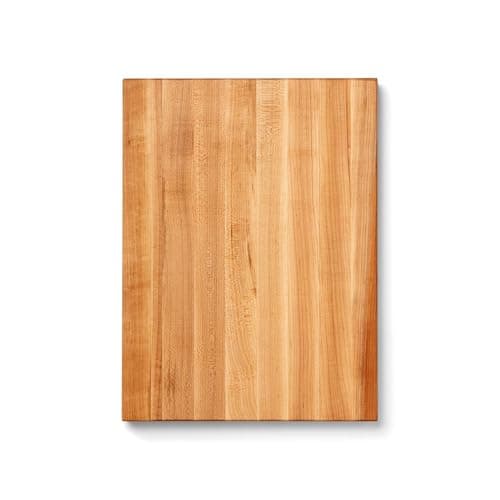
The John Boos R-Board is a solid maple cutting board, 1-1/2 inches thick, built edge grain and finished with oil and beeswax cream at the factory in Effingham, Illinois. The 20 x 15 inch size weighs 12 lb, flips over for a second cutting side, and is listed by NSF under its food equipment standard. It is a good buy if you want one large board that lives on the counter and you will oil it about once a month. If you want a board that goes in the dishwasher, skip it and look at a paper composite board instead.
What the Board Is Made Of and Finished With
John Boos lists the R-Board’s wood as “Northern Hard Rock Maple” with “Edge Grain Construction” and an “Oil Finish.” The board is “Reversible With Recessed Finger Grips” and “Made in the USA with domestic and imported materials.” (One sentence in the product summary calls the series end grain, but the spec list and the rest of the page say edge grain, and that matches the board.)
The finish is named on the maker’s FAQ: Boos Block cutting boards “ship from the factory with a Boos Block Cream Finish (with Beeswax).” John Boos describes that cream as an “all natural formula of unbleached beeswax and food-grade mineral oil.” John Boos calls its other care product, Mystery Oil, “a food-grade oil” that soaks deep into the grain, but it does not publish the oil’s ingredient list.
An edge-grain board is long maple rails joined side by side, and John Boos does not name the adhesive that joins them.
What the NSF Listing Covers
The product page says the maple is “NSF Certified.” NSF’s own listings directory backs that up:
- Company and standard: John Boos & Co, Effingham, Illinois, under NSF/ANSI 2, which NSF titles “Food Equipment.”
- Product line: “R Carving Board – Reversible,” models R01, R02 and R03, made at the Effingham facility. NSF describes them as “Hard Maple cutting board, reversible” with “John Boos oil finish.”
- This size: John Boos sells the 20 x 15 inch board as R03, which matches the listed model exactly.
NSF/ANSI 2 is NSF’s standard for commercial food equipment. A listing means NSF certifies the product line to that standard. It is not a promise about your health.
How to Oil and Care for It
John Boos’s care guide and FAQ spell out the routine.
Oiling, at least once a month:
- Start with a clean, dry board, free of food, grease and water.
- Rub an even coat of Boos Mystery Oil over every surface, top, bottom and edges, with a cloth or the Boos applicator.
- Leave it overnight to soak in, then wipe off the excess.
- For extra protection, follow with a coat of Boos Board Cream, again overnight, then wipe off.
The maker says to oil “a minimum of once a month,” more often if you wash the board a lot. The sign it is due: the wood looks dry and lighter in color. John Boos says plain food-grade mineral oil is an acceptable stand-in for Mystery Oil, and it is firm that you should never use cooking oil (“THIS WILL DAMAGE YOUR BOARDS”). It also warns against over-oiling. Oiling is not optional if you care about the warranty: the FAQ says Mystery Oil or a food-grade mineral oil is “required” to keep coverage.
Cleaning, after every use:
- Wash with hot, soapy water and dry with a clean towel, or stand it on end to air dry. Skip harsh detergents.
- Never soak it or put it in the dishwasher. John Boos says soaking upsets the wood’s moisture and can split the rails.
- For a deeper clean, the maker suggests one teaspoon of liquid chlorine bleach in a quart of water, or one part vinegar to five parts water.
- Coarse salt rubbed in with a damp sponge lifts stains; salt and a cut lemon lift onion and garlic smells.
Storing and long-term care: store it on its edge, out of direct sun. If it lives flat on a stone counter, put a mesh rubber mat under it so air can reach the bottom. Spread your cutting over the whole surface, flip the board now and then, and sand out deep scratches with #200 grit paper, going with the grain, then re-oil.
The federal food safety advice applies to every board you own. CDC says to “wash utensils, cutting boards, and countertops with hot, soapy water after preparing each food item,” and to use one cutting board for raw meat, poultry and seafood and a separate one for produce, bread and other foods that will not be cooked. FDA gives the same two rules. The R-Board is reversible, but CDC’s advice is a separate board, so a plastic or composite board for raw meat alongside the maple one is the simplest way to follow it.
Wood or Plastic: Bacteria and Microplastics
Bacteria. FDA and CDC guidance does not crown one material. FDA’s Food Code, the model rules FDA offers state and local regulators for restaurants and stores, bars most wood from food-contact use but makes an exception: “Hard maple or an equivalently hard, close-grained wood may be used for” cutting boards. The same code says boards that are scratched and scored “shall be resurfaced if they can no longer be effectively cleaned and sanitized, or discarded if they are not capable of being resurfaced,” because germs can build up in the grooves. FDA’s note on wood is that moist foods can make the surface deteriorate and get hard to clean, which is why the oiling and no-soaking rules above matter. John Boos goes further on its FAQ and cites research by Dr. Dean Cliver to argue that maple holds up better than scored plastic. Whichever you use, the deciding factors are washing after each food, separate boards for raw meat, and retiring a board when the grooves get deep.
One practical difference follows from that rule: a 1-1/2 inch maple board can be sanded smooth again many times, while a thin plastic board is usually thrown out once it is badly scored.
Microplastics. On a plastic board, the surface your knife cuts into is plastic. On the R-Board it is solid maple. For readers taking plastic out of the kitchen, a wood or paper composite cutting surface is a real reason to switch. Keep it in proportion, though: FDA says “current scientific evidence does not demonstrate that levels of microplastics or nanoplastics detected in foods pose a risk to human health,” and that more research is needed. Our guide to microplastics at home covers where else they turn up.
How It Compares With Teak, Paper Composite and Plastic
| John Boos R-Board 20 x 15 | Teakhaus edge-grain 20 x 15 | Epicurean Kitchen Series | Typical plastic board | |
|---|---|---|---|---|
| Material | Hard rock maple, edge grain | Teak, edge grain | Paper composite | Usually polyethylene or polypropylene |
| Thickness and weight | 1-1/2 inch, 12 lb | 1-1/2 inch, 12 lb | 1/4 inch, light | Thin and light |
| Oiling | At least monthly, per John Boos | Mineral oil 2–3 times a month, per Teakhaus | None | None |
| Dishwasher | No | No, hand wash | Yes, per Epicurean | Usually yes |
| NSF listing | Yes, NSF/ANSI 2 (model R03) | None we found | Yes, NSF/ANSI 2 | Varies by brand |
| When worn | Sand and re-oil | Sand and re-oil | Shows knife marks over time | Replace when deeply scored |
| Cutting surface | Solid maple; glue not named by John Boos | Teak; glue not named by Teakhaus | “Microplastics Free,” per Epicurean | Plastic |
The Teakhaus teak board is the closest rival: same size, same weight, same edge-grain build. Pick it if you prefer teak’s darker color and do not mind oiling more often; pick the Boos if you want the NSF listing and a monthly routine. The Epicurean paper composite board is the choice if you want the dishwasher and no upkeep, and it makes a good second board for raw meat.
Edge Grain or End Grain, and Which Size
Grain. John Boos explains the difference itself. Edge-grain boards like the R-Board use full-length maple rails about 1-3/4 inches wide, which gives “a uniform thickness and true flat cutting surface.” End-grain boards are short blocks glued with the cut ends facing up; John Boos says those fibers absorb the knife’s impact, so knives stay sharper and the surface stays smoother. For everyday chopping, edge grain is the practical choice; end grain is worth it if you care most about keeping a fine knife edge.
Size. The R-Board comes in three sizes, all 1-1/2 inches thick:
- 18 x 12 inches, 10 lb: for small counters and one or two cooks. Two pounds lighter than the 20 x 15 and easier to fit under a small sink tap.
- 20 x 15 inches, 12 lb: the one to buy for most kitchens. Room to dice an onion and a pepper side by side or carve a chicken without crowding the counter.
- 24 x 18 inches, 18 lb: for big prep, roasts and holiday birds, if you have counter space to leave it out. At 18 lb it is not a board you lift in and out of a cabinet, and it is awkward to wash.
Measure your sink before you choose. You will hand wash this board every time, so it has to fit under the tap.
See the John Boos R-Board maple cutting board, 20 x 15 inch, on Amazon →
Is It Worth the Money?
For the right cook, yes. You are paying for a thick, solid hardwood board made in Illinois, listed by NSF, that can be sanded back to a fresh surface instead of thrown away. John Boos says that with basic care you can “lengthen the life” of a board “by many years,” and that long life is what you are paying for. Against the same-size Teakhaus board, the choice comes down to wood and routine: the Boos is maple with an NSF listing and wants oil monthly; the Teakhaus is teak and wants mineral oil two to three times a month.
It is not worth it if the board will go in the dishwasher, sit in a wet sink or never get oiled, and John Boos’s warranty excludes damage from not following its care guide. The warranty runs one year and covers only boards bought from johnboos.com or an authorized seller, so if it matters to you, buy from an offer sold by John Boos or a retailer it authorizes.
- Buy it if you cook most days, want one big board that stays put on the counter, and will oil it once a month.
- Pick the 18 x 12 if your counter or sink is small.
- Skip it if you want dishwasher cleaning or no upkeep; a paper composite board suits you better.
Frequently Asked Questions
What wood is a John Boos cutting board made of?
The R-Board is Northern Hard Rock Maple, per John Boos. John Boos also sells walnut boards in other series.
What oil should I use on a John Boos board?
John Boos says to use its Mystery Oil, followed by Board Cream (beeswax and food-grade mineral oil) for extra protection. Plain food-grade mineral oil is an acceptable substitute. Never use olive, vegetable or other cooking oils.
How often should I oil it?
At least once a month, according to John Boos, and sooner whenever the wood looks dry and pale. Let each coat soak in overnight, then wipe off the excess.
Can a John Boos board go in the dishwasher?
No. John Boos says its wood boards are not dishwasher safe and should never be soaked. Wash by hand with hot, soapy water and dry it on its edge.
Is the 20 x 15 board end grain or edge grain?
Edge grain. The spec list says “Edge Grain Construction,” and the board is built from full-length maple rails.
Is a John Boos board really NSF certified?
Yes. NSF’s directory lists John Boos & Co under NSF/ANSI 2, Food Equipment, including the reversible maple R-Board model R03, which is the 20 x 15 inch size.
Is wood or plastic better for a cutting board?
FDA’s Food Code accepts hard maple for cutting boards, and CDC’s advice to wash after each food and keep a separate board for raw meat applies to both. Maple can be sanded smooth when it scores and gives you a wood cutting surface instead of a plastic one; plastic can go in the dishwasher but is replaced when deeply scored.
This article contains affiliate links. NonToxicFinder (Solved Labs LLC) may earn commissions on qualifying purchases at no extra cost to you. We are not affiliated with, endorsed by, or partnered with the Environmental Working Group or any certification program.