Affiliate Disclosure: This article contains affiliate links. NonToxicFinder (Solved Labs LLC) may earn commissions on qualifying purchases at no extra cost to you. We are not affiliated with, endorsed by, or partnered with the Environmental Working Group or any certification program.
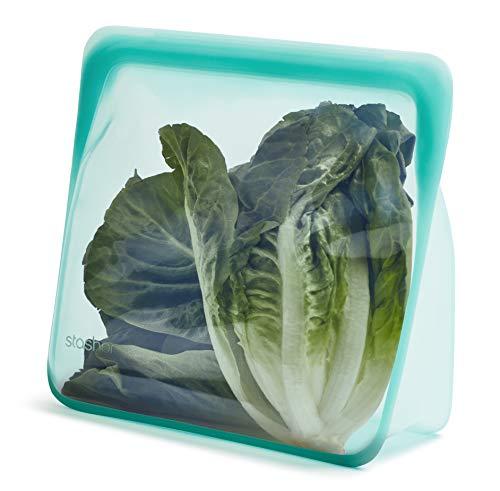
Stasher bags are reusable food bags made of what Stasher calls “food-grade platinum silicone,” with “no BPA, BPS, lead, latex, or phthalates,” closed by a press-shut Pinch-Loc seal. Stasher says every bag goes in the dishwasher (top or bottom rack), the freezer, the microwave with the seal open a quarter inch, and the oven up to 425°F. The Stand-Up Mega is the biggest: 104 fl oz, about three quarts, on a flat base that stands open while you fill it. Buy it if you batch-cook, freeze in bulk or store produce and bread. For lunches, buy the snack and sandwich sizes instead; for leftovers you reheat in portions, glass containers are easier to live with.
What Stasher Bags Are Made Of
On the Stand-Up Mega’s product page, Stasher lists the bag as “endlessly reusable, food-grade platinum silicone” with “no BPA, BPS, lead, latex, or phthalates” and a “leak-free patented Pinch-Loc® seal.” Every other bag size carries the same spec lines. Stasher says the silicone is “cured under heat and pressure” into a stable rubber. Stasher’s FAQ says its colorants pass FDA testing requirements and that the bags are designed in Emeryville, California and made in China. Stasher describes its products as silicone throughout and lists no other material, but it does not name a separate material for the Pinch-Loc seal.
“Food-grade” has a specific meaning in U.S. rules. FDA regulates rubber made for repeated food contact, silicone elastomers included, under 21 CFR 177.2600. The rule lists which elastomers and additives may be used and caps how much can be extracted from the finished surface by water and by hexane, a stand-in for fatty food. It also says finished articles “shall be thoroughly cleansed prior to their first use in contact with food,” so wash a new bag before you use it. Stasher says it sends finished products to third-party labs such as Intertek and SGS, but it does not publish the reports.
Dishwasher, Microwave, Freezer and Oven: What Stasher Allows
Stasher’s care page and FAQ give the limits for every bag size, the Mega included:
- Dishwasher: top or bottom rack. Hand washing in warm, soapy water works too.
- Microwave: yes, with the seal open about a quarter inch to vent. Stasher says printed and dotted bags can go in too.
- Freezer: yes. Stasher points its stand-up and larger bags at freezer storage.
- Oven: up to 425°F (218°C). Set the bag on a baking sheet and keep the seal partly open.
- Boiling water: Stasher suggests steaming vegetables in a partly sealed bag in boiling water for about 10 minutes, and boiling water to sanitize a bag.
- Never: broilers, open flames, knives or sharp bones. Stasher calls the bags “durable, not indestructible.”
A hot bag is soft and floppy, so Stasher says to lift it with tongs or gloves, or let it cool first. Do not turn a bag inside out to wash or dry it; Stasher says that can damage the seal and lead to tears.
How to Clean a Stasher Bag and Get Rid of Smells and Stains
Every time: run it through the dishwasher or wash it by hand. Stasher recommends unscented dish soap, because fragrance can leave a residue or a smell. Scrub the corners and the inside of the seal with a bottle brush; Stasher says doing this after every use prevents mold. Dry it upside down with the seal open, draped over a drying rack, a bottle or a cup. The Mega has deep corners, so give it time to dry fully before you close it up.
When it smells or looks stained:
- Soak it in warm water with baking soda for a few hours, or in a 50/50 mix of hot water and vinegar.
- For a full reset, bake the empty bag on an oven-safe tray at 350°F for 10 to 15 minutes, as Stasher’s product page and FAQ direct. Let it cool before handling.
- For tomato, carrot or watermelon stains, leave the bag in direct sunlight for a few hours. Stasher says this naturally lightens the stain.
- For mold in a corner, scrub with a bottle brush, then sanitize in boiling water or a 50/50 water and vinegar bath.
Stasher says strong-smelling or deeply colored foods can leave “temporary odors or stains over time.” Silicone also takes up fat with use, which is the slightly tacky film some owners notice; a grease-cutting soap and the soaks above deal with it. Our guide to swapping plastic sandwich bags for reusable silicone compares how Stasher, Bumkins and Zip Top each say to handle that film.
Which Stasher Size to Buy
All sizes below come from Stasher’s own spec lists.
| Bag | Holds | Size (inches) | Best for |
|---|---|---|---|
| Snack | 12 fl oz | 7.5 x 4.5, flat | Crackers, fruit, cut vegetables in a lunchbox |
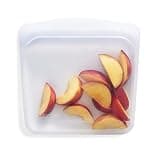
| Sandwich | 28 fl oz | 7.5 x 7, flat | A sandwich on sliced bread; about a quart zip bag’s footprint |
| Stand-Up Mini | 28 fl oz | 7.5 x 5.75 x 2.5 | Single portions, dips, half an avocado |
| Stand-Up Mid | 56 fl oz | 8.5 x 7 x 3.5 | Everyday leftovers, a head of lettuce, marinating |
| Half Gallon | 64 fl oz | 8.5 x 10.25 x 1.5, flat | Two steaks, sous vide (Stasher calls it its sous vide bag), freezing flat |
| Stand-Up Mega | 104 fl oz | 9.5 x 8.25 x 4.75 | Batch soup or chili, bulk rice or beans, a loaf of bread, a melon |
Stasher sums it up itself: snack and sandwich sizes are for “lunchboxes, snacks, and everyday packing,” while stand-up and larger bags are “better for leftovers, produce, meal prep, bulk storage, and freezer use.”
Mega or Mid? The Mid is the size Stasher calls its best seller, and it suits most households for leftovers. Choose the Mega if you regularly store more than the Mid’s seven cups at once: a double batch of soup, a family-size bag of spinach, a sourdough loaf or a few pounds of chopped vegetables. Stasher says the Mega “holds nearly a gallon,” but 104 fl oz is about three quarts, and Stasher’s own review summary notes that some buyers found it smaller than they expected. If you pictured a gallon zip bag, size down your expectations a little. At regular price on Stasher’s site, the Mega costs about half again as much as the Mid and holds nearly twice as much.
Flat or stand-up? Flat bags (snack, sandwich, half gallon) freeze thin and stack like files in a freezer drawer. Stand-up bags sit open on the counter while you ladle food in, which matters most with soup and sauce, and stand upright in the fridge door or freezer.
Stasher Mega vs Glass Containers vs Zip Bags
The glass and stainless facts below come from our guide to swapping plastic food storage for glass and stainless steel; the zip-bag facts from our silicone bag guide.
| Stasher Stand-Up Mega | Glass container (Pyrex, Anchor Hocking) | Disposable zip bag (Ziploc) | |
|---|---|---|---|
| What touches food | Platinum silicone, per Stasher | Glass base; plastic lid | Polyethylene film |
| Oven | Up to 425°F, on a baking sheet | Glass base only; Anchor Hocking says up to 425°F, preheated | No |
| Microwave | Yes, seal open a quarter inch | Yes; vent or remove the plastic lid | Defrost and reheat only, vented; Ziploc warns it may melt |
| Freezer | Yes | Yes; thaw before it goes in a hot oven | Yes |
| Dishwasher | Top or bottom rack | Glass yes; lids top rack | No; hand-wash, not after raw meat |
| When empty | Folds flat in a drawer | Takes cabinet space; stacks or nests | Thrown away |
| Cleaning effort | Corners and seal need a brush; slow to dry | Easiest; lids can stain | None, it is single use |
| Breaks if dropped | No | Can chip or shatter | No |
Is it worth the price? Against disposable bags, yes, if you use it every week. Stasher says one bag replaces 260 single-use bags a year, and a Mega that holds a weekly batch of soup or a bulk bag of rice pays back its cost over months, not days. It is not worth it if it will sit in a drawer, or if the food you store mostly leaves the house and does not come back. Against glass, it depends on what you store. Glass is the better buy for portioned leftovers you reheat: it is easier to clean, you can see inside, and several containers stack in the fridge. The Mega wins for bulky, soft or odd-shaped food (bread, greens, a whole melon), for freezing soup without a rigid tub, and for kitchens with no cabinet space, since it folds flat.
Are Stasher Bags Safe to Cook In?
The research on silicone kitchenware points in one direction. FDA permits silicone elastomers for repeated food contact under the rule above. Studies of silicone kitchenware find that small amounts of leftover siloxanes (by-products of making silicone) can move into food, mostly hot, fatty food from new items, and that the amount falls with use:
- FDA scientists detected no siloxanes in milk or infant formula after 6 hours of direct contact with silicone at 40°C (Zhang et al., “Determination of siloxanes in silicone products and potential migration to milk, formula and liquid simulants,” Food Additives & Contaminants: Part A, 2012).
- In silicone molds used up to 1,700 times in a pizza bakery, migration into food fell from 11 to 18 mg/kg to below detection, and no new siloxanes formed as the silicone aged (Helling et al., “Characterisation and migration properties of silicone materials during typical long-term commercial and household use applications,” Food Additives & Contaminants: Part A, 2012).
- A 2025 study of platinum silicone baking molds found the most migration into pastry baked at 180°C, especially from molds that had not been post-cured (heat-treated at the factory), and measurable migration into chocolate at 45°C (Eckardt et al., “Migration of cyclic dimethyl siloxanes from silicone elastomers into food,” Food Additives & Contaminants: Part A, 2025).
In practice: cold storage and freezing are the mildest use. If you plan to bake or reheat fatty food in a new Mega, wash it first, stay under 425°F, and keep it off the broiler, as Stasher directs. Stasher does not publish a siloxane test for its bags. On microplastics, the reason many people switch, FDA says “current scientific evidence does not demonstrate that levels of microplastics or nanoplastics detected in foods pose a risk to human health,” and that more research is needed. A silicone bag is not a plastic film, so it takes plastic out of the freezer drawer; our guide to microplastics at home covers where else they turn up.
Food Safety With a Bag This Big
A full Mega is a lot of food in one mass, and CDC’s food safety rules apply to it like any container:
- Cool hot food fast. CDC says to package warm or hot food into “several clean, shallow containers” and refrigerate cooked leftovers within 2 hours (1 hour above 90°F). Three quarts of hot chili in one bag cools slowly, so split a big batch across two bags or cool it in a shallow pan first.
- Keep the cold cold. CDC says to keep the fridge at 40°F or below and the freezer at 0°F or below.
- Thaw in the fridge, cold water or microwave, never on the counter, per CDC.
- Marinating meat: CDC says to keep raw or marinating meat, poultry, seafood and eggs separate from other foods. Wash the bag hot or run it through the dishwasher before it holds anything else.
- Reheat to 165°F. CDC says to check microwaved leftovers with a food thermometer.
Leave an inch or two of headroom when you freeze soup or stock in the Mega, because liquid expands as it freezes.
Who Should Buy the Stand-Up Mega
- Buy it if you cook in batches, freeze soup or stock, buy rice, beans or flour in bulk, or want a bag big enough for a loaf of bread or a whole head of lettuce.
- Buy the Mid instead if you mainly store a night’s leftovers for two or three people.
- Buy snack and sandwich bags if the goal is replacing zip bags in lunchboxes.
- Skip silicone if you mostly reheat portioned leftovers or want to avoid cleaning corners and seals by hand; glass suits you better.
See the Stasher Stand-Up Mega Bag, 104 oz, on Amazon →
For lunchboxes: Stasher Snack Bag, 12 oz → and Stasher Sandwich Bag, 28 oz →
When a bag finally tears, Stasher offers free TerraCycle recycling labels for bags sent from the U.S., since most recycling facilities do not take silicone.
Frequently Asked Questions
What are Stasher bags made of?
Stasher says they are “food-grade platinum silicone” with no BPA, BPS, lead, latex or phthalates. They are designed in California and made in China, per Stasher.
Can Stasher bags go in the oven?
Yes, up to 425°F (218°C), according to Stasher. Put the bag on a baking sheet with the seal partly open, keep it away from the broiler and open flames, and handle it with tongs or let it cool.
Can you microwave and freeze Stasher bags?
Yes, per Stasher. In the microwave, leave the seal open about a quarter inch so steam can escape. In the freezer, leave headroom above liquids.
Are Stasher bags dishwasher safe?
Stasher says they go on the top or bottom rack. Do not turn them inside out, and dry them upside down with the seal open.
How do I get the smell out of a Stasher bag?
Soak it for a few hours in warm water with baking soda, or in a 50/50 mix of hot water and vinegar. For stubborn smells, Stasher says to bake the empty bag on a tray at 350°F for 10 to 15 minutes. Sunlight lifts stains.
Are Stasher bags safe?
Stasher says they are platinum food-grade silicone free of BPA, BPS, lead, latex and phthalates, and FDA permits silicone rubber for repeated food contact under 21 CFR 177.2600. Studies find small amounts of leftover siloxanes can move from silicone into food, mostly hot, fatty food from new items, and the amount drops with use. Stasher does not publish its test reports. Wash a new bag before first use and stay within Stasher’s 425°F limit.
Which Stasher size should I buy?
Snack (12 oz) and sandwich (28 oz) for lunches, the Stand-Up Mid (56 oz) for everyday leftovers, the half gallon (64 oz) for marinating and sous vide, and the Stand-Up Mega (104 oz, about three quarts) for batch cooking and bulk storage.
Are Stasher bags worth it?
If you use them every week, yes: Stasher says one bag replaces 260 single-use bags a year, and it calls them “endlessly reusable.” If you mainly reheat portioned leftovers, glass containers are easier to clean and may suit you better.
This article contains affiliate links. NonToxicFinder (Solved Labs LLC) may earn commissions on qualifying purchases at no extra cost to you. We are not affiliated with, endorsed by, or partnered with the Environmental Working Group or any certification program.