This article contains affiliate links. NonToxicFinder (operated by Solved Labs LLC) earns commissions on qualifying purchases at no extra cost to you. We are not affiliated with the Environmental Working Group.
Leftover season starts in October and does not let up until New Year's. More meals at home means more containers in the fridge, more lids to track, and a storage drawer that gets a real workout. It's a reasonable time to ask whether the containers stacking your food are ones you want to keep using.
EWG's PFAS research has flagged a specific concern with some plastic food-contact materials: fluorinated plastic containers, including those processed with PFAS-based fluorination treatments the FDA approved in 1983, can allow PFAS compounds to migrate into stored food. EWG has publicly called on the FDA to restrict PFAS in food packaging, citing this as a real exposure route. The concern EWG documents is not about every plastic container on the market. Plain polypropylene and HDPE, the most common plastics in everyday food storage, are different from fluorinated plastic. But glass and stainless steel sidestep the question altogether: neither requires fluorination treatments, and neither carries the PFAS chemistry EWG has flagged in its food-contact materials research.
This guide covers four verified in-stock picks: Pyrex, Anchor Hocking, OXO, and U-Konserve, with prices from $19.99 to $54.99. For PFAS-free cookware to pair with a storage upgrade, see our PFAS-free cookware guide.
What EWG's PFAS Research Found on Food-Contact Plastics
EWG has documented PFAS concerns in food-contact materials through its PFAS Central research project and related policy work. The concern it flags is not about every plastic container. It is specifically about fluorinated containers: some plastic food storage products are treated with a fluorination process that can generate PFAS compounds on the container surface, and EWG's research indicates those compounds can migrate into food stored inside.
In 2021, EWG published findings noting that the FDA's 1983 approval of this fluorination process predates modern PFAS science and called on the agency to restrict PFAS in food packaging. EWG has also tested fast-food wrappers and found fluorinated chemicals in roughly 40 percent of samples. Its focus-area page on cookware and food containers explicitly flags chemical concerns with certain food-contact plastics. (Sources: EWG news release, August 2021; ewg.org/areas-focus/household-consumer-products/cookware-food-containers.)
Most everyday plastic food storage containers in the US market use polypropylene (#5) or HDPE (#2), not fluorinated treatments. The practical takeaway from EWG's research is that glass and stainless steel are the alternatives that sidestep the PFAS chemistry it has documented. NonToxicFinder is reporting EWG's published findings and positions. We are not affiliated with EWG and these are not our independent safety determinations.
Why Glass and Stainless Steel Sidestep the Concern
Glass and stainless steel do not require a fluorination treatment. Neither has a chemical coating that could migrate into stored food under normal use. That makes them the most direct alternative consistent with what EWG's research recommends for food storage.
There are also practical advantages that have nothing to do with ingredient concerns. Glass does not absorb odors or stain from tomato sauce, curries, or oily leftovers the way plastic typically does. Tempered glass from Pyrex or Anchor Hocking goes from fridge to oven without a container transfer. It does not warp in the dishwasher or crack from microwave use the way thin plastic does over time. Stainless steel is lighter, more durable for transport, and the right call for school lunches or desk meals where a dropped glass container would be a problem. The four picks below cover both materials.
4 Non Toxic Food Storage Containers (Verified In Stock)
1. Pyrex Simply Store 12-Pack Glass Containers
Price: $42.35 | EWG basis: Tempered glass consistent with EWG PFAS research recommendations for food storage; glass does not contain the PFAS chemistry EWG has flagged in some fluorinated food-contact plastics
Pyrex is the reference point most families reach for when they think about glass food storage. The 12-pack Simply Store set makes the switch practical rather than incremental: twelve containers in 1, 2, and 3-cup sizes replace the stack of mismatched plastic that accumulates in most households over a few years. The tempered glass is oven safe and microwave safe. BPA-free plastic lids are not oven safe; remove them before putting the container in the oven.
At $3.53 per container, this isn't the cheapest glass on this list. But Pyrex containers last years without staining, warping, or absorbing food odors. The 12-pack is enough to handle a full week of batch cooking leftovers and school lunch prep without running the dishwasher every day.
Pyrex Simply Store 12-Pack on Amazon →
2. Anchor Hocking 26-Piece Glass Storage Set
Price: $41.99 ($1.62 per piece) | EWG basis: Tempered glass inherently free of the PFAS chemistry EWG has documented in fluorinated food-contact plastics; no chemical coatings required
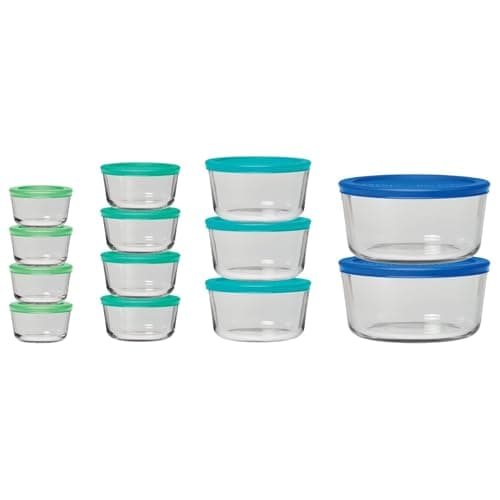
At $1.62 per container, the Anchor Hocking 26-piece set makes the case for replacing a plastic food storage drawer in one purchase rather than piece by piece. Thirteen glass containers with thirteen mixed blue SnugFit lids cover the full size range: 1-cup, 2-cup, 4-cup, and 7-cup. That range handles everything from a single portion of leftovers to a full batch of soup.
The glass is tempered, oven safe, and microwave safe. The SnugFit lids provide a solid snap-on seal. They are adequate for fridge and freezer storage, though not designed for leakproof transport of liquids. For a family replacing an entire plastic container drawer at once, this set offers the most coverage per dollar on this list.
Anchor Hocking 26-Piece Glass Set on Amazon →
3. OXO Good Grips 16-Piece Smart Seal Glass Container Set
Price: $54.99 | EWG basis: Glass construction avoids the PFAS chemistry EWG has tracked in some food-contact plastics; airtight silicone seals contain no fluorination treatments
The OXO Smart Seal set solves a specific problem: glass containers that are genuinely leakproof for liquid-heavy foods. The four-tab locking lid creates an airtight seal with a silicone gasket. Leftover soup, stew, or marinades stay contained in a bag or when a container tips over in the fridge. Most glass storage with snap-on lids cannot claim that. The silicone seal also means no PFAS-based coatings are involved in the sealing mechanism.
The 16-piece set provides eight containers in a range of sizes. At $54.99, this is the most expensive option on the list, and it earns that position by being the most versatile for families who store a lot of soups or anything where a leaked container is a real problem. Oven safe (lid off), microwave safe (lid off), freezer safe, and dishwasher safe.
OXO Good Grips 16-Piece Smart Seal Set on Amazon →
4. U-Konserve 25oz Stainless Steel Rectangle Container
Price: $19.99 | EWG basis: 18/8 stainless steel inherently free of the PFAS chemistry EWG has documented in some food-contact plastics; no coatings, no fluorine treatments required. Note: not microwave safe.
U-Konserve makes the most sense for the school lunch and desk lunch use case, where glass is a liability. The 25oz rectangle is 18/8 stainless steel with no coatings and no fluorination process. The clear silicone lid shows contents without opening the container. U-Konserve is a Certified B Corporation.
Two important use notes: stainless steel is not microwave safe, so this container requires transferring food to a plate for reheating. It is also not the right choice for highly acidic foods like tomato sauce stored for multiple days, though short-term storage is fine. For school lunches, desk meals, or portioned leftovers you will reheat elsewhere, this is the right container at the lowest price on the list. For kids' water bottles and lunch gear that pairs with this approach, see our guide to non-toxic kids water bottles and lunch gear.
U-Konserve 25oz Stainless Steel Container on Amazon →
How to Make the Switch
You do not need to discard every plastic container at once. EWG's concern is specifically about fluorinated plastic, and most households cannot tell from looking at a container whether it was fluorinated. A reasonable starting point is to replace the containers you use most often with hot foods, oily leftovers, or anything you reheat directly in the container.
Start with high-use containers. The container you reach for leftover pasta, tomorrow's soup, or next week's batch of grains is the one to swap first. The Pyrex 12-pack handles that ground for most families; the Anchor Hocking 26-piece covers it for households that batch cook heavily.
Cost over time. Plastic food storage containers typically need replacing every one to two years due to staining, warping, and cracking. Glass containers from Pyrex or Anchor Hocking last years without degrading. The Anchor Hocking 26-piece at $41.99 replaces the cost of two or three cycles of a plastic set over the same period. At $1.62 per container, the math tends to favor glass once you look past the initial purchase.
Glass versus stainless for which meals. Glass is better for fridge and freezer storage, oven-to-table transfers, and anything acidic stored long-term. Stainless is better for transport, school lunches, and situations where a dropped container would be a problem. The four picks on this list cover both materials, so you can match container to use case.
Freezing in glass. Pyrex and Anchor Hocking tempered glass is freezer safe. Leave headspace because frozen liquids expand. Allow frozen food to thaw in the fridge rather than microwaving directly from frozen to minimize thermal shock.
Frequently Asked Questions
Are all plastic food storage containers a PFAS concern?
No. EWG's research is specific: the concern it documents is with fluorinated plastic food-contact materials, not all plastics. Plain polypropylene (#5) and HDPE (#2) are the most common plastics in everyday food storage and are different from fluorinated containers. Glass and stainless steel sidestep the question entirely, which is why they are the alternatives EWG's research points toward for food storage.
Is Pyrex microwave safe?
Yes. Pyrex Simply Store tempered glass containers are microwave safe. Remove the plastic lid before microwaving; the BPA-free plastic lids are not rated for microwave use. Anchor Hocking glass containers follow the same pattern: the glass is microwave safe, the lids are not.
Can glass containers go in the freezer?
Yes, with one precaution: leave headspace. Frozen liquids expand, and filling a glass container to the brim can cause cracking. Leave at least an inch of space at the top. Both Pyrex and Anchor Hocking are rated freezer safe. Thaw frozen food in the fridge before microwaving to avoid thermal shock.
Is stainless steel safe for acidic foods?
For short-term storage, yes. High-quality 18/8 stainless steel handles acidic foods without significant concerns at typical leftover durations. For long-term storage of highly acidic foods like tomato sauce, glass is the more appropriate choice. The U-Konserve stainless container is not microwave safe; food stored in it needs to be transferred to a plate for reheating.
How do I know if my plastic containers are fluorinated?
There is no easy way to tell from the label, because fluorination is a treatment process rather than a listed ingredient. The PFAS fluorination concern EWG documents is more common in some industrial food-contact applications than in standard household plastic food storage. Switching to glass or stainless removes that uncertainty regardless of what your current containers contain.