Affiliate Disclosure: This article contains affiliate links. NonToxicFinder (Solved Labs LLC) may earn commissions on qualifying purchases at no extra cost to you. We are not affiliated with, endorsed by, or partnered with the Environmental Working Group or any certification program.
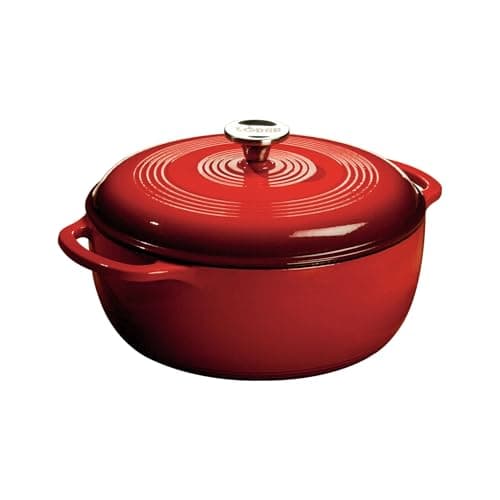
An enamel dutch oven is a cast iron pot coated inside and out with a fused glass layer, so there is no PTFE nonstick coating and no seasoning to keep up. The Lodge 6 Quart Essential Enamel Dutch Oven is the budget way to get one: Lodge says it is made without PFAS, goes in the oven up to 500°F with its stainless steel knob, and comes with an enameled cast iron lid. It is a good first pot for soups, braises and bread for a family of four. One thing to know before you pick a color: Lodge’s California chemical disclosure lists cadmium compounds in its red and orange enamel only, so choose another color if you want to avoid them.
Is Enameled Cast Iron a Good Alternative to Nonstick?
For pots, yes, with one adjustment. The cooking surface is glass fused to iron, which Lodge describes as “a smooth porcelain surface bonded to the iron.” Lodge’s California disclosure says its cookware is made without PFOA and PTFE, the coatings at the center of the PFAS debate (our explainer on what PFAS are and where they turn up covers why people avoid them).
The adjustment is that enamel is not slick the way a PTFE pan is. Lodge’s advice for keeping food from sticking is “a low to medium heat and a generous amount of oil.” That suits what a dutch oven does best: browning, then long, wet cooking. For eggs and pancakes, a skillet is the better tool, and our comparison of Victoria, Lodge and FINEX cast iron skillets covers those.
Enamel’s real edge over bare cast iron is acid. Lodge says the enamel “can handle acidic and alkaline ingredients (even tomato sauce!)” and that you can marinate and refrigerate food in it. For its bare iron, Lodge advises against leaving acidic ingredients in the pan for “more than about 45 minutes” and says an all-day simmer belongs in enamel. If you make chili, ragu or wine braises, that is the reason to choose enamel.
Lead and Cadmium: What Lodge Discloses
California’s cookware law (AB 1200) makes makers list any chemical from the state’s Candidate Chemicals list that is intentionally added to a pot’s handles or food-contact surfaces. Lodge’s list for its enameled cast iron (USA Enamel and Essential Enamel, “all colors and all sizes”) reads, in its own grouping:
- Iron, with phosphorus, manganese and manganese compounds, and strontium (plus carbon, silicon, sulfur and steel, which Lodge marks as not on the state list).
- Antimony compounds.
- Steel, with nickel and nickel compounds, copper, and chromium compounds.
- “Red and Orange items only”: cadmium compounds and sulfate.
Two things follow. First, the Amazon pot we link below is Island Spice Red, so it falls under the red line. The law covers handles and food-contact surfaces, but Lodge’s disclosure page does not say which part of a red pot carries the cadmium compounds or which of its color names count as red or orange. If you would rather have none, pick a clearly different color, such as Heron (blue), Oyster, Indigo or Desert Sage, all listed on Lodge’s product page.
Second, lead is not on Lodge’s list. Because the law covers only intentionally added chemicals, that means Lodge does not add lead; it is not a test result. On testing, Lodge says in a post on its cookware materials that it uses “vetted, third-party labs to verify that our cookware is free not only of PFAS, but also dangerous levels of Lead and Cadmium,” and its disclosure page says its cookware complies with FDA standards for direct food contact. Neither page shows the lab results.
For comparison, Le Creuset’s disclosure tool lists cadmium sulphoselenide red and orange pigments for its Cerise (red) dutch oven, but keeps them off that pot’s separate food-contact list, which names the same chemicals as the record for its black Licorice pot. Lodge’s single list does not make that split. Staub, whose safety and materials page says it does “regular third-party certified lab testing for all of our products,” states that “Staub is Cadmium Free, Lead-Free, PFOA Free, PTFE Free, and PFAS Free.” That page shows no test results either.
What FDA says. FDA’s consumer guidance on glazed ceramicware, the closest FDA guidance to a glass glaze on cookware, explains that a properly fired glaze binds lead so that any that moves into food is “an insignificant amount,” and that ware “made in commercial factories for everyday use is much less likely to have problems related to lead.” Its list of pieces to watch includes ware that is “damaged or excessively worn” and ware “brightly decorated in orange, red, or yellow color.” FDA’s lead in food and foodwares page also notes a letter to cookware retailers warning that certain imported aluminum, brass and aluminum-alloy cookware can leach lead; that page names those metals and does not mention enameled cast iron.
How Hot It Goes, and Baking Bread in It
Lodge rates the pot for “any stovetop (including induction) or oven up to 500℉.” The knob is stainless steel, and Lodge’s replacement knob page says it is “oven safe up to 500℉” too, so the whole pot, lid and knob included, can go into a hot oven for bread. Lodge’s own no-knead bread recipe preheats the oven to 475°F and lists this 6 quart pot for it.
Lodge’s bread tips for enamel:
- Put the pot and its lid in the oven and preheat for about 45 minutes. Lodge says preheating empty enamel in the oven is fine; it is the stovetop where an empty pot can damage the enamel.
- Lower the dough in on a sling or parchment.
- Bake lid on for the first half, then lid off to finish.
- Never add water or ice to the hot pot. Lodge says the lid traps enough steam, and that ice in a hot bread oven “is a recipe for cracked cookware.”
Two limits: Lodge says long stretches at high heat “can damage the porcelain enamel,” and the pot is not for grills, campfires or microwaves. Lodge’s dimension drawing puts it at 7.31 inches tall with the lid knob, so check your rack spacing.
How to Care for It and Avoid Chipping
These come from Lodge’s enamel care page and the warranty, which is voided by several of the same mistakes.
- Heat gently. Put oil or water in before you heat it on the stove, start low, and stay at medium or below. Never heat it empty on a burner.
- Avoid thermal shock. No cold liquid or ice into a hot, empty pot. Food straight from the fridge should go back on gentle heat.
- Use wood, silicone or nylon tools. Lodge says metal can scratch the enamel.
- Wash by hand. Let it cool, then use warm soapy water and a sponge or brush, and dry it right away, rim included. Lodge says the pot is “technically” dishwasher safe but prefers hand washing, and dishwasher drying is one cause of rust on the bare rim. A little cooking oil rubbed on the rim keeps rust off.
- Skip citrus-based cleaners, including some dish detergents. They dull the outside gloss and are excluded from the warranty.
- Do not stack it bare. Use the pot protectors that come in the box, and store it dry.
- Stains are normal. Lodge says some staining is expected and does not affect cooking. For stubborn marks it suggests its enamel cleaner, a 2–3 hour soak in 3 tablespoons of household bleach per quart of water, or boiling 2 cups of water with 4 tablespoons of baking soda to lift baked-on food.
If the enamel chips. Lodge’s Made Right limited lifetime warranty says that if Essential Enamel “chips, cracks, or is otherwise damaged during cooking, we’ll replace it,” though not always in the same color. Drops, overheating, metal utensils, stacking and citrus cleaners are not covered. Given FDA’s note on damaged glazed ware, the sensible course for a chip on the cooking surface is to stop cooking in the pot and file a claim through Lodge’s returns and troubleshooting page.
Lodge vs Le Creuset, Staub and Bare Cast Iron
| Lodge Essential Enamel 6 qt | Lodge seasoned cast iron 5 qt | Le Creuset Signature Round 5.5 qt | Staub La Cocotte Round 5.5 qt | |
|---|---|---|---|---|
| Cooking surface | Porcelain enamel | Bare iron seasoned with vegetable oil | Light-colored enamel | Black matte enamel |
| Made in | China or Vietnam | USA | France | France |
| Oven limit | 500°F, knob included | Oven, grill and campfire; no temperature limit on its product page | 500°F, knob included | 500°F |
| Long tomato or wine simmers | Yes | About 45 minutes at most, per Lodge | Yes (enamel) | Yes (enamel) |
| Dishwasher | Technically yes; hand wash preferred | No | Yes; hand wash recommended | Listed as dishwasher safe |
| Warranty | Limited lifetime, covers chips in normal cooking | Limited lifetime | Limited lifetime | Limited lifetime |
| What the maker says about cadmium | California disclosure lists it for red and orange colors only; part not specified | Not on its California disclosure | California disclosure lists red and orange pigments, not on the food-contact list (6.5 qt Cerise record) | “Cadmium Free, Lead-Free” for all products, third-party lab tested, per Staub; no results shown |
| Price tier | Budget | Budget | Premium | Premium |
Is the Lodge as good as Le Creuset or Staub? On the specs that decide most cooking, it matches them: the same 500°F oven limit with an oven-safe knob, an enameled lid and a lifetime warranty. What the premium pots add, by their makers’ accounts, is French manufacture, Le Creuset’s claim to the “lightest weight per quart” (the Lodge weighs 13.52 lb) and its dishwasher rating, and Staub’s self-basting lid spikes, black matte interior and its statement that all its cookware is cadmium-free and lead-free. Le Creuset and Staub sell their 5.5 quart pots for several times what Lodge charges. If you cook in a dutch oven a few times a month, the Lodge does the job; if you cook in one daily and want a lighter pot made in France, the premium brands are the step up.
Bare cast iron is the cheapest choice and has no glass layer at all, but it needs oiling after every wash and cannot hold a long acidic simmer. If you are weighing ceramic-coated nonstick instead, our Caraway cookware review covers that route, and our PFAS-free cookware guide rounds up pans made without PTFE.
Is 6 Quarts the Right Size?
For most households, yes. Lodge’s size guide recommends the 6 quart for families, calls it its most popular size, and says the most common dutch ovens run 5 to 6 quarts. Its rule of thumb is about one quart per person.
- 3 or 4.5 quart: Lodge’s pick for one or two people.
- 6 quart: a family of four with room for guests, a whole chicken up to about 4 lb, or a round no-knead loaf.
- 7.5 quart: potlucks, big roasts and chickens up to about 6 lb.
Weight is the other test. At 13.52 lb empty, the 6 quart is heavy to lift out of a hot oven full of stew; if that is a concern, the 4.5 quart is easier to handle.
See the Lodge 6 Quart Essential Enamel Dutch Oven (Island Spice Red) on Amazon →
Who Should Buy It
- Buy it if you want your first enameled dutch oven without paying for a French brand, you bake bread at up to 500°F, or you cook long tomato and wine dishes that bare iron does not like.
- Pick a non-red, non-orange color if you want a Lodge whose disclosure lists no cadmium compounds, or Staub if you want a maker that says every color is cadmium-free and will pay the premium.
- Pick the 4.5 quart if you cook for one or two, or lifting a 13.5 lb pot is hard for you.
- Skip it if you want a pot made in the USA (Lodge’s bare seasoned dutch oven is, and its USA Enamel line is made in the USA with imported hardware), or one you can put on a grill or campfire.
Frequently Asked Questions
Is an enamel dutch oven better than nonstick?
It is a different trade. Enameled cast iron has a glass surface with no PTFE coating, and Lodge says its cookware is made without PFAS, PFOA and PTFE. It needs oil and moderate heat to keep food from sticking, which suits braises, soups and bread more than eggs.
Does the Lodge enamel contain lead or cadmium?
Lodge’s California disclosure lists cadmium compounds for red and orange items only, and lead is not on its list. Lodge says third-party labs check its cookware for dangerous levels of lead and cadmium; its pages do not show the results. Any other color avoids the disclosed cadmium compounds.
Can the Lodge enamel dutch oven bake bread at high oven heat?
Lodge rates the pot and its stainless steel knob to 500°F, and its no-knead bread recipe uses 475°F. Preheat the pot in the oven, and do not add ice or water to it while it is hot.
Can it go in the dishwasher?
Lodge says it technically can, but it recommends hand washing to keep the finish, and dishwasher drying can rust the bare rim. Avoid citrus-based detergents, which dull the outside gloss.
What should I do if the enamel chips?
Stop cooking in it if the chip is on the cooking surface, and contact Lodge. Its limited lifetime warranty replaces Essential Enamel that chips or cracks during normal cooking, though drops, overheating, metal utensils and stacking are excluded.
Where is the Lodge Essential Enamel dutch oven made?
Lodge says it is made by its partners in China or Vietnam. Lodge’s bare seasoned cast iron is made in the USA, and its separate USA Enamel line is made in the USA with imported hardware.
Is 6 quarts big enough for a family?
Yes. Lodge recommends the 6 quart for families of four and says it holds a chicken of up to about 4 lb. Go to 7.5 quarts for crowds and bigger birds.
This article contains affiliate links. NonToxicFinder (Solved Labs LLC) may earn commissions on qualifying purchases at no extra cost to you. We are not affiliated with, endorsed by, or partnered with the Environmental Working Group or any certification program.