Affiliate Disclosure: This article contains affiliate links. NonToxicFinder (Solved Labs LLC) may earn commissions on qualifying purchases at no extra cost to you. We are not affiliated with, endorsed by, or partnered with the Environmental Working Group or any certification program.
For most kitchens the best pair is a wooden board for everyday chopping and a dishwasher board for raw meat. Buy the Teakhaus 18 x 14 inch end-grain teak board as the wooden one and the Epicurean 17.5 x 13 inch paper composite board as the raw-meat board. Choose the Boardsmith Sidekick only if you want a small, hand-built end-grain maple board as a second wooden board or a gift. “Non toxic” is not a label this guide takes from any of the three makers, so it compares what each board is made of, what it is finished with and what holds it together, in each maker’s own words.
Which Cutting Board Should I Buy?
- One board only, and you want wood: the Teakhaus end-grain teak board. It is the larger of the two wooden boards here.
- One board only, and you want it to go in the dishwasher: the Epicurean. It is the only one of the three whose maker says it can go in the dishwasher; Teakhaus and Boardsmith both say no.
- Two boards, the setup USDA describes: Teakhaus for produce and bread, Epicurean for raw meat, poultry and seafood.
- A small premium board or a gift: the Boardsmith Sidekick, at 9 x 12 inches. It is too small to be your only board.
- Skip all three if you want a very heavy butcher block that never moves; our John Boos maple board review covers a 12 lb edge-grain option.
How Do the Three Boards Compare?
| Epicurean Kitchen Series | Teakhaus End Grain 802 | Boardsmith Sidekick | |
|---|---|---|---|
| Material | Paper composite | Teak | Solid hardwood, maple option |
| Grain | Not applicable | End grain | End grain |
| Size | 17.5 x 13 in, 1/4 in thick | 18 x 14 x 1 in | 9 x 12 x 1 3/8 in |
| Weight | Not given with a unit on Epicurean’s page | 4 lb | 3 lb |
| Finish | None described; oiling optional | Mineral oil and natural beeswax | Mineral oil bath and Board Butter (mineral oil and beeswax), per its care page |
| Glue or binder | Resin, in a thermoset composite with paper | KOYOBOND on Teakhaus boards, per its FAQ | Waterproof adhesive, “FDA-approved for indirect food contact” |
| Dishwasher | Yes, per Epicurean | No, per Teakhaus | No, per Boardsmith’s FAQ |
| Knife wear | “Knife Safe” per Epicurean; shows score marks | “Gentle on knives and self-healing” per Teakhaus | Knife “almost exclusively contacts wood,” per Boardsmith |
| Care effort | Lowest | Oil two or three times a month | Oil weekly for a month, then monthly |
What Is the Epicurean Board Made Of?
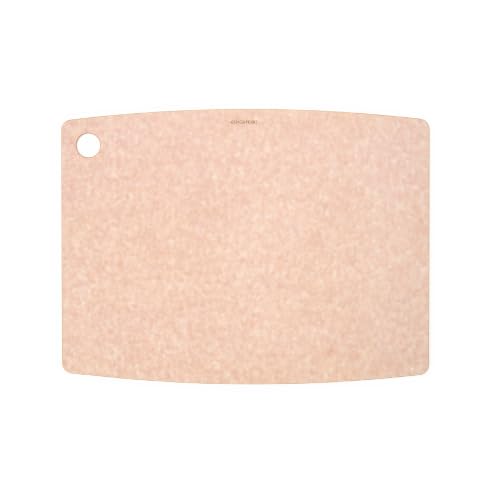
Epicurean lists the Kitchen Series as “Paper Composite,” and its FAQ says the boards are a “durable thermoset composite of” paper and resin, “permanently fused under high heat and pressure.” The FAQ does not name the type of resin. Epicurean lists it as “Microplastics Free”; our Epicurean Kitchen Series review covers the supplier’s resin documents and the lab report behind that wording.
Dishwasher and heat. The FAQ says “The products are dishwasher safe” and that the material is “heat resistant up to 350°F.” For drying, Epicurean says “We recommend all boards to be stored on its side (versus flat on a surface) to dry.” It adds that “Minor warping may occur from time to time” and that in most cases warping “may either self-correct” or can be remedied.
Knives. Epicurean says its boards are knife safe and that “Score marks demonstrate that your board is working as intended.” Expect a surface that scars with use. When it does, Epicurean suggests that you “sand a dry board lightly with 220-grit sandpaper.”
Warranty. Epicurean’s warranty covers defects in material and workmanship “for the lifetime of the product.”
Size. The 17.5 x 13 inch size is the largest Kitchen Series size and is the right pick for raw-meat prep and carving. If you want a smaller raw-meat board, Epicurean also sells 8 x 6, 11.5 x 9 and 14.5 x 11.25 inch sizes, which our spotlight explains.
What Is the Teakhaus Board Made Of?
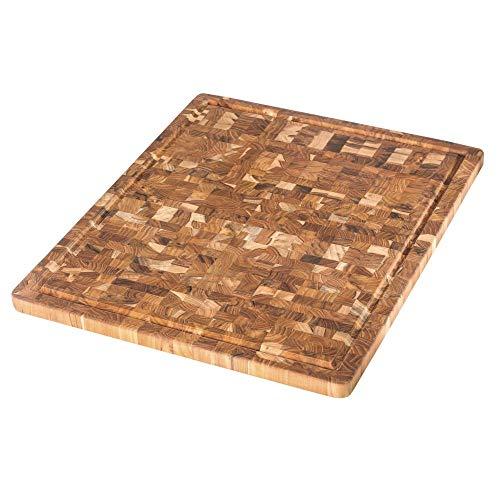
Teakhaus calls this model the “Thin & Lightweight End Grain Cutting Board (L) 802,” 18 x 14 x 1 inches and 4 lb. End grain means the wood fibers stand perpendicular to the cutting surface, which Teakhaus’s FAQ describes as the grains being “perpendicular to the cutting surface, and not parallel as in ordinary cutting boards.”
- Wood: teak. Teakhaus’s FAQ says the wood is transported to its Vietnam facility for manufacture.
- Finish: the product page says “Pre-oiled and ready to use” and that the boards are coated with “a mixture of mineral oil and natural beeswax.”
- Glue: the product page for this model does not name the adhesive. Teakhaus’s FAQ names its board adhesive as KOYOBOND, a water-based polymer-isocyanate, which “does not contain formaldehyde or volatile organic compounds (VOC).”
Knives. The product page says “The checkerboard surface is gentle on knives and self-healing.”
Care. The page says “Non dishwasher-safe,” “Hand wash, towel dry,” and to apply Teakhaus oil or food-grade mineral oil “at least two or three times a month.” It also says non microwave-safe and non oven-safe. Teakhaus’s one-year replacement does not cover an Amazon purchase: its Warranty Policy excludes “Products purchased out of teakhaus.com , such as retail stores, other e-commerce, marketplaces, or Amazon.” For an edge-grain teak board in the larger 20 x 15 inch size, see our Teakhaus teak board guide.
What Is the Boardsmith Sidekick Made Of?
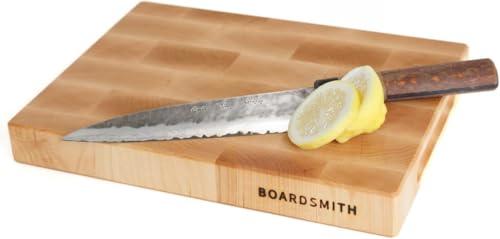
The Boardsmith’s product page describes the Sidekick as “solid hardwood,” 9 x 12 x 1 3/8 inches and 3 lb, with maple among the wood options. The maple board on Amazon is the one linked below. Every board is “hand-assembled in our Frisco workshop.”
- Glue: the page says the wood is joined with a “professional-grade, waterproof adhesive that is FDA-approved for indirect food contact.” It does not name the adhesive.
- Finish: “We finish every board by hand with food-safe oil and Board Butter.” The maker’s care page says “your board was submerged in a mineral oil bath and buffed with a heavy coat of Board Butter (a mixture of mineral oil and beeswax).”
Care. The care page says to scrub with warm water and a small amount of dish detergent, “dry immediately,” and oil “once a week for the first month, then once a month for the next few months,” then as needed. It recommends USP mineral oil and warns that less refined oils “will go rancid over time.” The product page says the board can be “sanded down and re-oiled over time.”
Dishwasher and warranty. Boardsmith’s FAQ answers the dishwasher question with “Absolutely no.” and says “putting your board in the dishwasher will void your warranty.” Its Our Guarantee page says each board is “warrantied to be free from defects in material and workmanship for a period of 60 days from the date of receipt.”
Wood or Paper Composite: Which Is Better for Knives and Cleaning?
Choose paper composite if you run the dishwasher daily and want no upkeep. Choose end-grain wood if you want a thick board that cuts softly and that you can sand and re-oil. In wood you trade the dishwasher for hand washing and regular oiling. USDA FSIS says that “Nonporous surfaces are easier to clean than wood,” yet also that consumers “may use wood or a nonporous surface for cutting raw meat and poultry.”
On plastic, a 2023 study in Environmental Science & Technology, “Cutting Boards: An Overlooked Source of Microplastics in Human Food?,” identified “plastic chopping boards as a substantial source of microplastics in human food.” The study tested polyethylene and polypropylene boards, not these three. Keep it in proportion: FDA says “Current scientific evidence does not demonstrate that levels of microplastics or nanoplastics detected in foods pose a risk to human health.” Our guide to microplastics at home covers where else they appear.
How Should I Use and Clean Cutting Boards Safely?
This is the guidance that matters more than the material. USDA’s Food Safety and Inspection Service says to “consider using one cutting board for fresh produce and bread and a separate one for raw meat, poultry, and seafood.” It explains that this “will prevent bacteria on a cutting board that is used for raw meat, poultry, or seafood from contaminating a food that requires no further cooking.”
For cleaning, FSIS recommends “washing them with hot, soapy water after each use; then rinse with clear water and air dry or pat dry with clean paper towels.” It also says that “Once cutting boards become excessively worn or develop hard-to-clean grooves, they should be discarded.” Its page is the USDA FSIS cutting boards guide. Teakhaus’s FAQ gives the same habit, to use “one for raw meat, and another for vegetables,” which is the pairing recommended above.
Which Size Should I Pick?
- 18 x 14 inch Teakhaus: enough room for a whole meal’s prep, and at 4 lb you can lift it into the sink.
- 17.5 x 13 inch Epicurean: the large raw-meat and carving board. Check that it fits your dishwasher rack.
- 9 x 12 inch Boardsmith: a lemon, a shallot, cheese or bread. Too small to be the only board in a kitchen.
Our Picks
See the Teakhaus end-grain teak cutting board, 18 x 14 inch, on Amazon →
See the Epicurean Kitchen Series cutting board, 17.5 x 13 inch, Natural, on Amazon →
See the Boardsmith Maple Sidekick end-grain cutting board, 9 x 12 inch, on Amazon →
Frequently Asked Questions
What is the best non toxic cutting board?
For most kitchens, a Teakhaus end-grain teak board for everyday use plus an Epicurean paper composite board for raw meat covers both wood and dishwasher cleaning. Choose by material and finish, as the makers describe them.
Is a wooden cutting board better than plastic?
USDA FSIS says consumers may use wood or a nonporous surface for raw meat and poultry. Wood needs hand washing and oiling; FSIS says nonporous surfaces are easier to clean than wood.
Can an Epicurean board go in the dishwasher?
Yes. Epicurean’s FAQ says the products are dishwasher safe. Epicurean recommends storing boards on their side to dry.
Can I put a Teakhaus or Boardsmith board in the dishwasher?
No for both. Teakhaus says “Non dishwasher-safe,” and Boardsmith’s FAQ says “Absolutely no” and that a dishwasher will void the warranty.
What are the Teakhaus and Boardsmith boards finished with?
Teakhaus says a mixture of mineral oil and natural beeswax. Boardsmith’s care page says a mineral oil bath and Board Butter, a mixture of mineral oil and beeswax.
What glue holds these boards together?
Epicurean describes its boards as a thermoset composite of paper and resin, permanently fused under high heat and pressure, with no separate glue described. Teakhaus’s FAQ names KOYOBOND, a water-based polymer-isocyanate adhesive. Boardsmith describes a waterproof adhesive that is FDA-approved for indirect food contact.
How often do I oil an end-grain board?
Teakhaus says at least two or three times a month. Boardsmith says weekly for the first month, then monthly for a few months, then as needed.
Do I need two cutting boards?
USDA FSIS says to consider one board for fresh produce and bread and a separate one for raw meat, poultry and seafood. A wooden board plus an Epicurean is an easy way to do that.
When should I replace a cutting board?
USDA FSIS says that once boards become excessively worn or develop hard-to-clean grooves, they should be discarded.
This article contains affiliate links. NonToxicFinder (Solved Labs LLC) may earn commissions on qualifying purchases at no extra cost to you. We are not affiliated with, endorsed by, or partnered with the Environmental Working Group or any certification program.