Affiliate Disclosure: This article contains affiliate links. NonToxicFinder (Solved Labs LLC) may earn commissions on qualifying purchases at no extra cost to you. We are not affiliated with, endorsed by, or partnered with the Environmental Working Group or any certification program.
Pyrex and Anchor Hocking both make glass containers with plastic lids, so what touches your food is glass plus a lid, and the lid is where the rules differ. Buy the Anchor Hocking TrueSeal set if you want a shelf of containers for meal prep: Anchor Hocking says its glass goes in the oven up to 425°F and backs food storage with a 5-year limited warranty. Buy the Pyrex 7-cup if you want one big bowl for soup, salad or leftovers: Pyrex calls the glass tempered and the lid BPA-free plastic.
Which Is Better, Pyrex or Anchor Hocking?
Every row comes from the makers' own pages: Pyrex's 7-cup product page and use-and-care page, and Anchor Hocking's TrueSeal page, Care & Use page and FAQ. Anchor Hocking publishes one care page for all its glass food storage and no page for the exact set we link, so its rows describe the line.
| Pyrex 7-cup | Anchor Hocking TrueSeal | |
|---|---|---|
| Glass: oven | Per the use-and-care page, preheated conventional and convection ovens, no temperature given; the 7-cup product page does not list oven use | Pre-heated ovens up to 425°F |
| Glass: microwave | Yes | Yes, microwave ovens without a browning element |
| Glass: freezer | Yes; not straight to a hot oven | Yes; not straight to a pre-heated oven or microwave |
| Glass: dishwasher | Yes | Yes; wash glass and lids in the dishwasher before first use |
| Lid: oven | No | Not intended for the oven |
| Lid: microwave | Yes; remove or vent at least ¼ inch | Yes for reheating; leave a gap, no more than 60 seconds |
| Lid: freezer | Yes | Yes |
| Lid: dishwasher | Top rack | Top rack |
| Warranty | 2-year limited, glass container and plastic lid | 5-year limited, food storage |
What Are the Glass and the Lid Made Of?
The glass. Pyrex's product page calls the 7-cup a “tempered glass bowl” and says it “does not absorb food odors or flavors.” Anchor Hocking's TrueSeal page says its glass is “oven, microwave, dishwasher, refrigerator & freezer safe.” The TrueSeal page does not name the glass type. Anchor Hocking's Bakeware Facts page describes its glass bakeware as tempered soda-lime-silicate and lists Food Storage among the products it covers. Pyrex's pages say only “tempered.” Treat each maker's heat rules as the limit.
The lid. Pyrex says the 7-cup's lid is “BPA-free plastic” that is “top-rack dishwasher, freezer and microwave safe.” Anchor Hocking's TrueSeal page says its lids “have clear windows for viewing & are BPA free,” and its FAQ answers “Yes, and also CA Prop 65 compliant” to “Are your plastic lids BPA free?” Neither maker names the plastic.
Seals and airtightness. Neither the Pyrex 7-cup page nor the TrueSeal page describes a gasket or seal ring. Pyrex's use-and-care page says, “If lid includes a removable seal, DO be sure it is securely in place to prevent leaks during transport and storage.” Pyrex's 7-cup page lists a “Secure lid for taking on-the-go” and an “airtight lid,” while in its instructions for its insulated carrying case Pyrex says “Plastic lids are not airtight. Overfilled dishes or liquid from foods may leak.” Anchor Hocking's TrueSeal page says the containers are “Designed to prevent spills & leaks” and is among its containers for “marinades, sauces,” and other food prep, and its care page says to press the center of a TrueSeal lid to remove excess air when sealing. Our view: for soup or sauce in a lunch bag, test a sealed container upside down over the sink first, or use stainless.
What Anchor Hocking says is not in them. Anchor Hocking's FAQ answers “Yes, and also CA Prop 65 compliant” when asked whether its products are lead, cadmium and heavy metal free. The Pyrex pages read say nothing about lead, cadmium or heavy metals.
What Else Do the Makers Warn About?
- Not on a flame or in countertop appliances. Both say no to a stovetop, broiler or grill. Anchor Hocking adds the toaster oven. Pyrex's list is longer: “toaster, countertop oven, multi-cooker, electric pressure cooker, air fryer, slow cooker/crockpot, rice cooker or grilling appliance.”
- Preheat. Pyrex says not to insert glassware “until the oven has been preheated to the desired temperature,” and says “permanent discoloration may occur if decorated glass storage is used in oven,” a warning that applies to decorated glass only.
- Empty glass. Both say not to heat the glass empty or nearly empty in the microwave, or to overheat oil or butter.
- Freezer. Anchor Hocking: “do not take directly from freezer to pre-heated oven or microwave. Thaw food before cooking or reheating.” Pyrex: “DO NOT transfer directly from freezer to hot oven.”
- Lid in the microwave. Anchor Hocking: “Sealing the cover may create excessive pressure causing the cover to melt, warp or cause personal injury.” It says to open the cover away from your body to avoid steam burns.
- Staining. Pyrex says to “use care with tomato and acidic sauces that can stain plastic lids.” Anchor Hocking adds “Do not overfill or cover will not fit properly.”
How Do You Avoid Cracking the Glass?
Both makers say glass can fail from sudden temperature change, and both say a failure can come later. Pyrex opens its warnings with “FAILURE TO FOLLOW THE WARNINGS BELOW MAY RESULT IN PERSONAL INJURY OR PROPERTY DAMAGE, OR MAY CAUSE YOUR ITEM TO BREAK OR SHATTER IMMEDIATELY OR LATER.” Anchor Hocking's care page says misuse can cause “the product to suddenly fracture into many small pieces.”
- Hot glass. Pyrex: “DO NOT add liquid to hot glassware or ceramicware, place these hot items on a wet or cool surface, or handle these hot items with a wet towel, wet potholder or other wet cloth.” Anchor Hocking: “Do not add liquid to a hot dish. Handle hot dishes with a dry cloth or potholder. Never place hot dish on wet or cold surfaces.”
- Cooling. Pyrex says to “allow hot glassware and ceramicware to cool on a cooling rack, dry potholder or dry cloth” and “to cool before washing, refrigerating or freezing.”
- Damage. Pyrex: “DO NOT use or repair if broken, chipped, cracked or severely scratched.” Anchor Hocking: “Do not use if chipped, cracked, or noticeably scratched,” and says scratches from certain cleaning materials and utensils “can weaken glassware causing unexpected breakage immediately or at a later date.”
- Cleaning. Pyrex says not to clean with hard objects such as metal and to use plastic or nylon pads if scouring is needed. Anchor Hocking says to use plastic or nylon non-scratch pads.
How Should You Store and Reheat Leftovers?
The USDA's Food Safety and Inspection Service says: “Within 2 hours of cooking food or after it is removed from an appliance keeping it warm, leftovers must be refrigerated.” For cooling, it says to “divide large amounts of food into shallow containers.” It also says “Hot food can be placed directly in the refrigerator or be rapidly chilled in an ice or cold water bath before refrigerating.” Pyrex's separate rule is the one quoted above, to let hot glassware cool before refrigerating or freezing. Our suggestion for meeting both: divide the food into several shallow containers so it cools faster, and set any glass that has been heated on a dry rack or cloth so it is cool well inside the 2-hour window.
On storage time, FSIS says “Leftovers can be kept in the refrigerator for 3 to 4 days or frozen for 3 to 4 months.” On reheating, it says “When reheating leftovers, be sure they reach 165° F as measured with a food thermometer,” and for the microwave: “Be sure the covering is microwave safe, and vent the lid or wrap to let the steam escape.”
How Does Glass Compare With Plastic and Stainless Steel?
Glass is the container you can reheat in without a plastic wall around the food, but the lid is still plastic, so a glass set is a mix. Our guide to swapping plastic food storage for glass or stainless steel covers what pediatricians and regulators say about heat and plastic, and compares glass with stainless containers. For a lunch bag, our comparison of stainless steel lunch boxes shows what touches the food in each, and the makers there say not to microwave them. For what BPA is and how to read a plastic label, see our explainer on BPA and where it hides.
Who Should Buy the Anchor Hocking TrueSeal?
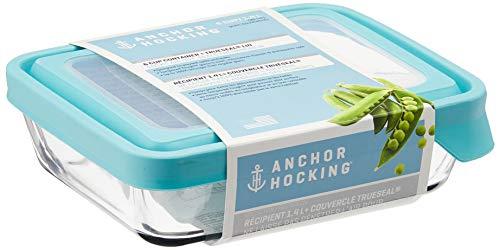
Anchor Hocking describes TrueSeal as glass containers with clear-window lids, in a line it says comes in “a variety of stackable shapes and sizes and multiple lid colors including red, white, light blue, and purple.” It also sets a 60-second limit on reheating the cover. Its pages list no sizes or set counts. The listing we link is a pack of four 6-cup (48 oz) containers, per the Amazon listing, so it suits several portions at once. Skip it if you want an oven rating stated for the exact set, since Anchor Hocking's pages describe the line, not this set.
See the Anchor Hocking TrueSeal Glass Food Storage Containers (6 cup, pack of 4) on Amazon →
Who Should Buy the Pyrex 7-Cup?
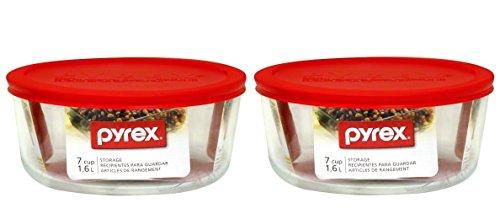
The Pyrex page we read describes the single 7-cup container; the Amazon link is a 2-pack that the Amazon listing gives as the same model. It is 7.5 inches across and 3.25 inches high, and Pyrex lists its weight as 32.5 ounces. Its capacity is 7 cups, enough for a pot of soup or a family salad, and the weight matters if you carry it. Choose it when one big container beats several small ones: a batch of soup, a large salad or a casserole of leftovers. Skip it for carrying soup in a bag, given Pyrex's carrying-case line quoted above. The warranty text says Pyrex will replace glass that breaks from oven heat, provided you followed its safety and usage instructions.
See the Pyrex 7-Cup Glass Bowl with Red Lid (2-pack) on Amazon →
Frequently Asked Questions
Which is better for glass food storage, Pyrex or Anchor Hocking?
For a set of containers, Anchor Hocking TrueSeal; for one large bowl, the Pyrex 7-cup.
Can you microwave glass food storage containers with the lid on?
Only with the lid vented or gapped, per both makers.
Can glass food storage containers go from the freezer to the oven?
Not directly. Pyrex says “DO NOT transfer directly from freezer to hot oven,” and Anchor Hocking says “Thaw food before cooking or reheating.”
Can the lids go in the oven?
Pyrex says “DO NOT use plastic or wood lids in a conventional or convection oven.” Anchor Hocking says covers are “not intended for conventional oven” use.
What is the glass made of?
Pyrex calls the 7-cup glass tempered; Anchor Hocking's TrueSeal page does not name it.
How long do leftovers keep in glass containers?
FSIS says 3 to 4 days in the refrigerator or 3 to 4 months frozen.
Are glass food storage lids dishwasher safe?
Yes, on the top rack, per both makers.
Affiliate Disclosure: This article contains affiliate links. NonToxicFinder (Solved Labs LLC) may earn commissions on qualifying purchases at no extra cost to you. We are not affiliated with, endorsed by, or partnered with the Environmental Working Group or any certification program.