Affiliate Disclosure: This article contains affiliate links. NonToxicFinder (Solved Labs LLC) may earn commissions on qualifying purchases at no extra cost to you. We are not affiliated with, endorsed by, or partnered with the Environmental Working Group.
For most kids from about 3 to 8, the PlanetBox Rover is the stainless steel lunch box to buy. PlanetBox says its tray is 18/8 stainless steel and its hinged lid is 18/0 stainless steel, so nothing but steel touches the food in the five compartments; the only non-steel food-contact part is the silicone top on each of its two dip cups. Older or hungrier kids fit the PlanetBox Launch, built the same way with 6.5 cups of space and room for a whole sandwich. Neither box is leakproof. If your child's lunch is mostly wet food, you need a box with a sealed silicone lid, and the comparison below shows which ones and what they trade.
Six Stainless Steel Lunch Boxes Compared
Every fact in this table comes from the maker's own product page or FAQ. Prices for the three boxes we link are in the product cards below.
| PlanetBox Rover | PlanetBox Launch | PlanetBox Voyager | LunchBots Large Trio | Bentgo Kids Stainless Steel | U-Konserve Rectangle 25 oz | |
|---|---|---|---|---|---|---|
| Touches food | 18/8 steel tray, 18/0 steel lid; dip cups 18/8 steel with silicone tops | 18/8 steel tray, 18/0 steel lid; dip cup 18/8 steel with silicone top | Recycled stainless steel base, silicone lid | 18/8 steel, including the lid | 18/8 steel tray and lid, silicone seal, removable silicone cup | 304 (18/8) steel, silicone lid |
| Compartments and capacity | 5; about 4.5 cups, plus 1-cup and 1/3-cup dip cups | 3; about 6.5 cups, plus a 1/3-cup dip cup | 4 sealed; 4 cups | 3; a full sandwich and two sides | 3, about 4 cups, plus a 2/3-cup silicone cup | 1; 25 oz |
| Leakproof? | No; the dip cups are | No; the dip cup is | Yes, per PlanetBox | No; dry foods only | Leak-resistant seal, per Bentgo | Leak-resistant lid, per U-Konserve |
| Outside size | 10 x 7.4 x 1.5 in | 10.3 x 7.7 x 2 in | 7.5 x 7.5 x 2 in | 8 x 6 x 1.75 in | 9.8 x 7.6 in | 7.75 x 5 x 1.75 in |
| Empty weight | 1.6 lb | 1.5 lb | 0.91 lb | Not listed | 1.6 lb | Not listed |
| Dishwasher | Yes; take the magnets off | Yes; take the magnets off | Yes | Yes | Top rack; hand washing recommended for the seal | Yes |
| Ages, per maker | 3 and up | 3 and up | 8 and up | All ages | 3 and up | Not given |
Which Box to Buy for Your Kid
- Preschool to about third grade, a grazer or picky eater: the Rover. Its five small wells (the main one is 4 x 4 x 1.5 inches) suit a little of this and a little of that, and the two dip cups take the wet foods. PlanetBox recommends its single-latch boxes for ages 3 and up.
- Older elementary or middle school, or a big eater: the Launch. Its main compartment is 6.75 x 4.5 x 2 inches, big enough for a whole sandwich, and PlanetBox says it holds 30% more than the Rover.
- A child who packs yogurt, saucy pasta or cut fruit most days: a sealed lid matters more than compartments. PlanetBox's Voyager has a silicone lid that seals each of its four compartments, and PlanetBox recommends it for ages 8 and up. For a younger child, Bentgo's Kids Stainless Steel box has a steel lid with a silicone seal, and Bentgo says it suits ages 3 and up. In both, silicone touches the food along the seal.
- You want nothing but steel against the food: the LunchBots Large Trio says it is "100% stainless steel interior, including the lid." LunchBots also says it is not leakproof and recommends dry foods only.
- One main dish, leftovers from home, or a tight budget: the U-Konserve 25 oz container costs far less than a PlanetBox kit and doubles as a freezer container. It has no compartments, so pair it with a dip cup or a small container for sides.
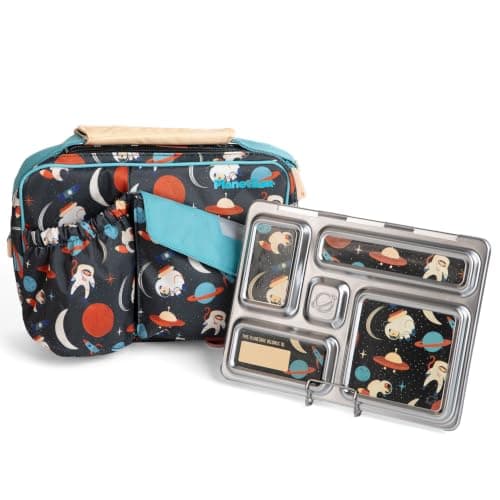
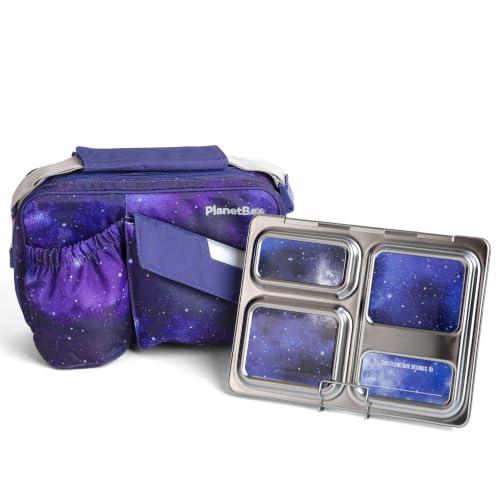
The PlanetBox Rover and Launch kits we link on Amazon come in printed editions (Space Animals and Stardust); the box, lid and dip cups are the same models PlanetBox describes on its own pages.
What Touches the Food, Part by Part
Tray and lid. "18/8" is a stainless steel grade, also sold as type 304: about 18% chromium and 8% nickel. "18/0" (type 430) has almost no nickel. PlanetBox uses 18/8 for its trays and 18/0 for its lids, and says the lower-nickel 400 series holds its decorative magnets better but is too hard to form into deep wells. So no box here is nickel-free. PlanetBox also says its lunch boxes are built without solder and that its steel has no coatings.
Silicone parts. Silicone is where most stainless boxes put their seal. On the Rover and Launch it is limited to the dip-cup tops. On the Voyager it is the whole lid, on the Bentgo it is the seal around each compartment plus the removable cup, and on the U-Konserve it is the lid, which the company calls "platinum-grade silicone" and "plastic-free." The LunchBots Trio has no silicone; its optional colored "Dots" cover is plastic and snaps onto the outside of the steel lid.
What the makers say is not in them. PlanetBox says its lunch boxes are "free from lead, PVC, phthalates or BPA material." U-Konserve lists "No BPA, BPS, phthalates, or lead." Bentgo calls its Kids stainless box BPA-free.
The bag. The insulated bag holds the closed box, so food does not sit against it. For its own Adventurer bag, PlanetBox lists recycled PET fabric outside, recycled PET with a TPU coating inside, and polyethylene foam insulation, and says the bag fits every PlanetBox box.
Is Stainless Steel Better Than a Plastic Bento Box?
It is different, and the differences are practical. A stainless box puts no plastic against the food (silicone seals aside), and it is built to last: PlanetBox warrants its steel boxes for five years. In exchange it costs more, weighs more (a Rover kit with its bag, dip cups and magnets weighs about 2.6 pounds, per PlanetBox), and it cannot go in the microwave. A plastic bento such as Bentgo's original Kids box is lighter and cheaper, and Bentgo says its removable tray can be microwaved. Bentgo's page names that box's materials only as "FDA-approved, food-safe materials (No BPA, Vinyl, Lead, or PVC)," without saying which plastic.
On the chemical question, the regulator's view is narrower than many parents expect. The FDA says that, based on its most recent safety assessment, BPA "is safe at the current levels occurring in foods" in its approved uses in food containers and packaging. The FDA no longer allows BPA-based polycarbonate in baby bottles and sippy cups, but it says that change was made because manufacturers had stopped the use, not on safety grounds. So the case for stainless is a preference for less plastic in contact with food, not a regulatory finding against plastic boxes. Our explainer on what BPA is and how to read a plastic label covers the plastics side, and our look at where microplastics turn up at home covers the other reason families give for switching.
Leaks, Backpacks and Keeping Lunch Cold
Leaks. PlanetBox says plainly that the Rover, Launch and Shuttle "are not airtight or leak-proof." PlanetBox says they are designed to keep foods separated in transport, not to hold liquids. PlanetBox's fix is to put yogurt, dips and sauces in the dip cups, which it calls leakproof. The Voyager and the Explorer are PlanetBox's leakproof boxes. Bentgo and U-Konserve describe their seals as leak-resistant, and LunchBots says to pack its Trio with dry foods.
Backpack fit. The Rover and Launch are about 10 inches long, 7.5 inches wide and 1.5 to 2 inches deep, and they lie flat. That is too long for some small kids' lunch bags, so measure the inside of the bag you already own. PlanetBox's own carry bags are made to fit them. The Voyager (7.5 inches square), LunchBots Trio (8 x 6 inches) and U-Konserve (7.75 x 5 inches) are smaller, and PlanetBox calls the Voyager "lunch bag-friendly."
Keeping it cold. None of these boxes is insulated. The CDC says bacteria multiply fastest between 40°F and 140°F and that perishable food should not sit out for more than 2 hours, or 1 hour above 90°F. A school lunch is packed hours before it is eaten, so the cold has to come with it. PlanetBox suggests packing the box the night before and chilling it in the fridge (magnets off), then putting it in an insulated bag with one ice pack on top and one underneath. For a hot lunch, PlanetBox says its lunch boxes are not designed to hold heat and food will reach room temperature by lunchtime; an insulated food jar is the tool for that.
Small parts. PlanetBox's care notes say its kits contain small parts and are not intended for children under 3, which matters for the magnets.
Washing and Care
- Dishwasher: all six makers say their steel parts can go in the dishwasher. Bentgo says top rack and recommends hand washing to keep its seal in good shape.
- PlanetBox magnets come off first. PlanetBox says wet magnets degrade and make the lid rust. Dry the box completely before putting them back, and store them on the fridge over school breaks.
- Soap: PlanetBox recommends a mild soap without phosphates or chlorine bleach. It says bleach can pit stainless steel, and washing it next to carbon-steel knives or rusty pans can leave rust spots.
- Spots or rust: PlanetBox suggests super fine steel wool (#000), a baking soda paste left for an hour, or salt and fresh lemon juice left for about two hours. It says scratches and dulling are normal on uncoated steel.
- Smelly or moldy silicone: PlanetBox suggests soaking silicone parts overnight in diluted white vinegar, or for 24 hours in 3% hydrogen peroxide, then washing in hot, soapy water.
- No microwave. PlanetBox (apart from the Explorer's removable tray) and U-Konserve both say not to microwave their boxes. U-Konserve's steel container can go in the oven up to 300°F, but not its lid.
- The bag: PlanetBox says to wipe or gently wash its bags and dry them fully to prevent mold, and to take the ice pack out soon after lunch.
PlanetBox Rover: The Pick for Most Kids
The Rover's specifications page lists "18/8 (304) stainless steel for the lunch box tray and 18/0 (430) stainless steel for the lunch box lid," with dip-cup bowls in 18/8 steel and "silicone for the Dipper top." Its five wells hold about 4.5 cups, and the set includes a 1-cup and a 1/3-cup dip cup. PlanetBox backs the steel with a five-year warranty and sells replacement latches. The trade-offs are weight, a footprint too long for some small bags, and a lid that will not hold liquids without the dip cups.
See the PlanetBox Rover Stainless Steel Lunch Box Set (Space Animals) on Amazon →
PlanetBox Launch: For Bigger Appetites
The Launch uses the same materials: an 18/8 steel tray (51% recycled, per PlanetBox), an 18/0 steel lid, and a tall 18/8 steel dip cup with a silicone top. Three larger compartments hold about 6.5 cups, and the 2-inch depth fits a whole sandwich. It weighs a little less than the Rover empty. Like the Rover, it is not leakproof outside the dip cup.
See the PlanetBox Launch Stainless Steel Lunch Box Set (Stardust) on Amazon →
U-Konserve Rectangle 25 oz: One Container, Many Uses
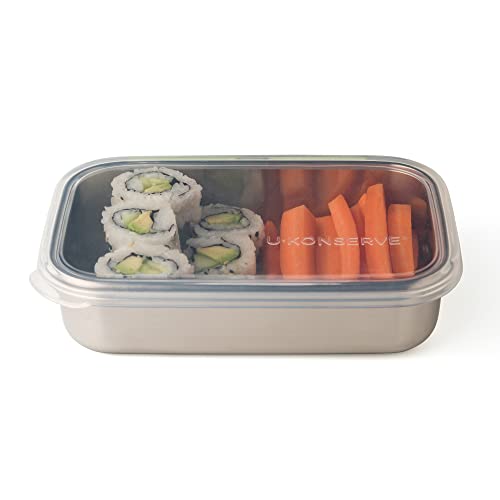
U-Konserve lists this container as "304 (18/8) Stainless Steel" with a "Platinum-Grade Silicone" lid, free of "BPA, BPS, phthalates, or lead." It is a single open compartment of 25 ounces, 7.75 x 5 x 1.75 inches with the lid on, with a flexible lid U-Konserve calls leak-resistant. It goes in the dishwasher and freezer, and the steel can go in the oven up to 300°F without its lid. It is the least expensive box here and the one most likely to fit any lunch bag, but it comes with no bag, no ice pack and no dividers. It also works as a leftovers container at home, which our guide to swapping plastic food storage for glass and stainless covers.
See the U-Konserve Rectangle Stainless Steel Container, 25 oz, on Amazon →
The Rest of the Lunch
For a water bottle to go with the box, our back-to-school bottles and lunch gear roundup covers stainless bottles, and our explainer on NSF/ANSI 42 vs. 53 for kids' water bottles sorts out filter bottles. If you pack sandwiches or snacks in bags, our guide to reusable silicone sandwich bags compares the main brands. If the drink goes in a cup with a straw, our guide to stainless steel straws from Klean Kanteen explains what touches the liquid. And for steel at the table at home, see our look at the Ahimsa stainless steel kids' plate.
Frequently Asked Questions
Which stainless steel lunch box is best for a young child?
For most kids from about 3 to 8, the PlanetBox Rover: five small compartments, a steel tray and steel lid, and two dip cups for wet foods. If the lunch is mostly wet, choose a sealed-lid box such as the Bentgo Kids Stainless Steel instead.
Is any plastic touching the food in a PlanetBox?
No. PlanetBox lists the Rover and Launch trays as 18/8 stainless steel and the lids as 18/0 stainless steel. The only non-steel part that touches food is the silicone top on each dip cup.
Are PlanetBox lunch boxes leakproof?
The Rover, Launch and Shuttle are not, PlanetBox says; pack wet foods in their dip cups, which are leakproof. PlanetBox's Voyager and Explorer have sealed lids and are leakproof.
What is the difference between 18/8 and 18/0 stainless steel?
18/8 (type 304) contains about 18% chromium and 8% nickel. 18/0 (type 430) has almost no nickel and is magnetic, which is why PlanetBox uses it for its lids, where the decorative magnets go.
Can you put a stainless steel lunch box in the microwave?
No. PlanetBox and U-Konserve both say not to microwave their boxes. The one exception is the removable tray in PlanetBox's Explorer. If your child reheats lunch at school, a plastic bento tray or a microwave-safe container is the practical choice.
How do I keep food cold in a stainless steel lunch box?
Chill the packed box overnight, then carry it in an insulated bag with an ice pack above and below it, as PlanetBox suggests. The CDC says perishable food should not sit between 40°F and 140°F for more than 2 hours.
Affiliate Disclosure: This article contains affiliate links. NonToxicFinder (Solved Labs LLC) may earn commissions on qualifying purchases at no extra cost to you. We are not affiliated with, endorsed by, or partnered with the Environmental Working Group.