This article contains affiliate links. NonToxicFinder (Solved Labs LLC) may earn commissions on qualifying purchases at no extra cost to you. We are not affiliated with, endorsed by, or partnered with the Environmental Working Group.
An under sink reverse osmosis water filter is usually the next step for a parent who has already tried a pitcher, checked a result like PFAS or lead in their tap water, and decided they want a permanent system at the kitchen sink instead of refilling a pitcher every day. The box on most of these units says "NSF certified" somewhere, but that phrase alone does not tell you much, and "reverse osmosis" on the label does not always mean the unit actually contains an RO membrane. NSF/ANSI 58 is the standard written specifically for reverse osmosis systems. We checked six widely sold under-sink units against each manufacturer's own certification page and spec sheet, and dropped one popular compact model from this list entirely once we confirmed it has no RO membrane, drain line, or storage tank at all, which means it is a carbon filter, not a reverse osmosis system, regardless of how it is marketed. The five systems below all use an RO membrane and are each independently certified to NSF/ANSI 58.
Why Families Move From a Pitcher to Under-Sink RO
A pitcher filter works fine for one or two people who remember to refill it, but it has real limits: a fixed reservoir, a filter that needs replacing every month or two, and contaminant coverage that depends entirely on which pitcher you bought. An under-sink reverse osmosis system installs permanently below the kitchen sink and delivers filtered water on demand through its own dedicated faucet, with no daily refilling and, in most cases, a wider certified contaminant list than a pitcher achieves. The tradeoff is cost and installation: RO systems run $40 to $850 depending on capacity and features, versus $25 to $110 for a pitcher, and most benefit from at least basic plumbing comfort to install.
What NSF/ANSI 42, 53, and 58 Actually Certify on an RO System
NSF/ANSI 58 is the standard written specifically for point-of-use reverse osmosis systems. A unit certified to NSF/ANSI 58 has been independently tested to demonstrate reduction of total dissolved solids (TDS) and whatever additional contaminants the manufacturer submitted for testing, which can include lead, arsenic, fluoride, or other dissolved substances depending on the model's specific certified claims list. NSF/ANSI 58 certification is not automatic just because a product uses an RO membrane; the manufacturer has to submit the exact model to NSF (or an equivalent accredited certifier) and pass.
NSF/ANSI 42 is a separate standard that covers aesthetic effects only: chlorine taste, odor, and similar non-health claims. It does not certify reduction of lead, PFAS, or other health-related contaminants. A unit can be legitimately "NSF certified" and only hold NSF/ANSI 42, with no NSF/ANSI 58 testing behind it at all. NSF/ANSI 53 is a third standard, more common on pitchers and pod-format filters, covering specific health-effects contaminants including lead; it is not universal on RO systems and should not be assumed present just because a unit is RO-based.
A fourth number you will see alongside 58 on some of these units is NSF/ANSI 372, which certifies that the product's own materials are lead-free. That is a materials standard, not a performance or contaminant-reduction standard, so it does not add filtering capability on top of whatever the unit is separately certified to reduce under 58. The Environmental Working Group does not evaluate or certify specific water filter products of any kind, including reverse osmosis systems; the certifications that apply here come from NSF, not EWG. For the full breakdown of what each numbered standard covers, see our explainer on NSF/ANSI 42, 53, and 58.
5 Verified Under-Sink Reverse Osmosis Systems at a Glance
| System | Certified standard | Capacity | Price |
|---|---|---|---|
| APEC ROES-50 | NSF/ANSI 58 (WQA Gold Seal) | 50 GPD, tank-based | $182.73 |
| iSpring RCC7AK-BN | NSF/ANSI 58 | 75 GPD, tank-based | $198.75 |
| iSpring RCC7AK-UV | NSF/ANSI 58 | 75 GPD, tank-based + UV | $280.47 |
| Waterdrop G3P600 | NSF/ANSI 58 | 600 GPD, tankless | $439.00 |
| Waterdrop G3P800 | NSF/ANSI 58 | 800 GPD, tankless | $849.00 |
Best Overall: APEC ROES-50 5-Stage Under-Sink RO System
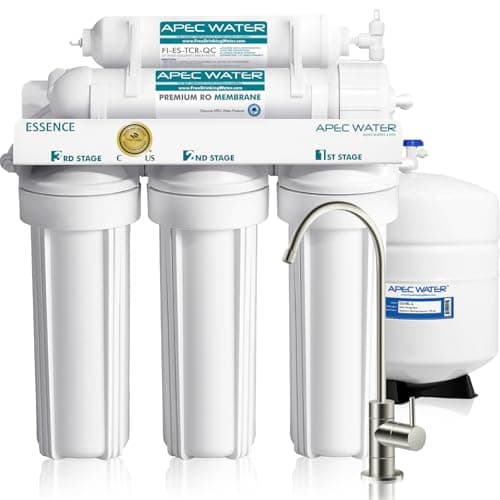
The APEC ROES-50 is certified to NSF/ANSI 58 for TDS reduction and NSF/ANSI 372 for lead-free materials, through WQA Gold Seal certification rather than a direct NSF listing. WQA (the Water Quality Association) is a separate, independent certifier that uses the same ANSI-accredited standards as NSF, which is why this model will not turn up in a search of NSF's own public database even though it holds a valid NSF/ANSI 58 certification. APEC is a long-established brand in residential RO, and the ROES-50 has been a consistent category bestseller: a 5-stage system (sediment pre-filter, two carbon block stages, RO membrane, carbon post-filter) producing 50 gallons per day into a storage tank, with a dedicated faucet included.
Certified for: NSF/ANSI 58 (TDS reduction, via WQA Gold Seal); NSF/ANSI 372 (lead-free materials, not a contaminant-reduction claim)
Format: Tank-based RO, 5-stage
Capacity: 50 GPD
Price: $182.73
APEC ROES-50 5-Stage Under-Sink RO System , Buy on Amazon ($182.73) ↗
Best for Alkaline Remineralization: iSpring RCC7AK-BN 6-Stage RO
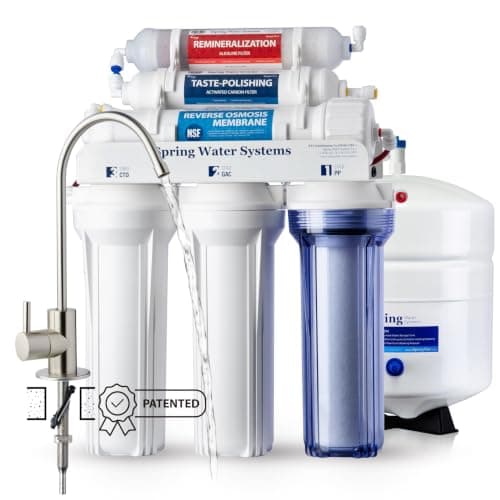
The iSpring RCC7AK-BN is certified to NSF/ANSI 58 for TDS and dissolved-solids reduction. It adds a sixth-stage alkaline remineralization filter that reintroduces calcium and magnesium after the RO membrane strips out nearly all dissolved minerals, which is what gives straight RO water its sometimes-flat taste. The system produces 75 gallons per day into a storage tank, with a top-mounted filter assembly designed for cartridge changes without crawling fully under the sink.
Certified for: NSF/ANSI 58 (TDS and dissolved-solids reduction)
Format: Tank-based RO with alkaline remineralization
Capacity: 75 GPD
Price: $198.75
iSpring RCC7AK-BN 6-Stage RO with Alkaline Remineralization , Buy on Amazon ($198.75) ↗
Best for High-Volume Households: Waterdrop G3P600 Tankless RO
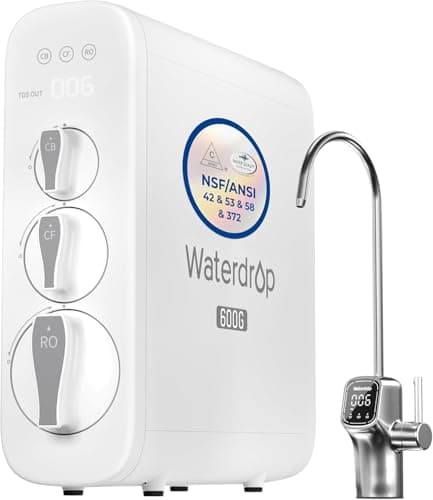
The Waterdrop G3P600 is certified to NSF/ANSI 58 for TDS reduction and separately to NSF/ANSI 372 for lead-free materials, per the manufacturer's own certification page. It is tankless, producing filtered water on demand at 600 gallons per day rather than storing it in a tank, which saves under-sink cabinet space and avoids the standing-water tradeoffs of a tank-based system. At this capacity it comfortably covers a full kitchen's drinking and cooking water without a noticeable wait at the faucet.
Certified for: NSF/ANSI 58 (TDS reduction); NSF/ANSI 372 (lead-free materials, not a contaminant-reduction claim)
Format: Tankless RO
Capacity: 600 GPD
Price: $439.00
Waterdrop G3P600 Tankless Reverse Osmosis System , Buy on Amazon ($439.00) ↗
Best with UV Sterilization: iSpring RCC7AK-UV 7-Stage RO
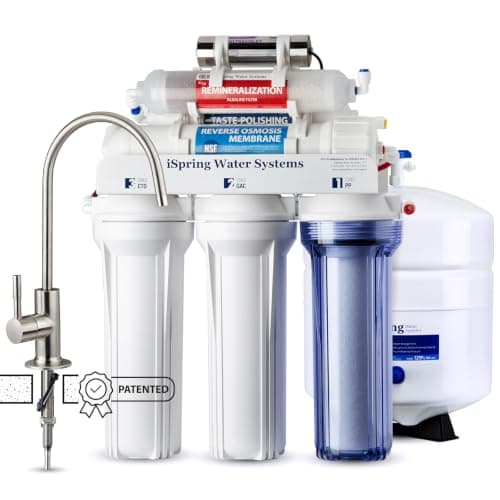
The iSpring RCC7AK-UV holds the same NSF/ANSI 58 certification as the RCC7AK-BN above, for TDS and dissolved-solids reduction, and adds an LED UV sterilization stage after the alkaline remineralization filter. UV light can deactivate bacteria and viruses that occasionally survive in a storage tank, which matters more for households on well water or with aging plumbing than for most municipal-water households. It is the same 75 GPD tank-based platform as the RCC7AK-BN, with the UV stage as the added feature.
Certified for: NSF/ANSI 58 (TDS and dissolved-solids reduction)
Format: Tank-based RO with alkaline remineralization + LED UV
Capacity: 75 GPD
Price: $280.47
iSpring RCC7AK-UV 7-Stage RO with Alkaline and UV , Buy on Amazon ($280.47) ↗
Best for Maximum Capacity: Waterdrop G3P800 Tankless RO
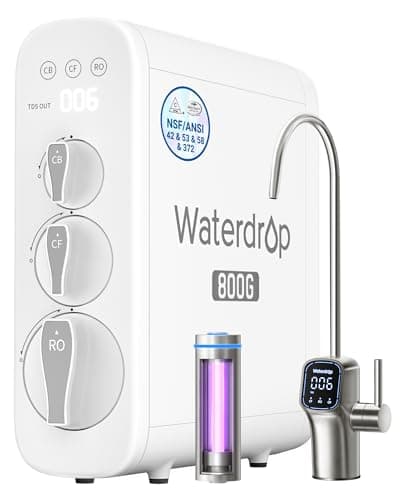
The Waterdrop G3P800 is the highest-capacity unit in this lineup, certified to NSF/ANSI 58 for TDS reduction and NSF/ANSI 372 for lead-free materials, matching the G3P600's certification basis at a larger 800 gallons per day. It is tankless, which keeps ongoing water-to-drain efficiency reasonable at this output level and avoids a bulky storage tank taking up cabinet space. This is the pick for households with the highest daily water volume, not for households simply wanting the highest certification tier, since its certified standard is the same NSF/ANSI 58 as the smaller units above.
Certified for: NSF/ANSI 58 (TDS reduction); NSF/ANSI 372 (lead-free materials, not a contaminant-reduction claim)
Format: Tankless RO
Capacity: 800 GPD
Price: $849.00
Waterdrop G3P800 Tankless RO System, 800 GPD , Buy on Amazon ($849.00) ↗
Installation and Cost Basics
Tank-based systems like the APEC and the two iSpring units above typically take one to two hours to install for someone comfortable with basic plumbing: connecting to the cold water line under the sink, mounting the dedicated faucet through the sink deck or countertop, and placing the storage tank in the cabinet. Tankless systems like the Waterdrop units skip the tank but still require the same cold-water-line connection and faucet installation. A licensed plumber typically charges $150 to $350 for a straightforward under-sink RO install, more if a dedicated drain line or additional cabinet modification is needed.
Ongoing cost comes mainly from filter replacement, not water or electricity. Sediment and carbon pre-filters are typically replaced every 6 to 12 months, and the RO membrane itself every 2 to 3 years, depending on your water's mineral content and how much water the household runs through the system. Manufacturers publish specific replacement schedules and filter-kit prices for each model; checking that schedule before buying tells you more about the real multi-year cost than the sticker price alone.
Related Reads
This is the first dedicated look at under-sink RO systems on their own; if you want the fuller picture across formats, see our broader guide to water filters for PFAS and lead, which compares pitcher, under-sink, and whole-house tiers side by side. If a permanent under-sink install is not the right fit for your kitchen, you can compare pitcher-format filters that need no installation at all. And if you want the full rundown of what every NSF/ANSI standard number actually covers before you shop, read our explainer on NSF/ANSI 42, 53, and 58. If you're still deciding between formats, see our RO-vs-pitcher comparison if a pitcher might cover your needs.
Frequently Asked Questions
Q: Does NSF certification mean the water is safe to drink?
No single "NSF certified" label makes that claim. NSF certification means a specific model was independently tested and confirmed to meet the requirements of a specific numbered standard, for specific contaminants it was tested against. NSF/ANSI 58 covers TDS and dissolved-solids reduction on RO systems; NSF/ANSI 42 covers only taste and odor. Check which standard and which contaminants apply to the exact model you are considering. The Environmental Working Group does not rate or certify water filters, so no EWG claim applies to any product in this guide.
Q: What's the difference between NSF/ANSI 42, 53, and 58?
NSF/ANSI 42 certifies aesthetic improvements like chlorine taste and odor and does not address health-related contaminants. NSF/ANSI 53 certifies specific health-effects contaminants, such as lead, and is more common on pitcher and pod-format filters than on RO systems. NSF/ANSI 58 is the standard written for reverse osmosis systems specifically, covering TDS and dissolved-solids reduction along with whatever other contaminants a given model was tested and certified for. A unit can hold one of these without holding the others.
Q: Do I need a plumber to install an under-sink RO system?
Not necessarily. Someone comfortable with basic plumbing can typically install a tank-based or tankless under-sink RO system in one to two hours using the included connectors and faucet kit. If you are not comfortable working under a sink or your setup needs a new drain connection, a licensed plumber typically charges $150 to $350 for the install.
Q: How much does an RO system cost to run per month?
The main ongoing cost is filter replacement, not water or power. Sediment and carbon pre-filters are usually replaced every 6 to 12 months, and the RO membrane every 2 to 3 years, with exact intervals and filter-kit prices set by the manufacturer for each model. There is no universal monthly figure; check the specific replacement schedule for the unit you are considering before buying.
Q: Does EWG certify or rate water filters?
No. The Environmental Working Group does not evaluate, rate, or endorse specific water filter products of any kind, including reverse osmosis systems. The certification claims in this guide all come from NSF/ANSI standards and each manufacturer's own certification documentation, not from EWG.
This article contains affiliate links. NonToxicFinder (Solved Labs LLC) may earn commissions on qualifying purchases at no extra cost to you. NSF/ANSI certifications referenced in this guide are issued independently by NSF, not by NonToxicFinder or EWG. We are not affiliated with, endorsed by, or partnered with the Environmental Working Group. Certifications and availability can change; verify current status with the manufacturer or NSF before purchase.