This article contains affiliate links. NonToxicFinder (Solved Labs LLC) may earn commissions on qualifying purchases at no extra cost to you. We are not affiliated with, endorsed by, or partnered with the Environmental Working Group.
Both PFAS ("forever chemicals") and lead have been detected in U.S. tap water supplies, and EWG's publicly available Tap Water Database at ewg.org/tapwater lets you look up what has been found in your local system by ZIP code. The database is run by the Environmental Working Group, an independent nonprofit; we reference it as a research tool because it is the most accessible public source for locating local PFAS and lead data. We are not affiliated with EWG.
Choosing the right filter means matching the certification to the contaminant. This guide explains the certifications that matter for PFAS and lead, then covers six picks across three tiers: pitcher filters for renters and households without installation access, under-sink reverse osmosis for homeowners who want permanent point-of-use filtration, and high-flow premium systems for households with the highest contamination levels or greatest volume needs.
Comparison Table: Best Water Filters for PFAS and Lead
| Filter | Tier | Format | Price | Certification | PFAS | Lead |
|---|---|---|---|---|---|---|
| Culligan ZeroWater 10-Cup | Budget Pitcher | Pitcher | $26.97 | IAPMO / NSF 53 | Yes | Yes |
| Clearly Filtered Pitcher | Mid Pitcher | Pitcher | $109.99 | NSF 42 & 372; tested to NSF 53 protocols | Yes | Yes |
| APEC ROES-50 Under-Sink RO | Under-Sink | 5-Stage RO | $179.99 | NSF 58 (TDS), 372 (materials); WQA Gold Seal | Not specifically certified* | Not specifically certified* |
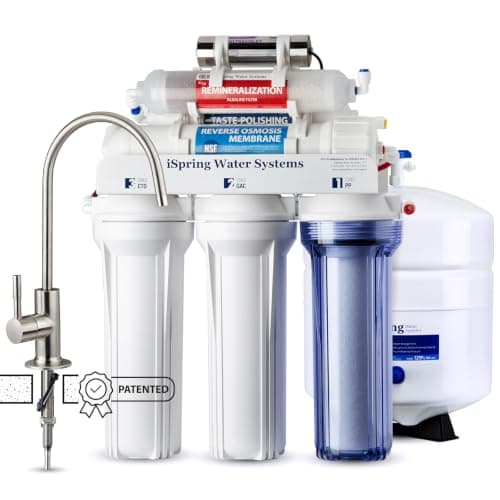
| iSpring RCC7AK-BN 6-Stage RO | Under-Sink | 6-Stage RO | $234.99 | NSF 58 (TDS + Lead)† | Not specifically certified† | Yes† |
| iSpring RCC7AK-UV 7-Stage RO | Premium Under-Sink | 7-Stage RO + UV | $329.99 | NSF 58 (TDS only)† | Not specifically certified† | Not specifically certified† |
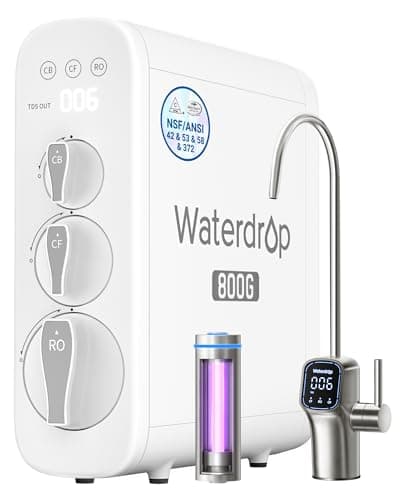
| Waterdrop G3P800 Tankless RO | Whole-Kitchen | 800 GPD Tankless RO | $849.00 | NSF 42, 53, 58, 372 | Yes | Yes |
*The APEC ROES-50's WQA Gold Seal certification covers NSF/ANSI 58 (TDS reduction) and NSF/ANSI 372 (lead-free materials, meaning the unit's own components do not add lead to the water). Neither is a certified PFAS or lead removal-percentage claim; APEC's own product documentation does not separate its general marketing contaminant list from what is actually covered by that certification. The RO membrane physically rejects a broad range of dissolved contaminants by size, which is why RO is generally effective against both PFAS and lead, but we could not verify a specific, independently certified PFAS or lead reduction claim for this model and do not repeat one here.
†The two iSpring RCC7AK models in this table carry different certified claims from each other, per NSF's own public certified-product database. The RCC7AK-BN (B005LJ8EXU) is NSF/ANSI 58 certified for a list that includes Lead Reduction specifically, alongside asbestos, barium, cadmium, chromium, copper, fluoride, selenium, and TDS, so its "Yes" on lead is a direct certified claim. The RCC7AK-UV (B006T3HYQ0) is a separate listing whose NSF/ANSI 58 certification covers TDS reduction only; neither lead nor PFAS appears in its certified contaminant list. Neither model's NSF/ANSI 58 listing, nor a separate NSF/ANSI 372 lead-content search, includes a PFAS-specific claim, despite retailer and manufacturer marketing describing both as "NSF 58&372 Certified" and "reduces PFAS." The RO membrane in both units still physically rejects a broad range of dissolved contaminants by size, which is why RO is generally effective against PFAS even without a model-specific certified PFAS claim, but we report only what each model's own NSF listing documents.
What EWG's Tap Water Database Says About PFAS and Lead
EWG's Tap Water Database (ewg.org/tapwater) pulls from publicly available utility testing data submitted to the EPA. Enter your ZIP code and the database shows which contaminants your water utility has detected, how those levels compare to the EPA's legal limits, and how they compare to EWG's own health guidelines, which are typically stricter than federal standards.
PFAS contamination is documented in water systems serving tens of millions of Americans. Lead, while nationally at lower levels than in older eras, still appears in water from homes with lead service lines or older plumbing, regardless of what the utility reports at the source. EWG's database reflects utility-level testing; in-home lead levels can be higher if your pipes or fixtures contain lead.
EWG does not evaluate, rate, or endorse specific water filter products. EWG VERIFIED® is a certification for personal care and cleaning products and does not apply to water filtration. For water filters, the relevant independent standards are NSF/ANSI 53 (activated carbon pitchers and under-sink carbon filters) and NSF/ANSI 58 (reverse osmosis systems).
How to Read NSF Certifications for PFAS and Lead
NSF/ANSI 53 covers health-based contaminant reduction by activated carbon and other non-RO filter types. For a pitcher or carbon under-sink filter to be certified to NSF 53 for PFAS or lead, it must be independently tested and demonstrate meaningful reduction of those specific compounds. Look for "NSF 53" and check the certified contaminants list, because certification may cover only some contaminants within the standard.
NSF/ANSI 58 covers reverse osmosis systems. RO removes dissolved contaminants through physical membrane separation: molecules too large to pass through the membrane's pores are rejected and flushed to drain, which is why RO is generally effective against both PFAS and lead as a filtration mechanism. NSF 58 certification itself, though, is tested and certified against a model-specific contaminant list, not a universal one: one certified RO system's list might include lead but not PFAS, another's might cover TDS only, and PFAS specifically is not part of every NSF 58 listing we have checked. Check the exact model's own certified contaminant list rather than assuming PFAS or lead are automatically included because a unit is "NSF 58 certified."
IAPMO certification means the product has been independently certified by the International Association of Plumbing and Mechanical Officials using the NSF/ANSI protocol. IAPMO-certified filters carry the same testing weight as NSF-certified filters; it is the certifying body that differs, not the standard.
WQA Gold Seal is granted by the Water Quality Association and similarly signals independent third-party testing to NSF/ANSI standards.
NSF/ANSI 42 covers aesthetic concerns such as chlorine taste and odor. Many filters carry NSF 42. Alone, it does not certify PFAS or lead reduction. See our NSF Certified Whole House Water Filter: What NSF/ANSI 42 Covers.
NSF/ANSI 372 certifies that a filter's materials are lead-free, meaning the components themselves do not leach lead. It is not a certification of lead removal from source water.
Tier 1: Pitcher Filters for PFAS and Lead ($27-$110)
Pitcher filters require no installation, work in any kitchen, and are the right starting point for renters, households that want an immediate upgrade, or anyone who has not yet confirmed contamination levels. The two options below carry independent certifications for both PFAS and lead reduction. Standard mass-market pitchers (Brita LF, PUR Faucet Mount) are typically not certified for PFAS reduction; the options below are specifically chosen for documented PFAS and lead performance.
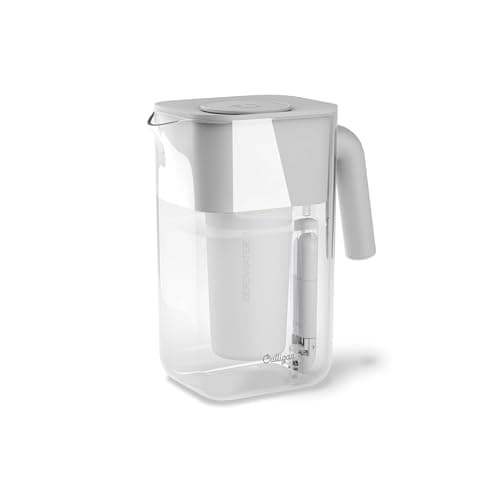
Culligan ZeroWater 10-Cup Pitcher (ASIN: B0DWTTYTQN): Best Budget Pitcher for PFAS and Lead
The Culligan ZeroWater uses a 5-stage ion-exchange filter certified by IAPMO to reduce total PFAS (including PFOA and PFOS), lead, chromium, mercury, and fluoride. It includes a built-in TDS (total dissolved solids) meter that alerts you when the filter needs replacement. At $26.97, it is the most affordable certified-for-PFAS pitcher widely available on Amazon.
A note on ZeroWater filter life: the 5-stage ion-exchange media is more aggressive than typical activated carbon pitchers. Filter life ranges from 25 to 50 gallons depending on your water's TDS level; in areas with high mineral content, you will replace filters more frequently. The TDS meter removes guesswork.
Certification: IAPMO certified; reduces total PFAS, lead, chromium, mercury, fluoride
Format: Pitcher, 10-cup
Filtration stages: 5
Filter life: 25-50 gallons (TDS meter included)
Culligan ZeroWater 10-Cup Pitcher : Buy on Amazon ($26.97) ↗
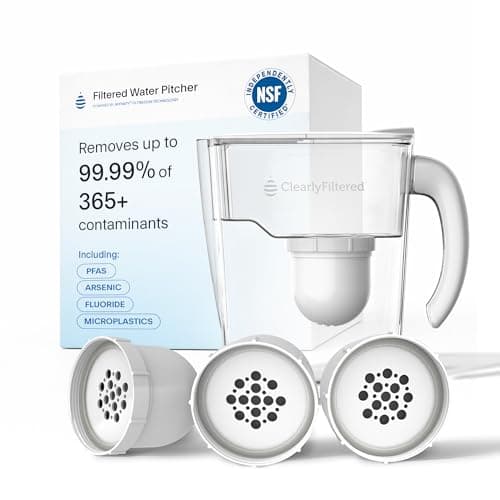
Clearly Filtered Water Filter Pitcher, 10-Cup (ASIN: B0CW4CDPNJ): Best Mid-Range Pitcher for PFAS and Lead
The Clearly Filtered pitcher targets 386+ contaminants using proprietary Affinity Filtration Technology. It is certified to NSF/ANSI 42 (chlorine reduction) and NSF/ANSI 372 (lead-free materials), and has been independently tested by an ISO 17025-accredited laboratory using NSF/ANSI 53 protocols for a wide range of contaminants including PFAS (PFOA, PFOS, GenX), lead, fluoride, arsenic, and microplastics. The distinction from formal NSF 53 certification: the testing was conducted to that protocol, not through NSF directly, a common route for filters with broader contaminant lists than the standard certification categories accommodate.
The 10-cup BPA/BPS-free pitcher has a 100-gallon filter life. At $109.99, it is the best pitcher option for households that want the widest independently-documented contaminant coverage in pitcher format.
Certification: NSF 42 & 372; independently tested to NSF/ANSI 53 protocols for PFAS, lead, fluoride, arsenic, microplastics
Format: Pitcher, 10-cup
Filter life: ~100 gallons
Material: BPA/BPS-free
Clearly Filtered Water Filter Pitcher, 10-Cup : Buy on Amazon ($109.99) ↗
Tier 2: Under-Sink Reverse Osmosis for PFAS and Lead ($180-$235)
Under-sink RO systems install under the kitchen sink and deliver filtered water through a dedicated faucet. They filter tap water on demand: no refilling, no waiting. Reverse osmosis is consistently one of the most effective methods for reducing PFAS and lead because the RO membrane physically rejects dissolved contaminants regardless of their chemistry, unlike adsorption-only filters that may be selective. Both systems below are NSF/ANSI 58 certified.
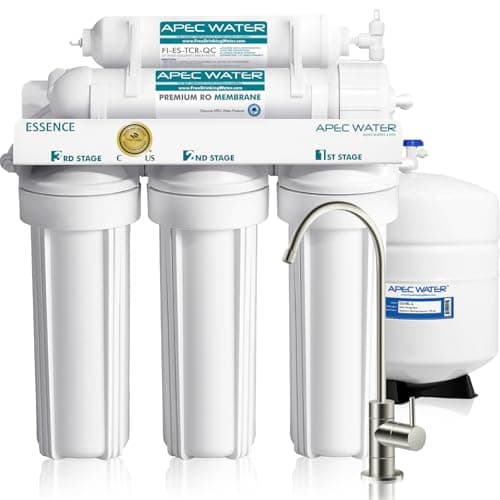
APEC Water ROES-50 5-Stage Under-Sink RO System (ASIN: B00I0ZGOZM): Best Entry Under-Sink RO
The APEC ROES-50 is a 5-stage under-sink reverse osmosis system certified to NSF/ANSI 58 and NSF/ANSI 372. It also holds WQA Gold Seal certification. The 50 GPD (gallons per day) flow rate covers typical household drinking and cooking needs at the kitchen sink. Five stages: sediment pre-filter, two carbon block pre-filters, RO membrane, and carbon post-filter. Installation requires a dedicated faucet (included) and connection to the cold water supply line under the sink; a storage tank holds filtered water until you turn the faucet.
At $179.99, the ROES-50 is one of the best-value NSF 58-certified RO systems available. APEC is a long-standing brand in residential water filtration; the ROES-50 has been a consistent category bestseller with a reliable service record.
Certification: NSF/ANSI 58, NSF/ANSI 372, WQA Gold Seal
Format: Under-sink RO with storage tank
Stages: 5
Flow rate: 50 GPD
Includes: Storage tank, dedicated faucet
APEC Water ROES-50 5-Stage Under-Sink RO System : Buy on Amazon ($179.99) ↗
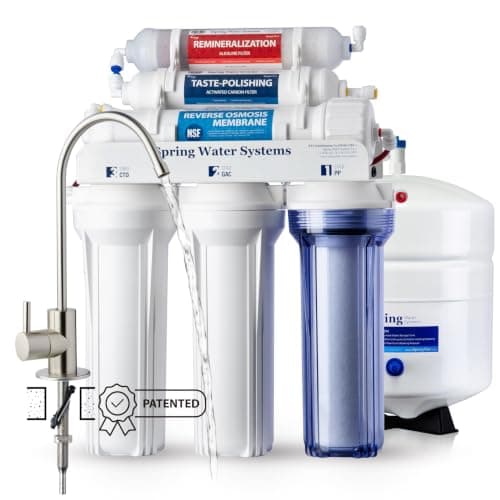
iSpring RCC7AK-BN 6-Stage RO with Alkaline Remineralization (ASIN: B005LJ8EXU): Best Under-Sink RO for Taste
The iSpring RCC7AK-BN adds a sixth stage to the standard RO process: an alkaline remineralization filter that adds calcium and magnesium back into the purified water. RO removes nearly all dissolved minerals (beneficial and otherwise), which can make the water taste flat. The remineralization stage addresses this while keeping the NSF/ANSI 58 certification, which for this exact model's listing in NSF's public database includes Lead Reduction specifically, along with asbestos, barium, cadmium, chromium, copper, fluoride, selenium, and TDS. PFAS is not part of that certified list. The system produces 75 GPD; includes a top-mounted filter assembly for easy cartridge access and a brushed-nickel dedicated faucet.
At $234.99, the premium over the ROES-50 buys you the alkaline stage, a brushed-nickel faucet that matches modern kitchen fixtures, and a certified lead-reduction claim the ROES-50 itself does not carry. If taste after RO filtration is a priority or you prefer the aesthetics, this is the pick.
Certification: NSF/ANSI 58, including Lead Reduction (per NSF's public database); not independently confirmed for PFAS or NSF/ANSI 372
Format: Under-sink RO with storage tank + alkaline remineralization
Stages: 6
Flow rate: 75 GPD
Includes: Storage tank, brushed-nickel dedicated faucet
iSpring RCC7AK-BN 6-Stage RO with Alkaline Remineralization : Buy on Amazon ($234.99) ↗
Tier 3: Premium and Whole-House Coverage ($330-$849)
This tier covers two needs: households that want the highest-performing under-sink RO (with UV sterilization as a bonus stage), and households with large-volume water needs or the highest contamination levels who benefit from a high-flow tankless system. Whole-house point-of-entry systems certified for PFAS and lead are also addressed below.
iSpring RCC7AK-UV 7-Stage RO with Alkaline and UV (ASIN: B006T3HYQ0): Best Under-Sink RO with UV
The iSpring RCC7AK-UV adds an LED UV sterilization stage to the RCC7AK alkaline platform. UV light at 254 nm wavelength deactivates bacteria and viruses that can pass through an RO membrane in rare cases (microorganisms can survive in storage tanks). This makes the RCC7AK-UV particularly well-suited for households on well water or with older plumbing concerned about biological contamination. NSF's public database lists this exact model's NSF/ANSI 58 certification as TDS reduction only, a narrower certified claim than its RCC7AK-BN sibling above; we did not find lead or PFAS in its certified contaminant list, so we do not repeat a lead or PFAS removal claim for this specific unit. 75 GPD. Patented top-mounted filter design for cartridge access without reaching under the sink.
Certification: NSF 58 (TDS reduction only, per NSF's public database for this model); not independently confirmed for lead, PFAS, or NSF/ANSI 372
Format: Under-sink RO with alkaline remineralization + LED UV
Stages: 7
Flow rate: 75 GPD
UV stage: Yes, LED (no bulb replacement needed)
iSpring RCC7AK-UV 7-Stage RO with Alkaline and UV : Buy on Amazon ($329.99) ↗
Waterdrop G3P800 Tankless RO System, 800 GPD (ASIN: B0987FCQQW): Best for High Volume and Lowest Ongoing Cost
The Waterdrop G3P800 is a tankless 10-stage under-sink RO system certified by IAPMO to NSF/ANSI 42, 53, 58, and 372, the full set of certifications relevant to PFAS and lead. Tankless means filtered water is produced on demand rather than stored: no storage tank takes up under-sink space. At 800 GPD, it supplies the entire kitchen's drinking and cooking needs without wait times. The 3:1 pure-to-drain ratio sends three gallons of filtered water out for every one gallon to drain, compared to 1:1 or 2:1 on lower-tier RO systems, which makes it the lowest ongoing water cost per gallon among the systems in this guide.
Independent tap-score lab testing showed all 14 PFAS analytes below detection limits. A smart LED faucet indicates filter life. At $849, this is the premium pick for households with the most demanding PFAS and lead concerns or the highest daily volume needs.
Certification: IAPMO certified to NSF/ANSI 42, 53, 58 & 372
Format: Tankless under-sink RO, no storage tank
Stages: 10
Flow rate: 800 GPD
Pure-to-drain ratio: 3:1
Faucet: Smart LED filter-life indicator
Waterdrop G3P800 Tankless RO System, 800 GPD : Buy on Amazon ($849.00) ↗
What to Know About Whole-House Point-of-Entry Filtration
Point-of-entry (POE) whole-house systems filter all water entering the home, covering every tap, shower, and appliance. For PFAS and lead specifically, POE systems certified to NSF/ANSI 53 for lead and NSF P473 for PFOA/PFOS are the benchmark. The Aquasana OptimH2O is the most widely cited residential whole-house system certified to both standards.
A few practical notes on whole-house POE systems:
- They require professional installation on the main water supply line and take more space than under-sink systems.
- Certified systems for PFAS and lead typically cost $800 to $2,000 or more for the hardware, plus installation.
- Availability on major retailers varies; these systems are often best ordered direct from the manufacturer.
- If your primary concern is drinking and cooking water, an under-sink RO system achieves the same result at the tap where exposure is highest, at substantially lower cost.
For most families, the right starting point is checking the EWG Tap Water Database for your area, then choosing a pitcher or under-sink RO to address your kitchen water. Whole-house filtration is a second-stage decision once drinking water is addressed.
How We Chose These Filters
Each filter in this guide was selected using the following criteria:
- Independent certification relevant to PFAS and lead: NSF/ANSI 53, NSF/ANSI 58, or IAPMO certification. Most picks carry a documented, contaminant-specific certified claim for PFAS and lead; the under-sink RO systems are included on the strength of NSF/ANSI 58 (which certifies broad dissolved-solids reduction via the RO membrane) even where a manufacturer has not separately certified a PFAS- or lead-specific removal percentage. We note the specific basis for each pick rather than assuming one from another.
- In-stock availability on Amazon as of September 16, 2026, verified via the Amazon Creators API.
- Three price tiers: to give readers options across budget levels, not just one recommendation.
- EWG-aligned framing: We referenced EWG's Tap Water Database and their published guidance on what certifications to look for. EWG does not endorse or rate water filter products, and no products here carry EWG VERIFIED® (that certification applies to personal care and cleaning products, not water filters).
How to Use the EWG Tap Water Database Before You Buy
- Go to ewg.org/tapwater and enter your ZIP code.
- Find the contaminants detected in your local water system. Look specifically for PFAS compounds (PFOA, PFOS, GenX, or others listed) and for lead.
- Note whether levels are above EWG's health guidelines, above the EPA legal limits, or below both. Higher concern: closer to or above EWG guidelines.
- If PFAS is detected above EWG health guidelines: prioritize an RO system (NSF 58 certified) over a pitcher. RO removes PFAS more completely and with less variability than activated carbon alone.
- If lead is your primary concern: both certified pitchers and RO systems address lead. If you have lead service lines, an under-sink RO that filters at the tap is the stronger choice, since lead can enter the water at your home's plumbing, not just the utility source.
PFAS vs. Lead: Two Different Problems in One Filter
PFAS and lead enter water through different pathways and have different chemistries, but the right filter addresses both. Here is a quick breakdown:
PFAS: Industrial compounds introduced to the water supply from manufacturing, firefighting foam, and other sources. Present in the supply before it reaches your home. Physically removed by an RO membrane and, on filters specifically certified for it, by activated carbon (NSF 53); not every NSF/ANSI 58-certified RO system's own certified list names PFAS specifically, so check the individual model. EWG's Tap Water Database documents PFAS at levels above EWG guidelines in many utilities.
Lead: Typically enters from aging service lines and household plumbing fixtures, not the utility source. A utility can report lead-free water at the source and your home's tap can still show elevated lead from pipes. NSF/ANSI 53 covers lead reduction in activated carbon filters; some, but not all, NSF/ANSI 58-certified RO systems carry a lead-specific certified claim too, so check the model's own certified list rather than assuming it from the "58" number alone. A filter with a documented, contaminant-specific certified claim for both PFAS and lead is the most practical choice for households concerned about either.
Related Reads
Filtering your drinking water is one part of reducing PFAS exposure at home. PFAS also enters through cookware: traditional nonstick pots and pans use PTFE coatings that EWG has flagged as a source of PFAS concern. See our guide to PFAS-free cookware rated by EWG for cast iron, ceramic, and stainless alternatives at every budget. For a broader look at everyday PFAS swaps around the house, see our guide to PFAS-free alternatives backed by EWG's research. If your fridge has a built-in water and ice dispenser, its filter is a separate purchase from the pitcher and under-sink options above. See our guide to NSF-certified refrigerator water filters to match the exact replacement cartridge to your model. Filtering what comes out of the tap is one piece of the picture; the faucet fixture itself is certified separately for lead content under a different NSF standard. See our guide to NSF/ANSI 372 certified lead-free kitchen faucets for what that certification covers. For a closer look at the under-sink RO tier specifically, including units that are not NSF/ANSI 58 certified despite similar marketing, see our dedicated guide to under-sink reverse osmosis water filters.
Frequently Asked Questions
Q: Is EWG VERIFIED® available for water filters?
No. EWG VERIFIED® is a certification program for personal care and cleaning products. It does not apply to water filters. EWG's Tap Water Database documents contamination and EWG publishes guidance on what certifications to look for, but EWG does not rate or endorse specific water filter products.
Q: What is the difference between NSF 53 and NSF 58 for PFAS removal?
NSF/ANSI 53 covers activated carbon pitcher and under-sink carbon filters certified to reduce specific contaminants including certain PFAS compounds. NSF/ANSI 58 covers reverse osmosis systems, which remove PFAS through physical membrane separation. RO is generally considered more comprehensive for PFAS reduction; a pitcher certified to NSF 53 for PFAS can still leave some compounds. If you have documented high PFAS levels, an RO system (NSF 58) is the more reliable choice.
Q: Does a certified water filter guarantee PFAS removal?
Certification means the system has been independently tested to demonstrate reduction of a contaminant under lab conditions. Performance in your home depends on proper installation, water chemistry, and following the manufacturer's filter replacement schedule. Replace filters on schedule to maintain the certified performance level.
Q: Will a whole-house filter protect my family from lead in shower water?
Dermal absorption of lead from shower water is considered low. The main exposure route for lead in water is ingestion (drinking and cooking). Addressing your kitchen drinking water with an NSF 53 or NSF 58 certified filter covers the highest-priority exposure route for most families. Whole-house filtration adds coverage but is a secondary consideration after the kitchen tap.
This article contains affiliate links. NonToxicFinder (Solved Labs LLC) may earn commissions on qualifying purchases at no extra cost to you. Contaminant data referenced in this guide comes from EWG's publicly available Tap Water Database. NSF, IAPMO, and WQA certifications are issued independently by those organizations, not by EWG. EWG does not rate, endorse, or certify water filter products, and its data is not a guarantee of water safety in your home. We are not affiliated with, endorsed by, or partnered with the Environmental Working Group. Certifications and availability can change; verify current status before purchase.