Affiliate Disclosure: This article contains affiliate links. NonToxicFinder (Solved Labs LLC) may earn commissions on qualifying purchases at no extra cost to you. We are not affiliated with, endorsed by, or partnered with the Environmental Working Group or the USDA.
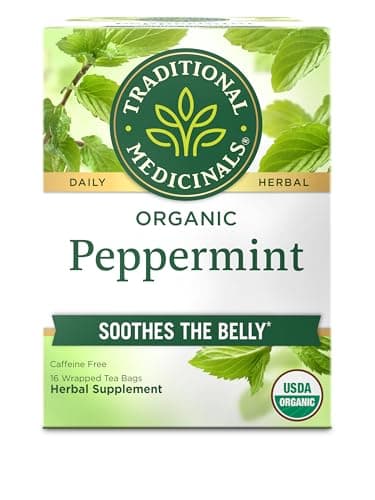
Traditional Medicinals Organic Peppermint is a one-ingredient tea: each bag holds 1,500 mg of organic peppermint leaf and nothing else, and the maker labels it caffeine-free. It carries the USDA Organic seal, and its label names CCOF as the organic certifier. Brew one bag in 8 ounces of just-boiled water, covered, for 10 to 15 minutes, for a strong, very minty cup. Buy it if you want a plain peppermint tea with no added flavors. If you have acid reflux, a hiatal hernia or gallstones, or are pregnant or breastfeeding, the maker’s own label says to ask your healthcare practitioner first.
See Traditional Medicinals Organic Peppermint (16 tea bags) on Amazon →
What Is in the Box, and Is It Caffeine-Free?
The Traditional Medicinals peppermint tea page lists one ingredient: organic peppermint leaf. The Supplement Facts panel on that page puts it at 1,500 mg of leaf per bag, one bag per 8-ounce cup, 16 bags per box, and zero calories. The page marks the tea “Caffeine Free.” Peppermint is an herb, not a tea plant, so there is no caffeine to start with.
- Nothing added: the page says “No Added Natural Flavors,” so the mint taste comes from the leaf alone.
- The bag: Traditional Medicinals describes it as a natural fiber tea bag, and the packaging as recyclable.
- Where the mint comes from: the product page says the peppermint is “primarily sourced from our partner-growers in the Pacific Northwest,” and the maker’s peppermint story names Trout Lake Farm in Washington State.
- Why it has a Supplement Facts panel: Traditional Medicinals sells its teas as herbal supplements, so the box has a Supplement Facts panel and a warnings line instead of a Nutrition Facts label. Its digestion wording carries the standard note that the FDA has not evaluated those statements.
Do not confuse it with two boxes that sit next to it on the shelf. Green Tea Peppermint adds green tea leaf and has about 9 mg of caffeine per bag, per its label. Belly Comfort Peppermint is a seven-herb blend. The plain Organic Peppermint is the one with mint and nothing else.
Is It Organic?
Yes. The maker’s product page shows the USDA Organic seal, and the Supplement Facts panel on the same page reads: “Certified organic by CCOF. All Ingredients Certified Organic.” CCOF is the USDA-accredited certifying agent behind the claim. Under the USDA’s organic labeling rules, organic product labels “must be reviewed and approved by a USDA-accredited certifying agent,” and a product whose ingredients are all organic, as this label states, is eligible for the top “100 percent organic” category.
Organic is a rule about how the peppermint was grown and handled, not a lab test of the finished tea. Our explainer on what the USDA organic seal means covers the label categories, and our glyphosate guide explains what an organic label does and does not tell you about pesticide residues.
How to Brew It, and How Strong It Is
Traditional Medicinals’ directions:
- Pour 8 ounces of freshly boiled water over one tea bag.
- Cover the cup and steep for 10 to 15 minutes.
- Squeeze the bag before you take it out.
That is a long steep, and with 1,500 mg of leaf in each bag it makes a strong cup. The same brand tells you to steep its spearmint and chamomile for only 5 to 10 minutes. Traditional Medicinals says “many plant people say that our peppermint is among the mintiest tasting around,” and its product page calls it “rich in natural essential oils.” If the full 15 minutes is more mint than you want, steep for less time or use a bigger mug of water. Traditional Medicinals says the tea “can be consumed daily,” suggests 3 to 4 cups a day, and, because it has no caffeine, presents it as an after-dinner or bedtime cup.
Peppermint Tea in Pregnancy, and for Children
Pregnancy and breastfeeding. The NIH’s National Center for Complementary and Integrative Health (NCCIH), in its peppermint fact sheet, says “use of oral peppermint in amounts commonly found in food is likely safe during pregnancy or while breastfeeding, but little is known about whether it’s safe to use oral peppermint in medicinal amounts during pregnancy or while breastfeeding.” NCCIH does not say how many cups of tea count as a food amount. Traditional Medicinals sells this tea as an herbal supplement and suggests up to 4 cups a day, and its label says to consult your healthcare practitioner before use if you are pregnant or breastfeeding. If you plan to drink it daily at the maker’s suggested amount while pregnant, that label advice is the one to follow: raise it at your next prenatal visit.
Everyone else. NCCIH says “peppermint tea, which is made from peppermint leaves, appears to be safe. However, the long-term safety of consuming large amounts of peppermint leaf is unknown.” It also says very little research has been done on peppermint leaf for any health condition, lists heartburn among the possible side effects of peppermint oil taken by mouth, and advises anyone who takes medicine to talk with their health care provider before using any herbal product. The Traditional Medicinals label adds its own warning: consult your healthcare practitioner first if you have gallstones or bile duct obstruction, a hiatal hernia or acid reflux.
Children. For babies 6 to 12 months old, the CDC’s list of drinks to offer is breast milk or infant formula and 4 to 8 ounces of water a day; tea of any kind is not on it. If you sweeten tea for a toddler, the CDC’s foods to avoid page says honey given to children younger than 12 months may cause botulism, and that children under 2 should avoid caffeinated drinks such as tea, which rules out the Green Tea Peppermint box. NCCIH warns that menthol should not be inhaled by or applied to the face of an infant or small child, a caution about peppermint oil rather than tea. Neither NCCIH nor the maker’s label gives a children’s amount for peppermint tea, so ask your pediatrician before making it a regular drink for a young child.
Which Box Size Is the Best Value?
Traditional Medicinals sells the tea as a single 16-bag box, a 3-pack (48 bags) and a 6-pack (96 bags). On its own store the 3-pack and the 6-pack carry the same discount per box, so the 6-pack saves you nothing extra per bag; it only saves you reordering. How long each lasts:
| Size | Bags | At 1 cup a day | At the maker’s 3 to 4 cups a day |
|---|---|---|---|
| 1 box | 16 | About 2 weeks | 4 to 5 days |
| 3-pack | 48 | About 7 weeks | 12 to 16 days |
| 6-pack | 96 | About 3 months | 24 to 32 days |
Start with the single box, which is the size linked here, to find out whether you like a strong peppermint. If you settle into a cup or more every day, the 3-pack gets you the per-box discount without a pantry full of tea; the 6-pack makes sense only if you drink several cups a day.
Peppermint vs. the Brand’s Other Mint and Tummy Teas
Shoppers holding this box are usually weighing it against the Traditional Medicinals teas beside it. All six below carry the same “Certified organic by CCOF” line on their Supplement Facts panels; the differences are in what is in the bag and what the label warns about.
| Tea | What is in one bag | Caffeine | Steep | Label warnings |
|---|---|---|---|---|
| Organic Peppermint | Peppermint leaf, 1,500 mg | None | 10 to 15 min | Gallstones or bile duct obstruction, hiatal hernia, acid reflux, pregnancy or breastfeeding |
| Organic Spearmint | Spearmint leaf, 1,500 mg | None | 5 to 10 min | Pregnancy or breastfeeding only |
| Green Tea Peppermint | Peppermint leaf 1,020 mg, green tea leaf 480 mg | About 9 mg | 10 to 15 min | Same as peppermint |
| Belly Comfort Peppermint | Peppermint, fennel, ginger, rose hip, papaya leaf, alfalfa, cinnamon | None | 10 to 15 min | Same as peppermint, plus parsley-family plant allergy |
| Organic Chamomile | Chamomile flower, 1,300 mg | None | 5 to 10 min | Daisy-family plant allergy, pregnancy or breastfeeding |
| Organic Ginger | Ginger root, 1,500 mg | None | 10 to 15 min | Pregnancy or breastfeeding |
- Want the strongest plain mint? Organic Peppermint.
- Does the peppermint label’s reflux or hernia warning apply to you? Spearmint’s label does not carry that warning, and it steeps in half the time.
- Want a morning lift? Green Tea Peppermint is the only one of the six with caffeine.
- Want a blend rather than one herb? Belly Comfort, unless you are allergic to fennel or other parsley-family plants.
- Want a non-mint evening tea? Chamomile, unless you react to daisy-family plants.
Traditional Medicinals’ ingredient lists, steeping times and warnings for these teas come from the spearmint, green tea peppermint, Belly Comfort, chamomile and ginger product pages.
How to Read a Bagged Herbal Tea Label
- Find the organic wording and the certifier. “Organic” with the USDA seal means at least 95 percent organic ingredients; “made with organic” is a lower category that cannot carry the seal. A named certifier, like CCOF here, tells you who approved the label.
- Read the ingredient line, not the front of the box. “Peppermint” on the front can mean a single herb, a blend, or mint plus green tea. Look for “natural flavors” too if you want the taste to come from the plant alone.
- Check for tea leaf if you avoid caffeine. Any green, black or white tea leaf in the list means caffeine; a herb-only list does not.
- Read the warnings line. Teas sold as herbal supplements list the conditions to raise with a clinician. NCCIH notes that dietary supplements are not approved by the FDA before they are sold, and that makers are responsible for their safety and labeling.
Frequently Asked Questions
Does Traditional Medicinals Organic Peppermint have caffeine?
No. The maker labels it caffeine-free, and its only ingredient is peppermint leaf. Its Green Tea Peppermint is different: about 9 mg of caffeine per bag.
Can I drink it every day?
Traditional Medicinals says it can be consumed daily and suggests 3 to 4 cups a day. NCCIH says peppermint tea appears to be safe but that the long-term safety of large amounts of peppermint leaf is unknown, and the label lists reflux, hiatal hernia, gallstones, pregnancy and breastfeeding as reasons to check with a practitioner first.
Can I drink it before bed?
Yes, as far as caffeine goes: it has none. If peppermint gives you heartburn, which NCCIH lists as a possible side effect of peppermint oil, an evening cup is when you would notice it.
Can I make it as iced tea?
The maker gives hot-brew directions only. Brewing it the same way and pouring it over ice gives you the same tea, chilled.
Is it the same as Belly Comfort Peppermint?
No. Belly Comfort is a blend of peppermint with fennel, ginger, rose hip, papaya leaf, alfalfa and cinnamon. Organic Peppermint is peppermint leaf only.
Affiliate Disclosure: This article contains affiliate links. NonToxicFinder (Solved Labs LLC) may earn commissions on qualifying purchases at no extra cost to you. We are not affiliated with, endorsed by, or partnered with the Environmental Working Group or the USDA.