Affiliate Disclosure: This article contains affiliate links. NonToxicFinder (Solved Labs LLC) may earn commissions on qualifying purchases at no extra cost to you. We are not affiliated with, endorsed by, or partnered with the Environmental Working Group or any certification program.
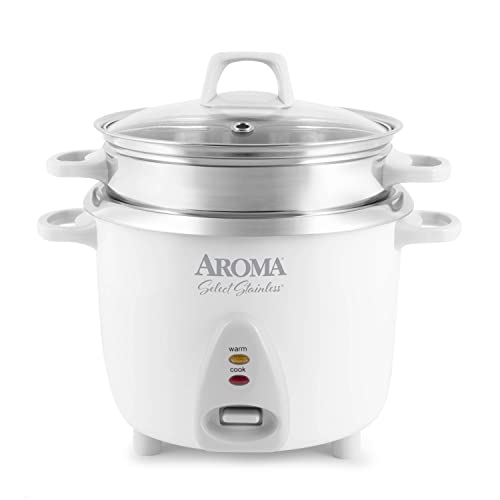
The Aroma Select Stainless ARC-757-1SG is a stainless steel rice cooker in the plainest sense: Aroma says the inner pot is “100% food-grade 304 stainless steel,” the lid is glass, and the steam tray is 304 stainless too, so the rice cooks without a nonstick coating. It makes up to 14 cups of cooked rice with one switch and a Warm mode. Buy it if you cook rice for three to six people and want a basic metal-pot cooker with a steamer. If you cook for one or two, Aroma’s 6-cup ARC-753-1SG is the same design in a smaller size.
What Touches Your Rice, Part by Part
Aroma describes each food-contact part across its product page, its ARC-757-1SG parts page and the replacement-part listings.
| Part | Touches food? | What Aroma says it is |
|---|---|---|
| Inner pot | Yes, the whole cook | “100% food-grade 304 stainless steel cooking pot.” No coating is mentioned. |
| Lid | Steam and condensation drip back onto the rice | The parts page lists it as a “Glass Lid” (part ARC-757SG_58). |
| Steam tray | Yes, holds food over the rice | The tray Aroma sells for this model is “Constructed of 304-grade stainless steel.” |
| Serving spatula | Yes, for stirring and serving cooked rice | Material not named. Aroma says it is “not intended to be used in contact with high temperatures” such as hot soup or chili. |
| Rice measuring cup | Dry, uncooked rice only | Material not named. |
So during cooking, the rice sits in steel under glass. Aroma does not name the material of the lid’s knob and rim or of the spatula; if you would rather no plastic touch hot rice at all, serve with your own wooden or stainless spoon, which is what Aroma itself suggests for stirring soups. Nothing on the parts list is a gasket or seal, unlike the ARC-914SBDS below.
How It Compares With Other Stainless-Pot Cookers
Every cooker below has a stainless pot in its maker’s words. The differences are size, controls and what else is in the lid.
| Cooker | Cooked rice | Controls | Steam tray | Lid |
|---|---|---|---|---|
| Aroma ARC-757-1SG | 2–14 cups | One switch, auto Warm | Included, 304 stainless | Glass |
| Aroma ARC-757SG | 2–14 cups | One switch, auto Warm | Not included; Aroma sells the same stainless tray for it | Glass |
| Aroma ARC-753-1SG | 2–6 cups (1.5 qt) | One switch, auto Warm | Included; Aroma sells it as a stainless steel tray | Glass |
| Aroma ARC-753SGB | 2–6 cups (1.2 qt) | One switch, auto Warm | Not included | Glass |
| Aroma ARC-914SBDS | Up to 8 cups (2 qt) | Digital presets, 15-hour delay timer | Included, material not named | Hinged, with a removable inner lid and gasket; materials not named |
| Aroma NutriWare NRC-687SD-1SG | 4–14 cups | Digital presets, including Sauté-Then-Simmer | Included, stainless steel | Glass |
| Instant Pot Duo 6 Qt | Up to 6 servings | Pressure cooker with a rice program | Stainless steel steamer rack | Locking lid with a silicone sealing ring |
- Pick the ARC-757-1SG if you want the full 14-cup size, a steamer in the box and the simplest controls.
- Pick the ARC-757SG if you will not steam vegetables. The pot and lid are the same; only the tray is left out.
- Pick the ARC-753-1SG if you cook for one to three people.
- Pick the NutriWare NRC-687SD-1SG if you want brown-rice and sauté settings on the same 14-cup scale, still with a glass lid and stainless tray.
- Pick an Instant Pot if you also want pressure cooking. Instant Pot says its pot is 18/8 stainless with a tri-ply bottom, but the lid seals with a silicone ring. Our stainless steel pressure cooker guide compares it with a stovetop model.
Does Rice Stick to the Stainless Pot?
It can, mostly the bottom layer when the rice sits on Warm. A stainless pot has no coating to release the grains, so Aroma’s manual and FAQ build the fix into the routine:
- Rinse first. Measure with the included cup, then rinse in a bowl of cool water for about 10 seconds and drain, at least twice, or until the water runs clear. Aroma says a bowl works better than a strainer, and warm water can start cooking the rice. Rinsing removes the surface starch that makes rice gummy and foam over.
- Use the water lines. Add rice first, then fill to the line that matches the number of cups: 2 cups of rice, line 2.
- Stir when it clicks to Warm. Fluff the rice right away to spread the moisture.
- Add water if it will wait. If the rice will sit on Warm for more than 20 minutes, Aroma says to mix in another ½ to 1 rice cup of water to keep it from sticking to the bottom.
Cleaning. Aroma says the pot and accessories can be washed by hand or on the top rack of the dishwasher. For stuck-on rice, its deep-clean advice is to soak the removable parts in warm, soapy water for 2 to 3 hours before washing. For visible build-up, or about every other month, Aroma suggests pouring in 1 cup of distilled white vinegar and 1 cup of water, running a 30-minute cook cycle on a timer, switching to Warm for 10 minutes, then washing with soap and water. Two more rules from the manual: never put the pot on a stovetop or burner, and dry the outside of the pot before it goes back in the cooker.
What the Prop 65 Warning Means
The product page, like every Aroma page we opened, including the glass lid and the stainless steam tray, carries the notice “WARNING: Cancer and Reproductive Harm – www.P65Warnings.ca.gov.”
Under California’s Proposition 65 warning rules (California Code of Regulations, title 27, section 25603), that is a short-form warning. The full warning says a product “can expose you to chemicals including [name of one or more chemicals]” known to the state to cause cancer or reproductive harm, and must name at least one chemical. The short form names none, so the notice does not tell you which chemical or which part it is for. Aroma’s FAQ says the law “applies to a wide range of materials, including the product packaging and the power cords,” and that Aroma includes the notice “out of an abundance of caution and for strict legal compliance regarding these external components.” The same notice appears on every cooker in the Aroma rows of the table above, so it does not separate one Aroma model from another.
Is 14 Cups the Right Size?
Aroma’s rice cup is smaller than a kitchen cup: it holds 180 ml, or ¾ of a standard U.S. cup. “14 cups cooked” means 14 of those cups, about 10½ standard cups, from 7 cups of uncooked white rice in a 3-quart pot.
- Family of four to six: this size. Aroma’s own guide puts 12-cup cookers at families of 4 to 5 and 20-cup cookers at 6 or more; the 14-cup sits between them, with room for leftovers.
- One to three people: the 6-cup ARC-753-1SG. Aroma’s white rice chart for the 14-cup starts at 2 rice cups uncooked, which yields 4 cups cooked, so very small batches suit the smaller pot better.
- Brown rice: the chart goes up to 5 rice cups uncooked, about 10 cups cooked.
- Steaming and rice together: with the tray in place, Aroma says only 4 rice cups of white rice can cook below it.
For brown rice, our Lundberg organic short grain brown rice guide gives the maker’s water ratios, which work in a rice cooker too.
Keeping Cooked Rice on Warm
Aroma says Keep Warm holds food at roughly 158°F to 194°F, that rice should not stay on Warm for more than 12 hours, and that Warm is not for reheating cold food. That lines up with CDC’s food safety advice: bacteria multiply quickly between 40°F and 140°F, cooked leftovers go in the refrigerator within 2 hours (1 hour above 90°F), and leftovers are reheated to 165°F. If you steam chicken in the tray, CDC’s minimum for all poultry is 165°F, and Aroma says to check meat for doneness and steam longer if needed.
CPSC’s recall database lists no recall of an Aroma rice cooker; the Aroma Housewares recalls it lists are juicers from 1999 and 2002.
Who Should Buy It and Who Should Skip It
- Buy it if you want rice cooked in bare stainless steel, cook for a family, and like a cooker with one switch and nothing to program.
- Skip it if you need a delay timer or a brown-rice setting (look at the digital ARC-914SBDS, or the NutriWare NRC-687SD-1SG for brown rice at 14 cups), if you cook small portions (the 6-cup ARC-753-1SG), or if you want rice that never sticks without a little care, which is what a nonstick pot gives you.
If you are taking nonstick out of the rest of the kitchen too, our PFAS-free cookware guide covers pans and pots.
See the Aroma Select Stainless 14-Cup Rice Cooker ARC-757-1SG on Amazon →
Frequently Asked Questions
Is the Aroma ARC-757-1SG pot really stainless steel, with no coating?
Aroma says it is “100% food-grade 304 stainless steel” and mentions no coating anywhere on the product or parts pages.
Is anything plastic touching the rice while it cooks?
Not according to Aroma’s parts list: the pot and steam tray are 304 stainless and the lid is glass. Aroma does not name the material of the serving spatula or measuring cup, and the spatula is not meant for very hot food.
How do I stop rice sticking to the stainless pot?
Rinse the rice until the water runs clear, fill to the matching water line, stir as soon as it switches to Warm, and add ½ to 1 rice cup of water if it will sit on Warm for more than 20 minutes. Soak stuck rice in warm, soapy water before washing.
Can the pot go in the dishwasher?
Yes. Aroma says the inner pot and accessories can go on the top rack of the dishwasher or be washed by hand.
What does the Prop 65 warning on Aroma cookers mean?
It is California’s short-form warning, which names no chemical. Aroma says it is there for materials such as packaging and power cords, and the same notice appears across Aroma’s product pages.
How many people does the 14-cup cooker feed?
Four to six. It makes up to about 10½ standard cups of cooked rice. For one to three people, the 6-cup ARC-753-1SG fits better.
Can I cook brown rice in it?
Yes. Aroma’s chart covers up to 5 rice cups of uncooked brown rice, and brown rice takes longer than white on the same switch.
This article contains affiliate links. NonToxicFinder (Solved Labs LLC) may earn commissions on qualifying purchases at no extra cost to you. We are not affiliated with, endorsed by, or partnered with the Environmental Working Group or any certification program.