This article contains affiliate links. NonToxicFinder (Solved Labs LLC) earns commissions on qualifying purchases at no extra cost to you. We are not affiliated with the Environmental Working Group.
Reynolds slow cooker liners are one of those kitchen conveniences that most parents grab without a second thought. Line the crock, cook your meal, pull out the bag, and the insert is already clean. It's genuinely useful. But a question has surfaced in family Facebook groups and parenting forums: are slow cooker liners safe, or do they leach chemicals into food?
EWG's PFAS research put a number behind that concern. EWG tested Reynolds slow cooker liners and found them PFAS-positive, meaning the liner material contains per- and polyfluoroalkyl substances, the chemical family EWG has identified as persistent environmental contaminants that accumulate in the body over time. That result, published through EWG's PFAS Central research project, is the basis for the swap this article covers.
The swap-in is straightforward: reusable food-grade silicone slow cooker liners. Silicone doesn't require PFAS-based coatings to be nonstick and heat-tolerant. It's a material that sidesteps that chemistry entirely. Four verified silicone picks are listed below, all confirmed in stock on Amazon as of September 19, 2026. If you're building out PFAS-free cookware across your whole kitchen, see our PFAS-free cookware guide for the full picture.
What EWG's PFAS Research Found on Slow Cooker Liners
EWG has documented PFAS in slow cooker liners through its PFAS Central research project, which tests consumer products for the presence of fluorinated chemicals using total organic fluorine (TOF) analysis. The finding for Reynolds slow cooker liners: PFAS-positive.
PFAS (per- and polyfluoroalkyl substances) are a class of synthetic chemicals EWG describes as "forever chemicals" because they don't break down in the environment or the human body. EWG's PFAS Central database documents human health concerns associated with PFAS exposure, including links to immune system disruption and developmental effects in children at high exposure levels, per EWG's research summaries. These are EWG's published research findings. NonToxicFinder is reporting EWG's work and is not making independent safety determinations.
For slow cooker liners, the concern EWG identifies is straightforward: the bag is in contact with your food at cooking temperatures (typically 190–300°F) for 4–8 hours. EWG has documented PFAS migration from food-contact materials as a real exposure route in its research on food packaging. Reynolds slow cooker liners tested PFAS-positive in EWG's testing. EWG does not assign Guide to Healthy Cleaning grades to slow cooker liners, so there is no letter grade to cite here: the relevant EWG data is its PFAS research findings, not a product rating. Check ewg.org/pfascentral for EWG's current research publications.
Why Silicone Is the Swap
Silicone is a synthetic polymer made from silicon (an element derived from sand) bonded with oxygen, carbon, and hydrogen. It does not require fluorination or PFAS-based treatments to be nonstick or heat-resistant: those are inherent properties of the silicone polymer itself. Food-grade silicone slow cooker liners are:
- PFAS-free by material No fluoropolymer coating is used or needed
- Heat-tolerant Food-grade silicone is rated to 400–450°F, well above slow cooker temperatures
- Reusable and dishwasher-safe Most liners rinse clean and go in the dishwasher
- Cost-effective over time One $9–$37 silicone liner replaces dozens of boxes of plastic bags
To be clear about what silicone picks in this article are and are not: they are PFAS-free by material, not EWG VERIFIED® or rated by EWG's Guide to Healthy Cleaning. EWG does not have a formal product rating for silicone slow cooker liners. The framing here is backed by EWG's PFAS research on the problem (PFAS in Reynolds liners), and silicone is the material solution that sidesteps that chemistry. These are the same grounds on which EWG's own consumer guidance recommends switching away from PFAS-containing food-contact products toward materials like glass, stainless steel, and silicone.
4 PFAS-Free Silicone Picks (Verified In Stock)
All four products below are food-grade silicone slow cooker liners confirmed in stock on Amazon as of September 19, 2026. Prices are as verified at time of publication. Check the product listing for current pricing.
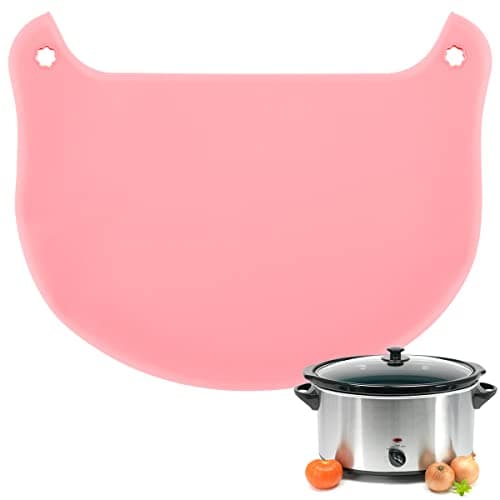
1. Foldable Silicone Slow Cooker Liner, 6–8 Qt, $8.49 (Best Value)
Price: $8.49 | Fits: 6–8 quart round or oval slow cookers | Material: Food-grade silicone
At $8.49, this is the most accessible entry point on this list. It's a foldable silicone liner that fits 6–8 quart slow cookers in both round and oval configurations, the two most common shapes for 6-quart Crock-Pot and Hamilton Beach models. Foldable means it collapses flat for drawer storage instead of taking up vertical space in a cabinet. Food-grade silicone; PFAS-free by material. This is the right pick if you want to test whether silicone liners work for your household before committing to a larger set.
Foldable Silicone Slow Cooker Liner 6–8 Qt on Amazon →
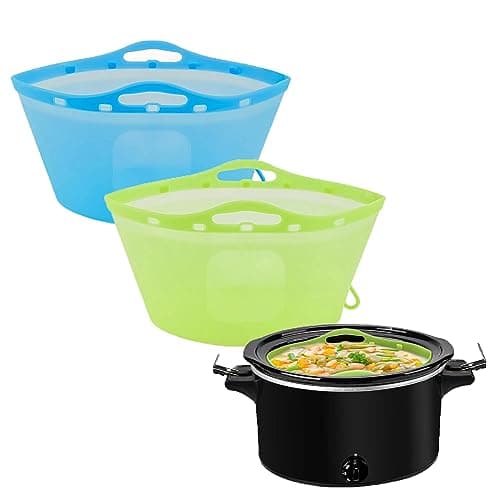
2. 2-Pack Foldable Silicone Liners with Hooks, 6–7–8 Qt, $15.99
Price: $15.99 for 2-pack | Fits: 6–8 quart round or oval | Material: Food-grade silicone | Feature: Built-in buttons and hooks
This 2-pack comes in at $15.99 (about $8 per liner) and adds a practical feature the single-liner picks don't have: buttons and hooks along the rim. These hooks grip the edge of your slow cooker insert to hold the silicone liner in place while you fill and stir. That prevents the liner from floating up or collapsing in when you add liquids, which is the main frustration users report with flat silicone liners in liquid-heavy recipes like soups and braises. Two colors (green and blue) so you can tell them apart. Fits 6-, 7-, and 8-quart oval or round pots.
2-Pack Silicone Slow Cooker Liners with Hooks 6–8 Qt on Amazon →
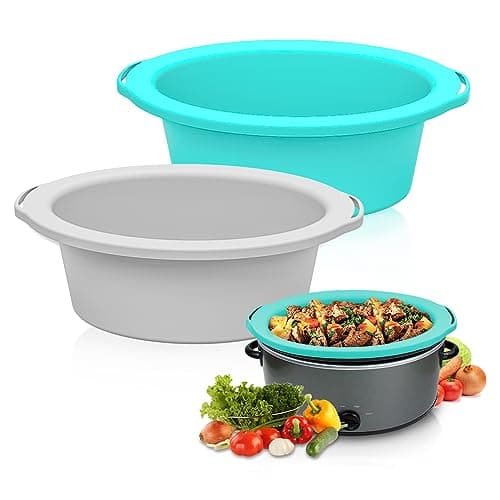
3. SOPHICO Silicone Crock Pot Liner, 6–8 Qt, $18.95
Price: $18.95 | Fits: 6–8 quart oval or round | Material: Food-grade silicone
The SOPHICO liner is a single liner at $18.95, more than the 2-pack above, but with a higher-end look and feel in a grey-mint colorway. It's designed for 6–8 quart oval and round slow cookers. SOPHICO's liner is food-grade silicone; PFAS-free by material. It's dishwasher-safe and folds flat for storage. The main reason to choose this one over the cheaper options: build quality. The silicone feels more substantial than budget liners, which can feel thin and prone to tipping when you're filling a heavy stew. If you're buying one liner you expect to use daily for years, this is a reasonable investment over the $8 entry-level pick.
SOPHICO Silicone Crock Pot Liner for 6–8 Qt on Amazon →
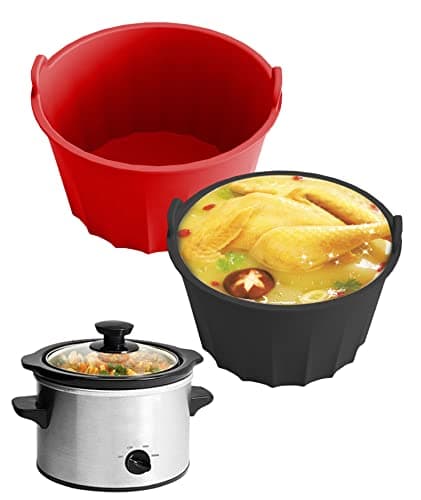
4. 2-Pack Food-Grade Silicone Liner, 5–6 Qt, $36.54
Price: $36.54 for 2-pack | Fits: 5–6 quart round or oval | Material: Food-grade silicone | Note: Fits smaller slow cookers
This 2-pack is specifically sized for 5–6 quart slow cookers rather than the 6–8 quart range of the other picks, if your slow cooker is in that range (many popular Crock-Pot 6-quart models are borderline between these size categories, so check your insert diameter), this set gives you two liners at once for $36.54. The per-liner price ($18.27) is comparable to the SOPHICO at $18.95, but you get two. Black and red colorway. Dishwasher-safe, food-grade silicone, leakproof design. The 5–6 quart sizing is the key differentiator: if the larger liners are too loose in your specific pot, this tighter sizing is worth the extra cost.
2-Pack Silicone Slow Cooker Liner 5–6 Qt on Amazon →
How to Make the Switch
Silicone liners work differently than Reynolds bags. Here's what to expect and how to get the best results:
- Sizing matters most. Silicone liners need to fit your specific insert diameter. Most 6-quart oval Crock-Pot and Hamilton Beach inserts fit the 6–8 quart liners. Measure your insert's interior diameter if you're unsure: a liner that's too small won't cover the sides and a liner that's too large will bunch and trap food in the folds.
- Use the hook feature if your recipe has a lot of liquid. Soup, broth, and braising liquid can push a flat silicone liner up and over. The hooks-and-buttons 2-pack above is the right pick for liquid-heavy recipes like pulled pork, soup, and oatmeal.
- Expect slightly more cleanup than a Reynolds bag. Reynolds bags are disposable: total cleanup in 10 seconds. Silicone liners need a rinse or dishwasher cycle, which takes longer. That's a real trade-off. For most families, once-weekly deep cleaning in the dishwasher is enough; rinse and reuse for daily or twice-daily use in between.
- For the cleanest transition: run the silicone liner through a full dishwasher cycle before first use to remove any manufacturing residue.
- What you're replacing: a typical household buying Reynolds slow cooker liners spends $15–20 per year on the bags. A silicone liner costs $9–37 upfront and lasts several years. The math favors silicone after the first year of use.
Frequently Asked Questions
Are Reynolds slow cooker liners safe?
EWG's PFAS research tested Reynolds slow cooker liners and found them PFAS-positive. PFAS (per- and polyfluoroalkyl substances) are synthetic chemicals EWG documents as persistent environmental contaminants that accumulate over time. EWG's PFAS Central research project is the source for this finding. NonToxicFinder is reporting EWG's published research; we are not affiliated with EWG and are not making independent safety determinations. Check ewg.org/pfascentral for EWG's current research on PFAS in consumer products.
Are silicone slow cooker liners PFAS-free?
Food-grade silicone slow cooker liners are PFAS-free by material. Silicone does not require fluoropolymer coatings to be nonstick or heat-resistant: that's an inherent property of the silicone polymer. The liners in this article are not EWG VERIFIED® and are not rated in EWG's Guide to Healthy Cleaning: EWG does not have a formal product rating for silicone slow cooker liners. The PFAS-free claim is based on the material composition of silicone, backed by EWG's PFAS research on the problem with conventional plastic liners.
What is EWG PFAS Central?
EWG PFAS Central is EWG's research hub documenting per- and polyfluoroalkyl substances in consumer products, water supplies, and the environment. EWG researchers use total organic fluorine (TOF) testing to identify the presence of fluorinated compounds in consumer products, then publish their findings on ewg.org/pfascentral. The Reynolds slow cooker liner finding is one of many product-category tests published through this research project. EWG advocates for regulation of PFAS in food-contact materials based on this research.
Do silicone slow cooker liners work as well as Reynolds bags?
For most recipes, yes, but with a different workflow. Silicone liners prevent food from sticking to your insert just as effectively as Reynolds bags. The difference is cleanup and liquid management: Reynolds bags are disposable (zero cleanup), while silicone liners need rinsing or a dishwasher cycle. For liquid-heavy recipes like soup and pulled pork, choose a silicone liner with hooks or buttons along the rim to hold it in place. For dry or low-liquid recipes (casseroles, pot roasts, overnight oatmeal), any of the four picks above work well.
What other PFAS-free cookware swaps should I know about?
EWG's PFAS research covers nonstick cookware (particularly PTFE-coated pans), food packaging, and food-contact materials broadly. If you're working through the PFAS-containing items in your kitchen, our PFAS-free cookware guide covers nonstick pans, bakeware, and kitchen tools backed by EWG's PFAS research and recommendations.