Affiliate Disclosure: This article contains affiliate links. NonToxicFinder (Solved Labs LLC) may earn commissions on qualifying purchases at no extra cost to you. We are not affiliated with, endorsed by, or partnered with the Environmental Working Group or MADE SAFE®.
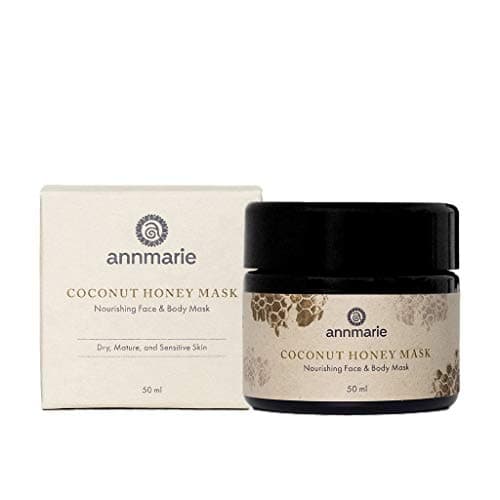
If you want a face mask whose formula has been screened by an outside certifier, and short enough to read in one breath, buy the Annmarie Coconut Honey Mask. It has four ingredients: honey, coconut oil, beeswax and vanilla extract. MADE SAFE’s own directory lists it as MADE SAFE® certified in every size it is sold in. Annmarie makes it for dry, mature and sensitive skin. It is not vegan, and if your skin is oily, the same brand’s clay-based Charcoal Cacao Mask, also MADE SAFE® listed, is the better match.
See the Annmarie Coconut Honey Mask (50 ml) on Amazon →
What Is in the Coconut Honey Mask
The whole formula fits on one line. Annmarie’s product page gives the full ingredient list as:
- Mel (raw clover honey), the base of the mask
- Cocos nucifera (extra virgin coconut) oil
- Cera alba (beeswax), which thickens the oil into a balm
- Vanilla planifolia (vanilla) extract, the only scent ingredient
Annmarie marks all four as “organically grown or wildcrafted.” Its product description calls the honey Colorado mountain wildflower honey, while the ingredient list says raw clover honey; either way, it is honey. There is no water, no clay, no added fragrance blend and no essential oil in the list. That makes it a balm-like mask that melts onto the skin, not one that dries down and tightens the way clay does.
What the MADE SAFE® Listing Covers
The MADE SAFE® directory entry names the brand (listed as Annmarie Skincare) and the Coconut Honey Mask, files it under the type Masks, and says: “MADE SAFE® Certified in all currently available sizes / packaging options.” So the 50 ml jar sold on Amazon is covered.
MADE SAFE® describes its screen on its certification standards page: products are “screened to validate that over 15,000 Banned / Restricted List substances have been avoided or constrained,” and companies must disclose all known added substances in a formula. It is a review of what goes into the jar, not a test of how the mask performs on skin. Our explainer on what MADE SAFE certified means covers how the program works and how it differs from EWG VERIFIED®.
How to Use It and How Often
Annmarie’s directions are simple: apply the mask generously to clean skin, leave it on for 15 minutes or longer, remove it with a wet towel and pat dry. The company suggests opening your pores first with a bath, a shower or a warm towel, and using the mask once or twice a week.
- Removal: this is an oil and wax mask, so plain splashing leaves a film. A warm, wet washcloth works better. Annmarie’s own summary of its reviews notes that a few owners find it slightly sticky or hard to wash off.
- Before it: Annmarie pairs the mask with its Aloe Herb Cleanser, which is one of the picks in our MADE SAFE certified face wash guide.
- How long a jar lasts: Annmarie says a 50 ml jar holds approximately 30 applications. At once or twice a week, that is roughly 15 to 30 weeks of masks.
- Storage: with no water and no added preservative in the formula, keep the lid on and your fingers dry. If you buy more than one jar, Annmarie suggests keeping the extras in the fridge.
Honey Mask vs. Clay Mask vs. Sheet Mask
Most people weighing this mask are choosing between three formats. The clay option below is Annmarie’s Charcoal Cacao Mask, because it shares the same MADE SAFE® basis and lets you compare format, not brand.
| Coconut Honey Mask | Charcoal Cacao Mask (clay) | Typical sheet mask | |
|---|---|---|---|
| Base | Honey, coconut oil, beeswax | Aloe juice, kaolin and bentonite clay, charcoal, cacao | A fabric or gel sheet soaked in a water-based serum |
| Feel on the skin | Rich and balm-like | Spreads wet, dries as clay does | Cool and wet; nothing to rinse |
| Maker says it suits | Dry, mature and sensitive skin | All skin types | Varies by product |
| Animal-derived ingredients | Honey, beeswax | None; in Annmarie’s vegan collection | Varies by product |
| Scent ingredients | Vanilla extract | Lavender, lemon tea tree and turmeric oils | Varies by product |
| Directions | 15 minutes or longer, once or twice a week | 15 minutes, once or twice a week; charcoal may stain towels | One sheet, one use |
| Uses per pack | About 30 per 50 ml jar | 50 ml jar; no count given | One per sheet |
| MADE SAFE® listing | Yes, all sizes | Yes, all sizes | No sheet masks among the directory’s Masks listings |
Pick the honey mask if your skin runs dry or tight and you want something that feels like a treat rather than a deep clean. Pick a clay mask if you want one that dries down and lifts off. Annmarie’s Charcoal Cacao Mask has a longer ingredient list, including essential oils, which matters if scent bothers you. A sheet mask is the most convenient of the three, but none of the masks in MADE SAFE’s directory is a sheet mask. The nearest thing it lists is a set of under-eye patches, covered in our True Botanicals Chebula eye patches spotlight. For a full-face mask with an outside ingredient screen, a jar is where you will find one.
Who Should Skip It
- Vegans: honey and beeswax are two of its four ingredients, and Annmarie does not include it in its vegan collection. The Charcoal Cacao Mask is the vegan option from the same brand.
- Anyone allergic to honey, beeswax or other bee products: both are in the formula, so this is not the mask for you. The FDA’s page on allergens in cosmetics says the best way to prevent a reaction is to know what you are sensitive to and avoid it by reading the ingredient panel.
- Very oily skin: Annmarie lists it for dry, mature and sensitive skin, and leaves it out of its oily-skin collection. An oil and wax mask is the opposite of what most oily-skin shoppers are looking for. Choose a clay mask instead.
- Anyone who reacts to vanilla: the FDA allergens page includes vanillin, the compound that gives vanilla its scent, among the fragrance allergens the EU added to its list in 2023.
If any new mask gives you a rash, itching or swelling, the FDA advises talking to your healthcare provider, and you can report the reaction to the FDA.
Is a 50 ml Jar Worth It?
For dry, mature or sensitive skin, yes. Annmarie says a 50 ml jar holds about 30 masks, so one jar lasts four to seven months at its once-or-twice-a-week schedule and stands in for about 30 single-use sheet masks. What you are paying for is a four-ingredient formula with a certifier listing you can open yourself, and only a handful of brands have face masks in MADE SAFE’s directory.
How to Choose a Face Mask With a Real Ingredient Screen
- Look for a listing you can open. “Natural” and “organic” on a cosmetic label are not screens. The FDA notes that it has no definition of “organic” for cosmetics and that “an ingredient’s source does not determine its safety.” A certifier’s directory entry for the exact product, like this mask’s MADE SAFE® listing, is something you can check.
- Do not lean on “hypoallergenic” or “for sensitive skin.” The FDA says there is no federal standard for “hypoallergenic” and that “the term means whatever a particular company wants it to mean.” The ingredient list tells you more.
- Match the base to your skin. Oil, butter and wax masks feel rich and are sold for dry skin. Clay masks, made with clays such as kaolin and bentonite, dry down and are the usual pick for oily skin.
- Scan for animal-derived and scent ingredients. Honey, beeswax, lanolin and pearl powder rule a mask out for vegans. Essential oils and the word “fragrance” are the things to look for if scent irritates you.
If a facial oil is your next step, our Annmarie Herbal Facial Oil for oily skin spotlight covers one from the same brand, and our comparison of True Botanicals MADE SAFE certified skincare covers a cream, a serum and a cleansing balm.
Frequently Asked Questions
Can I leave it on overnight?
Annmarie’s directions say 15 minutes or longer and set no upper limit, and some owners on its page say they sleep in it. Expect some of it to end up on your pillowcase.
Does the MADE SAFE® certification cover the size sold on Amazon?
Yes. The directory entry says it covers “all currently available sizes / packaging options,” which includes the 50 ml jar.
Should I patch test it first?
Yes, especially if you have reacted to honey, beeswax or vanilla before. The FDA notes that some cosmetics makers tell users to try a small amount first to check for a sensitivity, and that is a sensible habit with any new mask: try a little on a small area before covering your whole face.
Is MADE SAFE® the same as EWG VERIFIED®?
No. They are separate programs run by separate organizations. This mask’s certification basis is MADE SAFE®.
Affiliate Disclosure: This article contains affiliate links. NonToxicFinder (Solved Labs LLC) may earn commissions on qualifying purchases at no extra cost to you. We are not affiliated with, endorsed by, or partnered with the Environmental Working Group or MADE SAFE®.