Affiliate Disclosure: This article contains affiliate links. NonToxicFinder (Solved Labs LLC) may earn commissions on qualifying purchases at no extra cost to you. We are not affiliated with, endorsed by, or partnered with the Environmental Working Group or the USDA.
Carrageenan is a thickener and gelling agent extracted from red seaweed. It keeps cocoa suspended in chocolate milk, gives creamers and flavored yogurts a smooth body and sets the gel in canned pet food. Is it bad for you? The U.S. FDA permits it in food, and WHO’s expert committee (JECFA) gives it an acceptable daily intake of “not specified,” meaning it set no numeric limit.[1, 2] Europe’s food safety agency, EFSA, is more cautious: in 2018 it called its own intake limit temporary, found that some people may eat up to about ten times that limit, and could not rule out a higher sensitivity in infants.[3] The cancer finding often quoted online belongs to degraded carrageenan (poligeenan), which is not a food additive.[3, 4] If you want to skip it, plain milk and plain half-and-half contain no thickener at all.
What carrageenan is
Carrageenan is a family of sulfated sugar chains (polysaccharides) taken from red seaweed. The three main types behave differently: EFSA describes kappa as forming strong, rigid gels, iota as forming elastic gels, and lambda as non-gelling, so it only thickens.[3] The FDA regulation, 21 CFR 172.620, defines the additive as “the refined hydrocolloid prepared by aqueous extraction” from named red seaweeds, including Chondrus crispus (Irish moss) and Eucheuma species, and allows it “in the amount necessary for an emulsifier, stabilizer, or thickener in foods.” The same rule requires the label to name it as carrageenan.[1]
In Europe refined carrageenan is E 407, and a less purified form made from whole Eucheuma seaweed is E 407a, “processed Eucheuma seaweed” (also called semi-refined carrageenan).[3] Irish moss itself is the seaweed, not the additive. When a smoothie or supplement lists “Irish moss” or “sea moss,” it is listing the whole seaweed that carrageenan is extracted from.
Is carrageenan bad for you? What the authorities say
| Authority | What it concluded |
|---|---|
| U.S. FDA (21 CFR 172.620) | Permitted food additive that “may be safely used in food” as an emulsifier, stabilizer or thickener, at the amount necessary. No numeric limit.[1] |
| WHO and FAO, JECFA | Acceptable daily intake (ADI) “not specified,” so no numeric limit. Its 2014 review found use in infant formula at up to 1,000 mg per liter “is not of concern.”[2] |
| EFSA (2018 re-evaluation) | No concern for cancer or genetic damage, and carrageenan is not absorbed intact. But the 75 mg/kg/day group ADI “should be considered temporary” because of gaps in the data, and exposure in a brand-loyal scenario exceeded it by up to about tenfold. EFSA said exposure “may be overestimated” but the size of the gap “may be a safety concern.”[3] |
| IARC (WHO cancer agency) | Native carrageenan: Group 3, the data “do not provide evidence” that it causes cancer in animals, and there were no human data. Degraded carrageenan: Group 2B, with “sufficient evidence” of cancer in rats.[4] |
Why degraded carrageenan (poligeenan) causes the confusion
Most alarming headlines trace back to animal studies of degraded carrageenan. EFSA describes poligeenan as a much smaller polymer (10 to 20 kDa, against 200 to 800 kDa for food-grade carrageenan) made by holding carrageenan in strong acid at high temperature for hours. In rats it caused colitis and, over time, colon tumors. EFSA states that poligeenan “has not been authorised as a food additive and is not used in any food applications,” and that it is “not the same as the authorised food additive carrageenan (E 407).”[3] The live debate is narrower: whether a small low-weight fraction in food-grade carrageenan matters. EFSA asked the European Commission to tighten the molecular-weight specification for that reason.[3]
What studies in people show
Concern about gut inflammation comes mainly from cell and mouse studies, which EFSA reviewed and found hard to apply to food use because the carrageenan tested was often poorly characterized.[3] The one clinical trial is small. In a 2017 randomized, double-blind trial in Nutrition and Healthy Aging, people with ulcerative colitis in remission followed a no-carrageenan diet and took either placebo or carrageenan capsules. Of the 12 who completed it, three in the carrageenan group relapsed and none in the placebo group did.[5] A 2019 Cochrane review of diets for inflammatory bowel disease rated the carrageenan-free diet evidence “very low certainty” and drew no firm conclusions.[6] For most people the human evidence is simply not there either way; people with inflammatory bowel disease are the group researchers have studied.
Infants
Under EU law, carrageenan is not authorised in infant formula or processed cereal foods for infants. EFSA said the data “were not sufficient to rule out a possible increased sensitivity of infants to colitis induction by carrageenan.”[3] JECFA moved the other way: in 2007 it called use in infant formula “inadvisable,” and in 2014 it found use up to 1,000 mg per liter “not of concern,” noting that infants on special medical formulas with higher levels are normally under medical supervision.[2] The FDA regulation does not carve out infant formula, so in the U.S. the formula’s ingredient list is where to look.
Why organic food still contains carrageenan
Products labeled “organic” may contain up to 5 percent nonorganic ingredients from the USDA National List, and carrageenan is on that list as an allowed nonsynthetic.[10] Every listed substance comes up for review every five years. At its November 2016 meeting, the National Organic Standards Board voted to remove carrageenan, finding that alternatives “such as gellan gum, guar gum, or xanthan gum” exist and that, for some members, it did not meet organic consumers’ expectations.[7]
The board only advises. In April 2018 USDA’s Agricultural Marketing Service renewed carrageenan anyway, saying public comments showed it “continues to be necessary” because “potential substitutes do not adequately replicate the functions of carrageenan across the broad scope of use.”[8] In 2023 it renewed the listing again, until May 29, 2028.[9] Our guide to what the USDA Organic seal rules out explains the 5 percent allowance in more detail.
Carrageenan in pet food
In canned pet food, carrageenan does the same job it does in a dessert gel: it sets the jelly or gravy around the chunks. The FDA’s Center for Veterinary Medicine says pet food ingredients must be safe and have an appropriate function, and requires every ingredient to be listed on the label in order of weight.[11] Title 21 has no carrageenan-specific rule for animal food, so the most detailed safety review is European.
- Refined carrageenan (2022). EFSA’s feed panel said it could not conclude on safety for pets “owing the lack of information,” and found it works as a gelling agent and thickener that “contributes to stabilise canned pet feed.”[12]
- Semi-refined carrageenan (2023). Based on a 28-day study in beagles, the panel found it safe for dogs at 6,000 mg per kg of wet food. With no cat study, it set the maximum it considered safe for cats at 750 mg per kg of wet food, one eighth of the dog figure.[13]
So the authority that has looked hardest at pet food found no problem for dogs at normal levels and stayed cautious for cats only because cat data were missing. A cat owner who wants to avoid it has a clear tool: the ingredient panel. Propylene glycol is another additive treated differently for cats; see why propylene glycol is banned in cat food.
Where carrageenan hides
EFSA found the foods that contribute most carrageenan are flavored fermented milk products (flavored yogurts and yogurt drinks) for infants and children, plus fine bakery wares and flavored drinks for adults. It is also authorised in creams and in heat-treated meat products.[3] On U.S. shelves, the places to check are:
- Chocolate and other flavored milks, eggnog and milkshakes
- Liquid coffee creamers, whipping cream and some half-and-half
- Almond, soy, coconut and other plant milks
- Flavored yogurt, yogurt drinks, ice cream and puddings
- Deli meats, sliced turkey and other processed meats
- Canned and pouched wet pet food, especially “in gravy” or “in jelly” styles
How carrageenan compares with the thickeners that replace it
When a maker drops carrageenan it usually switches to one of these. All of them are allowed in organic food under the National List.[10]
| Thickener | Made from | Where you will see it |
|---|---|---|
| Carrageenan (E 407) | Red seaweed | Chocolate milk, creamers, plant milks, deli meat, canned pet food |
| Gellan gum | Bacterial fermentation | Chocolate milk boxes from Horizon and Organic Valley, Stonyfield kids’ yogurt tubes[15, 17] |
| Guar gum and locust bean gum | Guar and carob seeds | Ice cream, creamers, cream cheese |
| Xanthan gum | Bacterial fermentation | Dressings, sauces, gluten-free baking |
| Pectin and agar | Fruit; red seaweed | Yogurt, jams, gels |
How to find carrageenan-free milk, creamer and pet food
- Read the ingredient list, not the front of the pack. U.S. rules require carrageenan to be named. In imported foods, look for E 407 or E 407a.[1, 3]
- Choose plain over flavored. Plain milk and plain half-and-half need no thickener. Organic Valley Half & Half, for example, lists only “Organic Grade A Milk, Organic Grade A Cream.”[16]
- For flavored drinks, look for a substitute gum. Horizon’s and Organic Valley’s chocolate milk boxes both use gellan gum instead.[15, 17] Stonyfield’s kids’ yogurt tubes use pectin and gellan gum, as our Stonyfield yogurt tube review shows.
- For plant milks and creamers, expect a thickener of some kind; check which one before you buy and again when a carton’s design changes, since that is often when a formula changes.
- For pet food, check the ingredient panel FDA requires; carrageenan is used mainly in canned and pouched foods with gravy or jelly, and a wet food set with another gum such as guar does without it. Pet foods are outside our catalog, so we name no pick.
Our pick for a carrageenan-free milk box
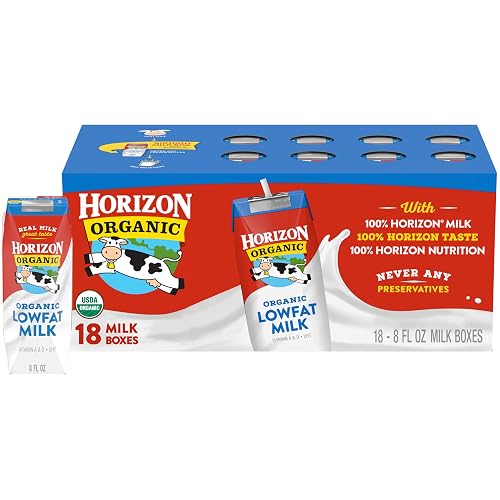
For lunchboxes and the pantry, Horizon Organic Shelf Stable 1% Lowfat Milk Boxes (pack of 18) are the simplest choice. Horizon lists the ingredients as “Grade A Lowfat Organic Milk, Vitamin A Palmitate, Vitamin D3” and labels the boxes Certified USDA Organic; there is no thickener of any kind.[14] If your child wants chocolate, Horizon’s chocolate box uses gellan gum rather than carrageenan. Storage, pack sizes and the Organic Valley comparison are in our Horizon shelf stable milk review.
Frequently asked questions
What is carrageenan made from?
Red seaweeds such as Irish moss (Chondrus crispus) and Eucheuma. The FDA defines it as a refined extract made with water from those seaweeds.
Is carrageenan bad for you?
FDA and WHO’s JECFA permit it without a numeric intake limit. EFSA calls its limit temporary, says some people may eat up to ten times it, and could not rule out greater sensitivity in infants. Human evidence is limited to one small trial in people with ulcerative colitis.
Does carrageenan cause cancer?
IARC found no evidence that food-grade carrageenan causes cancer in animals (Group 3). Degraded carrageenan, or poligeenan, is Group 2B based on rat studies, and EFSA says it is not used in food.
Why is carrageenan allowed in organic food?
It is on the USDA National List. The organic advisory board voted to remove it in 2016, but USDA renewed it in 2018 and again in 2023, saying substitutes do not replace it across all uses.
Is carrageenan bad for cats and dogs?
EFSA’s feed panel found semi-refined carrageenan safe for dogs at up to 6,000 mg per kg of wet food and set a lower limit of 750 mg per kg for cats because no cat study existed. It could not conclude on refined carrageenan for pets for lack of data.
What thickeners replace carrageenan?
Gellan gum, guar gum, locust bean gum, xanthan gum, pectin and agar. USDA’s organic board named gellan, guar and xanthan as alternatives.
References
- 21 CFR 172.620, Carrageenan. Electronic Code of Federal Regulations. Read November 8, 2026. Source
- WHO/FAO Joint Expert Committee on Food Additives (JECFA). Carrageenan (INS 407), evaluations of 2007 and 2014. Read November 8, 2026. Source
- EFSA ANS Panel. “Re-evaluation of carrageenan (E 407) and processed Eucheuma seaweed (E 407a) as food additives.” EFSA Journal, 2018;16(4):5238. Read November 8, 2026. Source
- International Agency for Research on Cancer. Carrageenan, IARC Monographs Vol. 31 (1983) summary and evaluation, with the Supplement 7 (1987) groupings. Read November 8, 2026. Source
- Bhattacharyya S, et al. “A randomized trial of the effects of the no-carrageenan diet on ulcerative colitis disease activity.” Nutrition and Healthy Aging, 2017;4(2):181-192. Read November 8, 2026. Source
- Limketkai BN, et al. “Dietary interventions for induction and maintenance of remission in inflammatory bowel disease.” Cochrane Database of Systematic Reviews, 2019;2:CD012839. Read November 8, 2026. Source
- USDA Agricultural Marketing Service, National Organic Program. “Response to National Organic Standards Board Recommendations (November 2016 Meeting),” May 1, 2017. Read November 8, 2026. Source
- USDA AMS. “National Organic Program: USDA Organic Regulations” (2018 sunset renewals). Federal Register, Vol. 83, No. 65, April 4, 2018, document 2018-06867. Read November 8, 2026. Source
- USDA AMS. “National Organic Program: 2023 and 2024 Sunset Review and Substance Renewals.” Federal Register, April 14, 2023, document 2023-07886. Read November 8, 2026. Source
- 7 CFR 205.605 and 205.606, National List of substances allowed in products labeled organic. Electronic Code of Federal Regulations. Read November 8, 2026. Source
- U.S. Food and Drug Administration, Center for Veterinary Medicine. “Pet Food.” Content current as of February 15, 2024. Read November 8, 2026. Source
- EFSA FEEDAP Panel. “Safety and efficacy of a feed additive consisting of carrageenan for pets and other non-food-producing animals (Marinalg International).” EFSA Journal, 2022;20(4):e07285. Read November 8, 2026. Source
- EFSA FEEDAP Panel. “Safety and efficacy of a feed additive consisting of semi-refined carrageenan for cats and dogs (Gel Systems Ltd.).” EFSA Journal, 2023;21(3):e07860. Read November 8, 2026. Source
- Horizon Organic. Shelf Stable Organic Plain 1% Milk, product page. Read November 8, 2026. Source
- Horizon Organic. Shelf Stable Organic Chocolate 1% Milk, product page. Read November 8, 2026. Source
- Organic Valley. Half & Half, product page. Read November 8, 2026. Source
- Organic Valley. 1% Low Fat Chocolate Milk Single Serve, product page. Read November 8, 2026. Source
Affiliate Disclosure: This article contains affiliate links. NonToxicFinder (Solved Labs LLC) may earn commissions on qualifying purchases at no extra cost to you. We are not affiliated with, endorsed by, or partnered with the Environmental Working Group or the USDA.