Affiliate Disclosure: This article contains affiliate links. NonToxicFinder (Solved Labs LLC) may earn commissions on qualifying purchases at no extra cost to you. We are not affiliated with, endorsed by, or partnered with the Environmental Working Group, OEKO-TEX®, GOTS or UL Solutions.
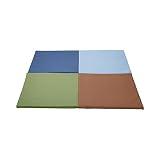
For a nursery room rug, buy The Citizenry's Ekani Handwoven Area Rug, a 100% wool flatweave with no separate backing, or its Ustav Hand-Knotted Area Rug if you want a thicker 3/4-inch pile for crawling. The Citizenry says "every rug is Oeko-Tex® certified."[13, 14] OEKO-TEX® STANDARD 100 is the label that matters most on a rug because it tests every part of the finished textile, backing included, and its strictest class is for babies and children up to 3.[1] If you would rather buy elsewhere, look for the same things: wool or cotton all the way through, an OEKO-TEX claim for the rug itself, and no "T" on the law label, which federal rules require on a rug treated with a flame retardant.[5] For tummy time on a wipeable surface, the ECR4Kids SoftZone Quad Fold-N-Go play mat is listed by ECR4Kids as UL GREENGUARD Gold certified.[10]
What to buy
Best room rug: The Citizenry Ekani Handwoven Area Rug
Basis: OEKO-TEX, as The Citizenry states it on the product page ("Every rug is Oeko-Tex® certified").[13] The Citizenry lists the Ekani as 100% New Zealand wool, handwoven as a flatweave in Panipat, India, 2/5 inch thick, in Grey and Ecru, in sizes from 6 x 9 to 10 x 14 feet. A flatweave is the same wool front to back, so there is no glued or latex backing to ask about. The maker's care directions are to vacuum lightly once a week on low suction with no beater brush, and it notes that shedding is normal in the first six months; it recommends a rug pad to stop wrinkles and slipping. Choose it if you want a flat, low rug that a crib, glider and dresser can sit on. Skip it if you need a rug you can machine wash, or one smaller than 6 x 9. Ekani Handwoven Area Rug at The Citizenry →
More cushion: The Citizenry Ustav Hand-Knotted Area Rug
Basis: OEKO-TEX, as The Citizenry states it on the product page, with the same "every rug is Oeko-Tex® certified" wording.[14] The Ustav is 100% New Zealand wool, hand-knotted, with what The Citizenry calls "undyed wool" blended with marled ecru, a 3/4-inch pile on a 1/8-inch flatweave base, in sizes from 5 x 8 to 10 x 14 feet. Choose it for a softer surface where a baby will crawl and sit. Skip it if the nursery door has little clearance (the maker says to measure for it) or if you want a rug that is easy to roll up and wash. Ustav Hand-Knotted Area Rug at The Citizenry →
The Citizenry publishes no certificate number or product class for these rugs, and OEKO-TEX's Label Check looks certificates up only by number, so we could not read the certificate itself or confirm that it is class I.
For a washable cotton rug, or any other brand: buy to this spec
The best-known washable nursery rugs are cotton, and their makers are clear about fiber but name no product certificate. Lorena Canals, which says its founder created the first washable rug, lists ISO 9001, ISO 14001 and ISO 18001 on its rug pages; those are factory management standards, not tests of the rug.[11] Nestig says its washable rugs use "non-toxic dyes on super soft, super durable organic cotton."[12] Whichever brand you like, buy a rug that meets all of these:
- Fiber stated in full: "100% wool" or "100% cotton," for pile and base. Lorena Canals, for example, lists its Nomad Kerman rug as "Pile: 97% cotton 3% other fibers; Base: recycled cotton."[11] A listing that says only "natural" or "eco" leaves you guessing.
- Backing you can name: woven cotton, wool, or none (a reversible flatweave). Ask before buying a tufted rug, because federal flammability rules treat latexes, foams and adhesives in carpet backings as part of what gets tested and labeled.[5]
- No "T" on the label and no stain-repellent or water-repellent finish.[5, 7]
- An OEKO-TEX STANDARD 100 claim for the rug itself, not only for the brand's cushions or bedding. If the label or page gives a number, Label Check will show whether it is valid. Class I is the baby class; class IV is home textiles such as curtains, so a class IV rug was tested to looser limits.[1]
- Care you can live with: a machine-washable cotton rug is the easiest in a spill zone. Lorena Canals' directions, for example, are a separate wash at 30°C maximum, no bleach or fabric softener, and a low tumble dry.[11]
For tummy time and crawling: a certified play mat
If what you need is a padded, wipeable surface for floor time, a play mat does that job better than a rug, and some carry a certificate. ECR4Kids lists its SoftZone Quad Fold-N-Go Activity Mat as "UL GREENGUARD Gold Certified for low VOCs." It is a dense foam core under a vegan leather cover, 48 inches square, with a non-slip base, sold in Assorted, Contemporary and Earthtone colorways.[10] GREENGUARD Gold is an emissions test: UL says certified products meet limits for more than 360 VOCs and total chemical emissions.[3] Choose it if you want something you can wipe clean and fold away. Skip it if you want natural fibers underfoot; it is foam under vegan leather, not cotton or wool. Our GREENGUARD Gold play mat comparison covers five other certified mats, including thicker and modular ones.
ECR4Kids SoftZone Quad Fold-N-Go Play Mat on Amazon →
Which material is best for a nursery
Cotton and wool are the two fibers that work as the surface a baby lies on. Cotton wins on washing; wool wins on cushion and size. Jute is best kept as a base layer, and synthetics are where stain-repellent treatments are most worth asking about.
| Material | Feel for crawling | Cleaning | Watch for | Best for |
|---|---|---|---|---|
| Cotton (flatweave or low pile) | Soft, thin; little cushion without a pad | Small sizes are often machine washable | Shedding when new: Lorena Canals says cotton rugs "may shed fibers when new or during use"[11] | A small rug you want to machine wash |
| Wool (tufted, knotted or flatweave) | Thick, springy pile | Usually vacuum and spot-clean; The Citizenry's care directions are light weekly vacuuming with no beater brush[13] | Tufted wool often has a glued backing; flatweave and hand-knotted rugs do not | A larger room rug, such as the Ekani or Ustav |
| Jute or sisal | Coarse and scratchy on bare skin | Spot-clean only; water can stain it | Rough for tummy time | A base layer under a softer rug or mat |
| Synthetic (polypropylene, polyester, nylon) | Varies; often plush and inexpensive | Many are washable or stain resistant | Stain- or water-repellent finishes; EPA lists them among household sources of PFAS[7] | A budget rug, if the listing rules out a repellent finish |
The PFAS point matters more in a nursery than elsewhere. EPA says young children "crawl on floors and put things in their mouths which leads to a higher risk of exposure to PFAS in carpets, household dust, toys, and cleaning products."[7] A rug sold as "stain resistant" or "water repellent" without saying how is the one to question. Our explainer on where PFAS hide at home covers the chemistry.
Which label matters most for a rug
OEKO-TEX STANDARD 100 is the one to look for first. It is the label you will actually find on rugs, it tests "every thread, button and accessory" of the certified article against a list of more than 1,000 substances, and it sets stricter limits the closer the contact with skin.[1] The others answer narrower questions.
| Label | What it tests | Covers the backing? | How to look it up |
|---|---|---|---|
| OEKO-TEX STANDARD 100 | Harmful substances in the finished textile, in four product classes; class I is for babies and children up to 3[1] | Yes, every component of the certified article | Enter the number in OEKO-TEX Label Check |
| GOTS | Organic fiber content (at least 95% for "organic," 70% for "made with organic materials") plus limits on processing chemicals[2] | Only if the backing is part of the certified product | Search the company in the GOTS certified suppliers database |
| UL GREENGUARD Gold | Chemical emissions (VOCs) from the finished product in a test chamber[3] | Yes, as tested | UL's product directory, by company or product |
| CRI Green Label Plus | VOC emissions from carpet, cushion and adhesive, tested by UL for the Carpet and Rug Institute[4] | Yes, as tested | CRI's certified carpets and certified cushions lists, by company |
| ISO 9001 / 14001 | A factory's quality or environmental management system | Not a product test | Not useful for this question |
CRI Green Label Plus is the carpet industry's own emissions label, and CRI says EPA's federal purchasing recommendations recognize it.[4] Its certified-carpet list is made up mostly of carpet manufacturers, so you will see it more on wall-to-wall carpet and rug pads than on nursery area rugs. GREENGUARD Gold is likewise rare on rugs and common on cribs, mattresses and play mats. For the detail behind each label, see our explainers on what OEKO-TEX STANDARD 100 means, what GOTS certification means and what GREENGUARD Gold covers.
The backing and the rug pad
The backing is often the part of a rug that is not wool or cotton. Flatweave and woven rugs (dhurries, kilims, most washable cotton rugs) are the same fiber all the way through. Tufted rugs are made by punching yarn through a backing cloth and locking it in place with a coating on the back. Federal flammability rules list "adhesives, foams, or latexes in carpet backings," and say that alumina trihydrate added to those backings counts as a fire-retardant treatment that triggers the "T" label.[5] If a tufted rug's listing does not name its backing, treat it as a coated backing and choose a flatweave instead.
A pad is a separate product with its own materials, and a rug's certificate does not cover it. The common types:
- Felt: cushion and floor protection, little grip. Good under a large rug that stays put on its own.
- Natural rubber: thin and grippy, for small rugs on hard floors. Natural rubber is latex; MedlinePlus says repeated exposure to a protein in natural latex can lead to a latex allergy, so skip it in a home where someone has one.[9]
- Felt bonded to natural rubber: cushion and grip together; the usual choice under a crawling-zone rug on wood or tile. The Citizenry sells one to go with its rugs, which it describes as felt with "a solid, natural rubber backing," needle-punched, made in the USA.[15] It names no certification for the pad.
- PVC or "vinyl" grip mesh: the cheapest grippers, and plastic rather than fiber. CPSC says phthalates are "most often, but not always, used to make plastics softer and/or more pliable," and it limits DEHP and several other phthalates in children's toys and child care articles; a rug pad is neither, so that limit does not apply to it.[16] Our phthalates explainer has the detail.
On carpet, a pad mainly stops the rug from creeping; on hard floors it stops slipping, which matters once a baby starts pulling up to stand. A rug pad listed on CRI's Green Label Plus certified-cushion list has had its emissions tested.[4]
Read the flammability label
Every rug sold in the U.S. falls under federal flammability standards. A rug with any side over 6 ft or an area over 24 sq ft must pass the federal test; small rugs (no side over 6 ft and no more than 24 sq ft) that fail may still be sold, but CPSC says the standards differ by size, and the rule requires a permanent label reading "FLAMMABLE (FAILS U.S. DEPARTMENT OF COMMERCE STANDARD FF 2-70): SHOULD NOT BE USED NEAR SOURCES OF IGNITION."[6, 5] A rug of any size that has had a fire-retardant treatment, or is made of treated fibers, must carry the letter "T" on its label.[5] For a nursery, that gives you two simple checks on the law label: no "FLAMMABLE" warning, and no "T."
How to air out a new rug
- Unpack it outside the nursery. Unroll it in a garage, porch or a room with the windows open. EPA's advice for products that give off VOCs is to "increase ventilation."[8]
- Leave it flat for 2 to 3 days. Lorena Canals gives that window for its cotton rugs, then says to brush or vacuum to restore the pile and lift loose fibers.[11]
- Wash it first if the label allows. A washable cotton rug can go through one cycle by the maker's directions before it goes down.
- Vacuum it again, then lay it with the windows open for the first day or two in the room.[8]
- Keep the law label and certificate number with your receipt. For stains later, our carpet and rug cleaner guide covers cleaners without heavy fragrance.
How to check a certificate number
- Find the number. An OEKO-TEX label has a number such as 24.HUS.86422 and the testing institute's name; it is often on the hang tag or law label rather than the product page. A GOTS label names the certification body and a license number.
- Use the certifier's own site. Type the OEKO-TEX number into Label Check at oeko-tex.com; it returns "The certificate is valid" or not, with the owner and scope. For GOTS, search the company in GOTS's certified suppliers database.[1, 2]
- Match the owner and scope to the rug. The owner should be the brand or its maker, and the scope should cover rugs or floor coverings, not only that brand's cushions or blankets.
- Check the class. Class I or II is closer to the baby standard than class IV.[1]
Building out the rest of the room? Our non-toxic baby registry guide covers the other nursery purchases in order of priority.
Frequently asked questions
Q: What is the best non-toxic rug for a nursery?
For a room rug, The Citizenry's Ekani Handwoven Area Rug (100% wool flatweave) or, for more cushion, its Ustav Hand-Knotted Area Rug; The Citizenry says every rug it sells is OEKO-TEX certified. From any other brand, look for wool or cotton all the way through, an OEKO-TEX claim for the rug itself and no "T" on the label. For a tummy-time surface, the ECR4Kids SoftZone Quad Fold-N-Go play mat is listed by its maker as UL GREENGUARD Gold certified.
Q: Is wool or cotton better for a nursery rug?
Cotton if you want to machine wash it, which suits a small rug in a spill zone. Wool if you want a thicker, cushioned rug for a larger area and are fine spot-cleaning it. Ask what the backing is on a tufted wool rug.
Q: Are jute rugs good for a nursery?
As a base layer, yes. Jute is coarse on bare skin and stains with water, so layer a cotton rug or play mat on top where the baby plays.
Q: Do I need a rug pad in a nursery?
On hard floors, yes: a felt-and-natural-rubber pad keeps the rug from sliding once a baby starts pulling up. Use plain felt instead if anyone in the home has a latex allergy.
Q: Does EWG rate rugs?
No. EWG's product ratings do not cover rugs or other home textiles, so look for OEKO-TEX, GOTS, GREENGUARD Gold or CRI Green Label Plus instead.
References
Each source was read on 2026-11-08.
- OEKO-TEX. "OEKO-TEX® STANDARD 100" (product classes, Label Check). Source, Label Check
- Global Standards gGmbH. "GOTS key features" and "Certified Suppliers Database." Source, Database
- UL Solutions. "UL GREENGUARD Certification." Source
- The Carpet and Rug Institute. "Green Label Plus" and "GLP Certified Carpets." Source, Certified carpets
- Electronic Code of Federal Regulations. 16 CFR Part 1630 (Surface Flammability of Carpets and Rugs), § 1630.5 and § 1630.32 (carpets and rugs with fire-retardant treatment), and 16 CFR Part 1631 (Small Carpets and Rugs), § 1631.5. Part 1630, Part 1631
- U.S. Consumer Product Safety Commission. "Flammable Fabrics Act (FFA)," Carpets and Rugs. Source
- U.S. Environmental Protection Agency. "Our Current Understanding of the Human Health and Environmental Risks of PFAS." Source
- U.S. Environmental Protection Agency. "Volatile Organic Compounds' Impact on Indoor Air Quality." Source
- MedlinePlus (National Library of Medicine). "Latex Allergy." Source
- ECR4Kids. "Quad Fold-N-Go Activity Mat, 48in Square" (ELR-13135). Source
- Lorena Canals. "Washable Rug Nomad Kerman" (composition, certificates, care, shedding note). Source, About
- Nestig. "Lattice Washable Rug." Source
- The Citizenry. "Ekani Handwoven Area Rug" (OEKO-TEX statement, materials, thickness, sizes, care). Source
- The Citizenry. "Ustav Hand-Knotted Area Rug" (OEKO-TEX statement, materials, pile height, sizes). Source
- The Citizenry. "Eco-Friendly Rug Pad." Source
- U.S. Consumer Product Safety Commission. "Phthalates Business Guidance & Small Entity Compliance Guide." Source
Affiliate Disclosure: This article contains affiliate links. NonToxicFinder (Solved Labs LLC) may earn commissions on qualifying purchases at no extra cost to you. We are not affiliated with, endorsed by, or partnered with the Environmental Working Group, OEKO-TEX®, GOTS or UL Solutions.