Disclosure: NonToxicFinder earns a commission on purchases made through affiliate links in this article, at no additional cost to you.
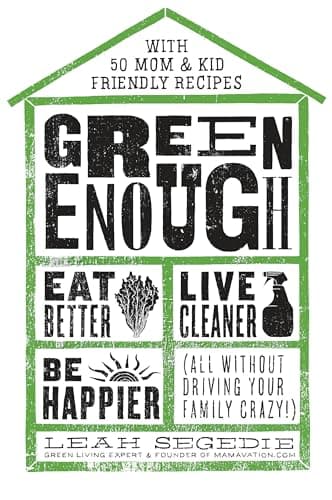
Fall is the season for rethinking the kitchen. New school-year routines settle in, holiday meal prep approaches, and the cleaning products and packaged foods accumulating in our cabinets quietly matter more than we usually stop to consider. Green Enough: Eat Better, Live Cleaner, Be Happier—All Without Driving Your Family Crazy! by Leah Segedie is a practical guide built for that exact moment: a room-by-room, category-by-category framework for reducing everyday chemical exposure without overhauling your family’s entire life at once. This is our full Green Enough review.
About the Author and Publisher
Leah Segedie is the founder of Mamavation, a consumer advocacy and product-testing platform known for independent PFAS and glyphosate testing that has been cited in mainstream journalism. She writes as an advocate and community organizer—not as a credentialed scientist or researcher. That distinction matters for how you read the book: it is organized around practical household decisions and consumer advocacy insights, not peer-reviewed studies.
The credibility anchors here are the publisher—Rodale Books, an imprint of Penguin Random House, with a long track record in health and wellness publishing—and the Mamavation community’s record of independent consumer product testing.
NonToxicFinder is not affiliated with, endorsed by, or partnered with EWG.
What Green Enough Covers
The book is organized around the rooms and product categories that contribute most to everyday household chemical exposure. Segedie works through:
- Kitchen and food storage: what’s in food-contact plastics, which containers to prioritize replacing, and how food packaging contributes to daily chemical load
- Produce and packaged food: guidance on organic prioritization, what labels like “all-natural” do and don’t mean, and how to read ingredient lists more critically
- Cleaning products: which ingredient types in conventional household cleaners have raised concerns, and how to evaluate alternatives
- Personal care products: a practical walkthrough of common ingredients and how to apply a “reduce the most concerning first” approach
Each chapter uses a Bad, Better, Best framework. Rather than requiring you to swap everything immediately, Segedie offers a tiered approach: the most concerning products first, workable middle options, and higher-quality alternatives for those ready to go further. This is the book’s most useful structural choice—it makes prioritization practical rather than overwhelming.
What We Found Most Actionable in the Green Enough Review
The kitchen cabinet detox section is the practical core of the book. Segedie walks through food storage containers (which plastic types raise more concerns, glass and stainless alternatives), cookware coatings, and the pantry staples most likely to carry higher chemical residue levels. For families who want to start somewhere concrete, that section is the most immediately usable part of the book.
The food chapter’s guidance on organic produce prioritization is similarly actionable. Rather than “buy everything organic,” Segedie builds a priority framework based on pesticide load by produce category—consistent with how consumer advocacy groups have approached this question for years.
The cleaning products chapter names specific ingredient types to look out for, which makes it easier to apply at the store rather than requiring you to memorize chemistry first. Whether you want to swap one product or a dozen, the tiered framework gives you a starting point.
Who This Book Is For
Green Enough is written for parents and home cooks who want to start reducing their household chemical exposure but don’t know where to begin—and don’t want to be lectured or overwhelmed while doing it. It is not an academic text. The writing is conversational, at times irreverent, and consistently practical.
If you’re looking for peer-reviewed citations and mechanism-of-action explanations, this is not that book—see our review of Non-Toxic by Dr. Aly Cohen and Frederick vom Saal, PhD for that. If you want a room-by-room action list you can actually follow without a science background, Green Enough delivers it.
The reading level is accessible to anyone. It’s a reasonable starting point for readers new to the topic, and a useful quick-reference for readers already familiar with the basics who want a structured household audit framework.
Our Take
Green Enough does what its subtitle promises. It gives you a practical entry point without making the problem feel unsolvable. The tone is notably less alarming than much of the consumer chemical safety genre—that’s a genuine virtue. The book positions itself accurately as a guide for making better choices in the real world, not a manual for achieving impossible perfection.
A few honest caveats. Segedie is an advocate and community organizer, not a scientist, and the book’s recommendations should be read in that context. Some framing shades toward alarm; the subtitle’s own positioning (“without driving your family crazy”) keeps the book anchored, but readers should treat specific product claims as advocacy starting points rather than settled science. The book was published in 2018, which means specific product examples and brand recommendations may be out of date; use the book for the framework and current resources for live product information.
For a reader who has been meaning to “clean up” the kitchen for years but hasn’t known where to start, Green Enough is a solid, approachable entry point.
Where to Get Green Enough
The print edition of Green Enough is available on Amazon, currently listed at $11.64 (list price $22.99—prices change frequently, so check Amazon for the current price). A Kindle edition is available at $5.99.
Get Green Enough (print edition) on Amazon →
Get the Kindle edition on Amazon →
Pair With Our Product Guides
The book identifies categories; our roundups give you current, specifically rated options:
- PFAS-Free Cookware, EWG-Rated
- Non-Toxic Dish Soap: Top-Rated Options
- Non-Toxic All-Purpose Cleaners, EWG-Rated
- Non-Toxic Kids’ Water Bottles and Lunch Gear
- Full Non-Toxic Living Reading List
Frequently Asked Questions
Is Green Enough by Leah Segedie scientifically peer-reviewed?
No. Segedie is the founder of Mamavation, a consumer advocacy platform, not a credentialed scientist or researcher. The book draws on publicly available information and Mamavation’s consumer advocacy work. It is published by Rodale Books (Penguin Random House) and is a practical household guide, not a scientific text.
Is Green Enough connected to EWG?
No. There is no EWG endorsement of this book or this author. NonToxicFinder is not affiliated with, endorsed by, or partnered with the Environmental Working Group. EWG’s independent databases (Skin Deep®, Guide to Healthy Cleaning) are tools any consumer can use alongside any book in this space.
What formats are available for Green Enough?
A print edition (ASIN 1623367603) and a Kindle edition (ASIN B075DZ2QFD) are available on Amazon. Check the Amazon listing for current prices and availability—prices change frequently.
Is the book still relevant in 2026?
The framework and general principles remain useful. Specific product examples from 2018 may be out of date or unavailable. Use the book’s Bad/Better/Best framework as a guide; verify current product information with up-to-date resources like EWG’s independent databases or our product roundups on NonToxicFinder.