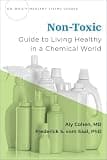
Every month, NonToxicFinder picks one book for health-conscious families who want to go deeper than a product swap list. August 2026 is our launch month, and our inaugural pick is the one that set the bar for everything that follows: Non-Toxic: Guide to Living Healthy in a Chemical World by Dr. Aly Cohen and Frederick vom Saal, PhD (Oxford University Press, 2020).
The Case for This One
Two things made this the obvious pick.
The credentials are genuine. Dr. Cohen is a board-certified rheumatologist with a clinical integrative medicine practice. Frederick vom Saal, PhD has spent more than 30 years studying the reproductive health effects of synthetic chemicals; his research on bisphenol A (BPA) was pivotal in getting that compound removed from mainstream consumer products. This is not a wellness influencer book. It’s written by people who spend their professional lives in the lab and the clinic.
The endorsement matters too. EWG President Ken Cook has spent decades in environmental health policy and very rarely endorses consumer books publicly. When he called this one “the blueprint for families,” it was worth paying attention. (One clarification: NonToxicFinder is not affiliated with, endorsed by, or partnered with the Environmental Working Group. Cook’s endorsement is of this specific book, not of our site.)
Who Gets the Most Out of It
Cohen and vom Saal wrote this for health-conscious adults who are not scientists: parents and caregivers, specifically, who want to reduce their family’s exposure to synthetic chemicals but feel overwhelmed by the conflicting information available. You don’t need a chemistry background to read it. You do need to want real explanations, not just lists of “good” and “bad” products.
If you’ve ever wanted someone credentialed to sit down and explain why phthalates are worth worrying about, what “endocrine disruption” actually means in practical terms, or how the U.S. regulatory system ends up approving chemicals that are later found to cause problems, this book answers those questions directly.
What’s Inside
The book is organized around the practical categories of daily life, not the chemistry. That’s a deliberate choice and it makes the book far more useful as a reference you’ll actually return to.
Room by Room, Category by Category
The opening section establishes the scientific case: the mechanism of endocrine disruption, how EDCs differ from conventional toxins, and why dose and timing of exposure matter more than most people realize. Then the book works through:
- Personal care products: what’s in your shampoo, lotion, deodorant, and cosmetics; which ingredients carry the most evidence of concern; how to read a label
- Household cleaning products: the chemicals in conventional cleaners that have raised concerns, and what to look for in alternatives
- Food and food storage: EDCs in food packaging (BPA, phthalates in plastics), pesticide residues, and practical guidance on reducing dietary exposure
- Indoor air quality: flame retardants in furniture and electronics, formaldehyde from flooring and cabinets, and ventilation strategies
- Pregnancy and early childhood: why the prenatal and early postnatal window is the period of highest vulnerability to EDC exposure, with specific guidance for expectant and new parents
The “Non-Toxic Five” Framework
One of the book’s most practically useful contributions is what Cohen calls the “Non-Toxic Five”: five chemical categories she argues deserve the most attention from families making everyday product choices. Without reproducing the full framework (read the book for the detail), the five center on endocrine-disrupting plasticizers (phthalates, bisphenols), synthetic fragrance, certain preservatives, heavy metals, and pesticide residues. The argument is that reducing exposure in these five categories will produce the largest reduction in overall chemical body burden for the least amount of effort and cost.
This prioritization is the book’s most practical gift. Non-toxic living guides can easily become paralyzing. Cohen and vom Saal explicitly reject the all-or-nothing framing and give you a hierarchy of where to start.
The Tone Gets It Right
The non-toxic living genre has a real alarmism problem. Many books in this space adopt an activist register that is emotionally compelling but scientifically imprecise, and the effect is to leave readers feeling the problem is unsolvable and nothing they do will matter.
Non-Toxic does the opposite. The scientific sections acknowledge that not all exposures are equal, that dose and timing matter, that the evidence for some chemicals is stronger than for others, and that practical reduction rather than impossible elimination is the realistic goal. The authorial voice is calm and specifically calibrated to keep you reading rather than shutting down.
A Few Notes from Our Reading
The book was published in 2020, which means some specific product recommendations and regulatory references are now five years old. In a space that moves quickly (new EWG data, regulatory updates, reformulations), the specific product examples are less valuable than the underlying framework. Use this book for the framework; use EWG Skin Deep® and our product roundups for current ratings.
The indoor air quality chapter is where actionability decreases the most. The interventions there (replacing furniture, renovating flooring) are more expensive and disruptive than the product swaps in other chapters. That’s not a flaw in the book; it’s a genuine constraint of the topic. Start with personal care, cleaning products, and food storage. The indoor air chapter is a longer-term project.
If I could put one book on the reading list for someone new to this topic, this would be it. The credential bar is the highest of any book in this genre accessible to a general audience. The framework is practical, the tone is measured, and the co-authorship matters: one author explains the clinical picture, the other explains the biochemistry. Together they produced a book that covers both what to do and why it matters in a way that neither could have managed alone.
For families with young children, pregnant parents, or anyone who has felt overwhelmed by the fragmented advice available online, this is where we’d point you first.
Pair With Our Product Guides
The book identifies categories; our roundups give you current, specific options:
- Best EWG VERIFIED® Sunscreens for Kids
- Non-Toxic Cleaning Products, EWG-Rated
- Top-Rated Non-Toxic Baby Shampoos
- Non-Toxic Deodorant: EWG’s Top-Rated Picks
- Full Non-Toxic Living Reading List
Frequently Asked Questions
Is this book endorsed by EWG?
EWG President Ken Cook publicly endorsed this specific book as “the blueprint for families.” That endorsement is of the book, written by the book’s authors. NonToxicFinder (Solved Labs LLC) is not affiliated with, endorsed by, or partnered with the Environmental Working Group. We reference Cook’s endorsement as a credibility signal for the book, not as an implication that EWG endorses our site.
Is the book available as an audiobook or Kindle edition?
Yes. Both Kindle and print editions are available on Amazon. An audiobook edition is also available. See the link above to check current availability and format options.
How does this compare to other non-toxic living books?
See our full reading list and comparison guide for how this book compares to other credentialed titles in the genre, including Count Down by Shanna Swan, Sicker, Fatter, Poorer by Dr. Leo Trasande, and others.