Affiliate Disclosure: This article contains affiliate links. NonToxicFinder (Solved Labs LLC) may earn commissions on qualifying purchases at no extra cost to you. We are not affiliated with, endorsed by, or partnered with the Environmental Working Group.
Choose a glass baby bottle whose maker names the glass and the nipple material on the product page. Two that do are the Lifefactory 4 oz and the BIBS glass bottle: both say borosilicate glass and a silicone nipple.
Soda-lime is the other glass in the story. Lifefactory says soda-lime bottles lack the freezer-to-boiling tolerance of its borosilicate baby bottle (see below). For a bottle you plan to boil, go by what that bottle’s maker says.
Borosilicate vs. Soda-Lime Glass: What the Makers Say
Two makers speak to the difference:
- Lifefactory says its glass hydration bottle cannot be used with boiling water “since it is made from soda lime glass,” and that soda lime glass “is not resistant to rapid temperature changes or impact.”
- Lifefactory FAQ, baby bottles: “Our baby bottles are made with high quality thermal shock-resistant borosilicate glass which allows safe transition from freezer to boiling water.” It adds: “Soda lime bottles do not have this quality.”
- Anchor Hocking says that for its bakeware, “tempered soda-lime-silicate bakeware is at least equal to or better than annealed borosilicate products in thermal shock resistance.” This is about its bakeware, not baby bottles.
Lifefactory ties its boiling and freezing instructions to the glass type, so our suggestion is to look for a product page that names the glass.
Glass vs. plastic. BIBS also makes bottles from polypropylene (PP). Its FAQ says “BPA-free PP is a lightweight plastic that can withstand most bumps associated with everyday use,” and that “PP is softer than glass or thicker materials, making it slightly more prone to minor scratches” from regular handling. Our Lifefactory spotlight compares glass with plastic, silicone and stainless steel in more detail.
What Each Bottle Is Made Of
| Lifefactory 4 oz | BIBS 4 oz and 8 oz glass bottle sets | |
|---|---|---|
| Glass, per the maker | Borosilicate glass | “lab-grade borosilicate glass” |
| Nipple, per the maker | Stage 1 silicone nipple | Medical-grade silicone nipple (silicone listings) |
| Other parts, per the maker | Silicone sleeve; polypropylene cap, ring and stopper | Polypropylene components, “such as caps, milk lock, and other accessories” |
The rest of this page uses BIBS as the worked example. The Lifefactory column comes from its product page and FAQ.
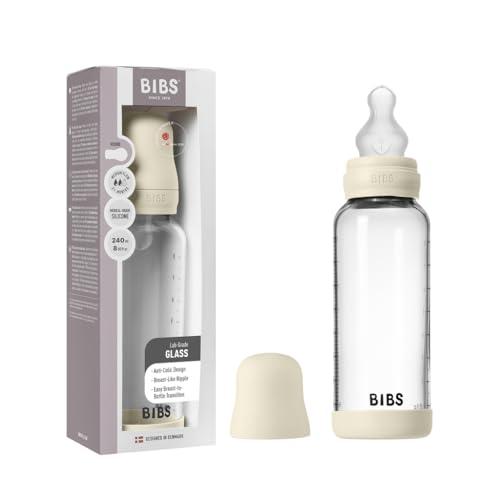
BIBS Glass Baby Bottle, 8 oz, Silicone Nipple
On its 8 oz product page, BIBS lists the set as one 8 oz glass bottle, a bottle cap, a screwcap, a nipple, a milk lock, a foldable funnel and a bumper. It calls the nipple “medical-grade silicone” and the glass “lab-grade borosilicate glass.” Its FAQ says the polypropylene components, “such as caps, milk lock, and other accessories,” are BPA-free. The product page does not name the material of the bumper.
Basis: materials basis, from BIBS’s own pages.
See the BIBS 8 oz Glass Baby Bottle with Silicone Nipple on Amazon →
Which Size and Nipple to Buy
- Lifefactory 4 oz: comes with a Stage 1 silicone nipple, labelled 0 to 3 months on the product page.
- BIBS 4 oz comes with a slow-flow nipple and the 8 oz with a medium-flow nipple. BIBS’s flow guide says “for newborn babies, a slow flow rate is recommended,” and adds “we have not age-specified our nipples and their flow rate.” Our suggestion: the linked 8 oz suits a baby who is ready for medium flow; for a newborn, choose the BIBS 4 oz with its slow-flow nipple, or the Lifefactory 4 oz.
- Silicone or latex: BIBS sells each bottle with either, and the Amazon title names the nipple, so check it before you buy. BIBS’s nipple pages describe the silicone one as “Medical-Grade Silicone” and the other as “natural rubber latex,” and its FAQ says latex is “particularly sensitive to sunlight, high temperatures, and moisture.”
- Latex allergy: MedlinePlus (National Library of Medicine) says “Repeated exposure to a protein in natural latex can make you more likely to develop a latex allergy” and that “it is best to try to avoid latex.” BIBS’s latex allergy guide says “If you have a latex allergy, you should completely avoid exposure to latex,” and that its relevant products state “Produced from Natural Rubber Latex.” Our suggestion: if latex is a concern in your household, buy the silicone listing.
- Replacing the nipple: BIBS’s pages give different intervals, from 4 weeks to 3 months. Its cleaning guide gives one rule for all of them: “always inspect the nipple before each use and replace the nipple at the first sign of damage or weakness.”
Cleaning, Boiling and Warming
- Cleaning: CDC says to “Clean baby bottles after every feeding” and that bottle parts include “the nipples, rings, and caps that go with them.”
- Boiling: Lifefactory says its glass baby bottle, caps and silicone parts can be boiled in water. BIBS says to “sterilize all bottle components in boiling water for 5 minutes” before first use and “Never exceed the bottle’s maximum heat resistance of 100°C.” CDC says to sanitize “daily if your baby is under 2 months old, was born premature, or has a weakened immune system.” Its boil method is 5 minutes in a pot of water, and it says to “Check with the item’s manufacturer about which method to use.”
- Warming: AAP’s HealthyChildren says “Never microwave formula. Microwaving can affect ingredients in formula and cause hot spots in the liquid that can burn your baby’s mouth.” BIBS’s cleaning guide says “Do not heat any plastic parts or the nipple in a microwave oven. The glass bottle can withstand microwave heating, but we recommend that you washed it in the above-mentioned ways to ensure it is absolutely clean.” Our suggestion: warm formula under warm running tap water or in a container of warm water, as AAP describes, and test a few drops on your wrist.
- Breakage: glass can break. Lifefactory says its bottles are “durable” but not unbreakable, and BIBS says “like all glass, it can still break if subjected to significant force.” Our suggestion: look the glass over for chips before each feed.
Who Should Skip Glass
Skip glass if you want a bottle that cannot break. Skip a latex-nipple listing if latex is a concern in your household.
Frequently Asked Questions
Is borosilicate better than soda-lime for a baby bottle?
Lifefactory says its borosilicate baby bottles allow “safe transition from freezer to boiling water” and that “Soda lime bottles do not have this quality.” Our suggestion: for a bottle you will boil or freeze, choose one whose maker says borosilicate and says it can be boiled.
Can I boil a glass baby bottle?
Yes, where the maker says so: BIBS says to “sterilize all bottle components in boiling water for 5 minutes” and “Never exceed the bottle’s maximum heat resistance of 100°C.”
Does a glass baby bottle contain BPA?
BIBS says its glass bottle “naturally does not contain BPA.” FDA says it amended its rules so that BPA-based polycarbonate resins are no longer provided for in baby bottles and sippy cups. Our BPA guide covers where it still turns up.
This article contains affiliate links. NonToxicFinder (Solved Labs LLC) may earn commissions on qualifying purchases at no extra cost to you. We are not affiliated with, endorsed by, or partnered with the Environmental Working Group.