Affiliate Disclosure: This article contains affiliate links. NonToxicFinder (Solved Labs LLC) may earn commissions on qualifying purchases at no extra cost to you. We are not affiliated with, endorsed by, or partnered with the Environmental Working Group.
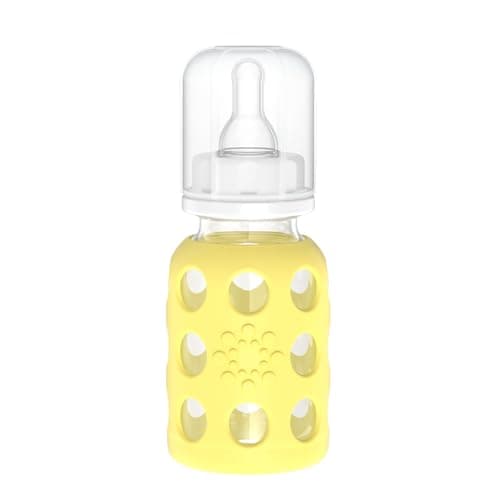
If you want a glass baby bottle, the Lifefactory 4 oz is a good one to start with. Lifefactory says the bottle is borosilicate glass, wrapped in a silicone sleeve, with a silicone Stage 1 nipple and a polypropylene cap, ring and stopper. During a feed, the milk touches only the glass and the silicone nipple. It suits parents who want glass for the newborn months and are fine with a bottle that weighs more than plastic and can still break. If your daycare does not take glass, or you want a lighter bottle for an older baby to hold, a stainless steel or silicone bottle fits better.
What the Lifefactory 4 oz Bottle Is Made Of
On its product page, Lifefactory names every part:
- Bottle: “high quality thermal shock-resistant borosilicate glass,” made in France. It holds 4 oz (120 ml).
- Nipple: a Stage 1 silicone nipple (0 to 3 months, the slowest flow), also made in France.
- Sleeve: a “protective silicone sleeve” that covers the outside of the glass and gives you a better grip. Made in the U.S.
- Cap, ring and stopper: polypropylene, made in the U.S. The ring holds the nipple on; the stopper is a flat disc that swaps in for the nipple when you store milk; the cap snaps over the top.
That means the milk path is short. During a feed, milk touches the glass and the silicone nipple. The polypropylene stopper touches milk only when you seal a bottle for the fridge or freezer, and the ring and cap sit outside the milk. Lifefactory describes the bottle and its plastics as “BPA-free and phthalate-free. Tested to meet FDA standards.” Its FAQ says its products are tested by independent laboratories, but Lifefactory does not publish the reports or name the lab.
Lifefactory is a Thermos brand. The bottle is assembled in the U.S. and carries a one-year Thermos warranty against defects, which you claim through Thermos directly rather than the store.
What “BPA-Free” and “Phthalate-Free” Mean on a Baby Bottle
Both labels describe what U.S. rules already expect of every baby bottle, so they do not set one bottle apart from another.
- BPA. BPA was used to make polycarbonate, the hard clear plastic of older baby bottles. In 2012, FDA amended its rules to no longer allow polycarbonate in baby bottles and sippy cups, because manufacturers had already stopped using it. FDA says that change “is not based on safety,” and its current view is that “BPA is safe at the current levels occurring in foods.” Either way, a new bottle sold in the U.S. should not be polycarbonate. Our guide to where BPA still turns up covers older bottles and other sources.
- Phthalates. These are softeners for plastics, mostly vinyl. Under federal law, CPSC counts “infant and toddler bottles” as child care articles, and bans eight named phthalates above 0.1% in any part a child can reach. Glass, silicone and polypropylene are not vinyl. Our phthalates explainer has the full list and the research.
What actually tells you more is the material list: a bottle that names every part, as Lifefactory does, lets you see what the milk touches.
Glass vs. Plastic, Silicone and Stainless Steel
None of the agencies above rank one bottle material over another. The real differences are weight, breakage, heat and how long the parts last.
| Lifefactory 4 oz glass | Lifefactory 8 oz stainless | Comotomo silicone | Typical polypropylene bottle | |
|---|---|---|---|---|
| What touches milk | Borosilicate glass, silicone nipple | Stainless steel, silicone nipple | Silicone body, silicone nipple | Polypropylene, silicone nipple |
| Weight | 0.4 lb for 4 oz; 0.6 lb for the 9 oz | 0.4 lb for 8 oz | Light | Light |
| Can it break? | Yes; the sleeve helps but does not prevent it | Will not shatter | Will not shatter | Will not shatter |
| Heat and cold | Freezer to boiling water, per Lifefactory | “Not for hot liquids,” per Lifefactory | Microwave and steam sterilizers, per Comotomo | Heat and sterilizing raise microplastic release in a lab study |
| When to replace | The glass when chipped or cracked; Lifefactory offers replacement glass | Not stated by Lifefactory | All parts every 6 months, per Comotomo | Varies by brand |
Plastic and microplastics. A 2020 lab study in Nature Food (Li and colleagues) found that polypropylene feeding bottles released microplastics into formula, “as high as 16,200,000 particles per litre,” and that sterilizing and hot water “significantly increase” the release. Keep it in proportion: FDA says “current scientific evidence does not demonstrate that levels of microplastics or nanoplastics detected in foods pose a risk to human health.” If you would rather not heat milk in plastic anyway, glass, stainless and silicone all avoid a plastic bottle body. Our microplastics guide covers the wider picture.
Which to pick:
- Glass if you want to see the milk, boil and freeze in the same bottle, and keep a bottle for years by replacing only the nipple.
- Stainless steel if you need a bottle that will not shatter when dropped. Lifefactory says not to store milk in its stainless bottle for more than an hour.
- Silicone if you want a soft, squeezable bottle that will not break, and you are fine replacing it about twice a year.
- Polypropylene if cost and weight matter most. If the Nature Food findings bother you, mix and warm milk in something else.
Will It Break, and How Heavy Is It?
It can break. Borosilicate glass handles sudden temperature changes better than ordinary glass, which is why Lifefactory says the bottle can go “from the freezer to boiling water pot.” The sleeve absorbs everyday bumps and makes the bottle easier to grip, but Lifefactory’s care and use guide is blunt: the sleeve “DOES NOT guarantee against breakage.” Its rules follow from that:
- Check the glass for cracks or chips before every use, and throw the bottle away if you find one.
- Do not scrub with abrasive cleaners or scouring pads, which can scratch or chip the glass.
- Do not use it on a stove or in any oven.
- Do not let a child walk or run with it, or chew on any part of it.
If the glass breaks, the sleeve and caps still work. Lifefactory offers plain replacement glass to U.S. addresses in the 48 contiguous states through its customer service team.
On weight, Lifefactory lists the 4 oz bottle at 0.4 lb, 6 inches tall and 2.5 inches wide. The 9 oz is 0.6 lb and 8.5 inches tall. For a newborn, you are holding the bottle, so the weight is yours to carry. It matters more later, when a baby starts holding the larger bottle alone.
Is 4 oz the Right Size, and When Do You Need 9 oz?
The 4 oz bottle is sized for the first weeks. The American Academy of Pediatrics says newborns take about 1 to 2 ounces per feed in the first week, building to 3 to 4 ounces per feed by the end of the first month, and 6 to 8 ounces at each feed by 6 months. AAP also notes that breastfed babies usually take smaller, more frequent feeds than formula-fed babies.
- 4 oz (120 ml): the bottle to buy for a newborn, and a good size for pumped milk because small portions waste less.
- 9 oz (265 ml): move up once your baby regularly finishes 4 oz and still seems hungry. AAP’s numbers put that near the end of the first month for many formula-fed babies; breastfed babies who take smaller feeds may stay with 4 oz longer. The 9 oz ships with a Stage 2 nipple.
The two sizes share the same nipples, so you do not have to replace 4 oz bottles to change flow. Lifefactory’s stages:
- Stage 1: 0 to 3 months, slowest flow (comes with the 4 oz).
- Stage 2: 3 to 6 months, medium flow (comes with the 9 oz).
- Stage 3: 6 months and up, fastest flow.
- Y-cut: 6 months and up, also fastest flow.
Lifefactory’s guide says the age ranges “might not be right for every baby,” so treat them as a starting point and follow your baby’s pace. Lifefactory also sells sippy caps that fit both sizes, so the bottles can carry on past the bottle stage.
How to Clean and Sterilize It
Lifefactory’s care guide and FAQ set the routine for this bottle, and CDC’s guidance on infant feeding items sets how often.
Before first use: boil the glass bottle and the nipple for 3 minutes, per Lifefactory.
After every feed:
- Take the bottle apart: nipple, ring, stopper and cap. CDC says to separate all parts.
- Wash every part in warm, soapy water as soon as you can and rinse well. CDC recommends a basin and bottle brush used only for feeding items, not the kitchen sink.
- Squeeze water through the nipple hole, and pull the nipple in every direction to check for tears. Lifefactory says to throw away a nipple at any sign of damage.
- Air dry on a clean towel or paper towel. CDC says not to rub or pat items dry with a dish towel.
Dishwasher: Lifefactory says the bottle can go in with the sleeve on, with the cap parts and nipple on the top rack. Its care guide still recommends hand washing, because milk can collect between the glass and the sleeve and dishwasher heat can dull the finish. Slide the sleeve off now and then with warm soapy water to clean underneath; the glass will be slippery, so handle it carefully.
Sanitizing: CDC says to sanitize feeding items at least daily if your baby is under 2 months old, was born premature, or has a weakened immune system; for older, healthy babies, daily sanitizing may not be needed if items are cleaned carefully after each use. Its boiling method is 5 minutes in a covered pot of water, removed with clean tongs. A dishwasher run with hot water and a heated drying or sanitize cycle also counts, per CDC. CDC lists bleach as a fallback, but Lifefactory says not to use bleach or chlorine cleaners on any part, so boil instead. Lifefactory names boiling for this bottle and does not mention steam sterilizers.
Warming and freezing: Lifefactory says the glass can go in the microwave but does not recommend it, and the nipple and caps must not. CDC goes further: never microwave a baby’s bottle, because it heats unevenly and can burn the mouth and throat. Warm the bottle under running warm water and test a few drops on your wrist. To freeze breast milk, stand the bottle upright and leave at least 2 oz of space at the top, per Lifefactory, which is more room than the one inch CDC suggests for any container, because frozen milk expands and can crack glass.
One assembly tip: do not over-tighten the ring. Lifefactory’s nipples vent through ridges on the flange, and a tight ring blocks the vent and makes the nipple collapse mid-feed.
Who Should Buy It, and Who Should Skip It
- Buy it if you want glass for a newborn, will boil or hand wash it, and like being able to freeze, thaw and feed from one bottle.
- Buy the 9 oz instead if your baby is already finishing 4 oz feeds and wants more.
- Skip it if your daycare does not accept glass or an older baby will be holding the bottle alone. A stainless or silicone bottle suits those needs better.
See the Lifefactory 4 oz Glass Baby Bottle with Stage 1 Nipple on Amazon →
Building out the rest of the nursery? Our baby registry checklist covers the other basics, and when your child moves on from bottles, our picks for kids’ water bottles and lunch gear pick up where this leaves off.
Frequently Asked Questions
Are glass baby bottles better than plastic?
Neither FDA nor CPSC ranks one material over the other, and every U.S. bottle must meet the same BPA and phthalate rules. Glass lets you see the milk, handles boiling and freezing, and keeps the bottle body out of plastic. A 2020 Nature Food study found polypropylene bottles shed microplastics, especially with heat. Plastic is lighter and will not shatter.
What is the Lifefactory glass bottle made of?
Borosilicate glass with a silicone sleeve, a silicone nipple and a polypropylene cap, ring and stopper, according to Lifefactory. The glass and nipple are made in France.
Can I boil a Lifefactory glass bottle?
Yes. Lifefactory says the glass bottle, caps and silicone parts can be boiled, and to boil the bottle and nipple for 3 minutes before first use. CDC’s method for sanitizing is 5 minutes at a boil. Do not use bleach on it.
Can it go in the freezer?
Yes. Freeze it upright and leave at least 2 oz of space at the top so the glass does not crack as the milk expands.
When should I switch from the 4 oz to the 9 oz bottle?
When your baby regularly finishes 4 oz and wants more. AAP says most babies reach 3 to 4 ounces per feed by the end of the first month and 6 to 8 ounces by 6 months.
Do the 4 oz and 9 oz bottles use the same nipples?
Yes. Lifefactory’s Stage 1, 2, 3 and Y-cut nipples and its sippy caps fit both sizes.
Does the silicone sleeve stop the bottle breaking?
It helps with bumps and grip, but Lifefactory says it does not guarantee against breakage. Check the glass before every use, and Lifefactory offers replacement glass if one breaks.
This article contains affiliate links. NonToxicFinder (Solved Labs LLC) may earn commissions on qualifying purchases at no extra cost to you. We are not affiliated with, endorsed by, or partnered with the Environmental Working Group.